
marvin martian
Diamond Member
- Thread starter
- #21
Follow along with the video below to see how to install our site as a web app on your home screen.
Note: This feature may not be available in some browsers.

The democracks are trying to make something that is a bad idea beginning to end, so, it doesnt work. What else is new? At least some people get RICH off the program. That and gathering votes from vegetables are the programs only goals, welcome to new liberalism AmericaWe're 3 years in, and they've produced 60 buses.
Simple math, which is far beyond you, indicates a serious problem.

 the Yellen plan for spending $78,000 billion on AGW.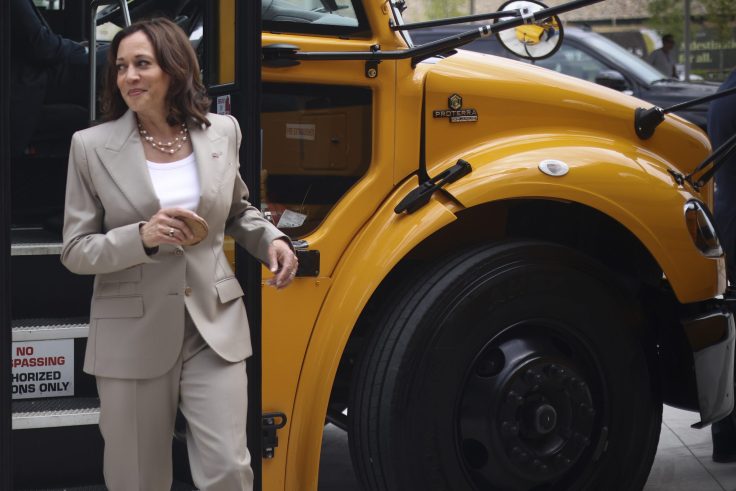
 freebeacon.com

And??, they allocate the money. They don't build the buses.Well, just following Obama's Solyndra et all BS. Plenty of money for kickbacks to Dem pols, though.
This woman is just plain awful. And I'm sure she just
One of Kamala Harris's highest profile responsibilities as vice president has been spearheading the federal government's billion-dollar efforts to deploy thousands of electric buses across hundreds of school districts nationwide. But years into the program, only a small fraction of those projects have been completed while dozens of school districts have withdrawn from the program altogether.As part of the first tranche of Clean School Bus program funding two years ago, Harris and EPA administrator Michael Regan unleashed nearly $1 billion in federal rebates for 389 school districts across all 50 states to help deliver a total 2,463 electric school buses. According to federal data reviewed by the Washington Free Beacon, just 27 of those districts have proven to the EPA that their buses were delivered and that their diesel-fueled buses being replaced have been discarded.Collectively, those districts have deployed a total of 60 battery-electric or low-emissions propane-fueled school buses. And 55 additional districts have pulled out of the program, according to other federal data shared with the Free Beacon, citing a variety of technological and infrastructure concerns. In other words: More school districts have withdrawn from the program than proven that they have completed it."EPA anticipates that transitioning to new technology school buses will take time, which is why the project period is two years with an option to extend where needed and justified," said EPA spokeswoman Shayla Powell.Powell didn't deny that 60 school buses have been deployed as part of the program, but she explained that districts still have three months until the EPA's deadline to either file close-out documentation showing they have obtained the buses and scrapped old buses, or file for an extension. The wide time frame is designed to give districts time to test the new buses out and integrate them into their fleet. Powell didn't say how many total buses may have been deployed in districts that have yet to file close-out materials.The slow progression of the Clean School Bus program is a blow to the Biden-Harris administration as it seeks to quickly get billions of dollars in green energy and climate funding—earmarked in President Joe Biden's signature 2021 Infrastructure Investment and Jobs Act and 2022 Inflation Reduction Act—out the door. It's also a black eye for Harris, who has, in many ways, taken credit for the program, which she characterized earlier this year as an "investment in our children, their health, and their education."The Clean School Bus program was created nearly three years ago as a provision of the 2021 infrastructure bill, which put aside $5 billion for the EPA to distribute in the form of rebates and grants over the course of five years. Since Harris's initial announcement, the agency has unveiled a $1 billion tranche of grants for 280 school districts and a second tranche of rebates, worth $900 million, for another 530 districts. None of those districts have deployed any buses under the program."This only makes economic sense if the bus is paid for with a grant like we received," Jeff Dicks, the superintendent of the Newell-Fonda and Albert City-Truesdale school systems in northern Iowa, told the Free Beacon. "The cost is so prohibitive that the cost savings are not worth it."...
Kamala Harris Touted a $5B Electric School Bus Program. Three Years Later, It's Produced Just 60 Buses.
One of Kamala Harris's highest profile responsibilities as vice president has been spearheading the federal government's billion-dollar efforts to deploy thousands of electric buses across hundreds of school districts nationwide. But years into the program, only a small fraction of those...

Can someone explain to me why just a few short months ago there was talk of removing Harris from the ticket because everyone saw she was a cackling airhead who could say nothing of substance - the passage of time is passing, the time to act is now and that time is now, Russia is a bigger country Ukraine, orc., etc., - to the heir apparent being made out to be a cross between Joan of Arc and Marilyn Vos Savant?


Kamala Harris Touted a $5B Electric School Bus Program. Three Years Later, It's Produced Just 60 Buses.


WOW. That's ONLY about $415 million per bus. Who does she know in that company?Well, just following Obama's Solyndra et all BS. Plenty of money for kickbacks to Dem pols, though.
This woman is just plain awful. And I'm sure she just
One of Kamala Harris's highest profile responsibilities as vice president has been spearheading the federal government's billion-dollar efforts to deploy thousands of electric buses across hundreds of school districts nationwide. But years into the program, only a small fraction of those projects have been completed while dozens of school districts have withdrawn from the program altogether.As part of the first tranche of Clean School Bus program funding two years ago, Harris and EPA administrator Michael Regan unleashed nearly $1 billion in federal rebates for 389 school districts across all 50 states to help deliver a total 2,463 electric school buses. According to federal data reviewed by the Washington Free Beacon, just 27 of those districts have proven to the EPA that their buses were delivered and that their diesel-fueled buses being replaced have been discarded.Collectively, those districts have deployed a total of 60 battery-electric or low-emissions propane-fueled school buses. And 55 additional districts have pulled out of the program, according to other federal data shared with the Free Beacon, citing a variety of technological and infrastructure concerns. In other words: More school districts have withdrawn from the program than proven that they have completed it."EPA anticipates that transitioning to new technology school buses will take time, which is why the project period is two years with an option to extend where needed and justified," said EPA spokeswoman Shayla Powell.Powell didn't deny that 60 school buses have been deployed as part of the program, but she explained that districts still have three months until the EPA's deadline to either file close-out documentation showing they have obtained the buses and scrapped old buses, or file for an extension. The wide time frame is designed to give districts time to test the new buses out and integrate them into their fleet. Powell didn't say how many total buses may have been deployed in districts that have yet to file close-out materials.The slow progression of the Clean School Bus program is a blow to the Biden-Harris administration as it seeks to quickly get billions of dollars in green energy and climate funding—earmarked in President Joe Biden's signature 2021 Infrastructure Investment and Jobs Act and 2022 Inflation Reduction Act—out the door. It's also a black eye for Harris, who has, in many ways, taken credit for the program, which she characterized earlier this year as an "investment in our children, their health, and their education."The Clean School Bus program was created nearly three years ago as a provision of the 2021 infrastructure bill, which put aside $5 billion for the EPA to distribute in the form of rebates and grants over the course of five years. Since Harris's initial announcement, the agency has unveiled a $1 billion tranche of grants for 280 school districts and a second tranche of rebates, worth $900 million, for another 530 districts. None of those districts have deployed any buses under the program."This only makes economic sense if the bus is paid for with a grant like we received," Jeff Dicks, the superintendent of the Newell-Fonda and Albert City-Truesdale school systems in northern Iowa, told the Free Beacon. "The cost is so prohibitive that the cost savings are not worth it."...
Kamala Harris Touted a $5B Electric School Bus Program. Three Years Later, It's Produced Just 60 Buses.
One of Kamala Harris's highest profile responsibilities as vice president has been spearheading the federal government's billion-dollar efforts to deploy thousands of electric buses across hundreds of school districts nationwide. But years into the program, only a small fraction of those...
By that reasoning, cave men should have built rockets to the moon with boulders because eventually, the technology would have evolved.As noted, it will take time for the technology to evolve. But it will happen.
In other words, we just need to keep spending enough even if we can't afford it no matter what the other consequences until it eventually becomes a bargain even if it runs into trillions and collapses human civilization?Eventually, the cost will be worth it.

That has got to be one of the absolute dumbest things I've ever seen you post.By that reasoning, cave men should have built rockets to the moon with boulders because eventually, the technology would have evolved.

The technology will evolve. Grow more cost effective. And eventually be adopted everywhere.In other words, we just need to keep spending enough even if we can't afford it no matter what the other consequences until it eventually becomes a bargain even if it runs into trillions and collapses human civilization?
Damn, Jack, you are somewhere between boring and incredible.
Like a new species of fungus.


What's your problem? 83 million bucks per bus just about keeps up with inflation these days.Well, just following Obama's Solyndra et all BS. Plenty of money for kickbacks to Dem pols, though.
This woman is just plain awful. And I'm sure she just
One of Kamala Harris's highest profile responsibilities as vice president has been spearheading the federal government's billion-dollar efforts to deploy thousands of electric buses across hundreds of school districts nationwide. But years into the program, only a small fraction of those projects have been completed while dozens of school districts have withdrawn from the program altogether.As part of the first tranche of Clean School Bus program funding two years ago, Harris and EPA administrator Michael Regan unleashed nearly $1 billion in federal rebates for 389 school districts across all 50 states to help deliver a total 2,463 electric school buses. According to federal data reviewed by the Washington Free Beacon, just 27 of those districts have proven to the EPA that their buses were delivered and that their diesel-fueled buses being replaced have been discarded.Collectively, those districts have deployed a total of 60 battery-electric or low-emissions propane-fueled school buses. And 55 additional districts have pulled out of the program, according to other federal data shared with the Free Beacon, citing a variety of technological and infrastructure concerns. In other words: More school districts have withdrawn from the program than proven that they have completed it."EPA anticipates that transitioning to new technology school buses will take time, which is why the project period is two years with an option to extend where needed and justified," said EPA spokeswoman Shayla Powell.Powell didn't deny that 60 school buses have been deployed as part of the program, but she explained that districts still have three months until the EPA's deadline to either file close-out documentation showing they have obtained the buses and scrapped old buses, or file for an extension. The wide time frame is designed to give districts time to test the new buses out and integrate them into their fleet. Powell didn't say how many total buses may have been deployed in districts that have yet to file close-out materials.The slow progression of the Clean School Bus program is a blow to the Biden-Harris administration as it seeks to quickly get billions of dollars in green energy and climate funding—earmarked in President Joe Biden's signature 2021 Infrastructure Investment and Jobs Act and 2022 Inflation Reduction Act—out the door. It's also a black eye for Harris, who has, in many ways, taken credit for the program, which she characterized earlier this year as an "investment in our children, their health, and their education."The Clean School Bus program was created nearly three years ago as a provision of the 2021 infrastructure bill, which put aside $5 billion for the EPA to distribute in the form of rebates and grants over the course of five years. Since Harris's initial announcement, the agency has unveiled a $1 billion tranche of grants for 280 school districts and a second tranche of rebates, worth $900 million, for another 530 districts. None of those districts have deployed any buses under the program."This only makes economic sense if the bus is paid for with a grant like we received," Jeff Dicks, the superintendent of the Newell-Fonda and Albert City-Truesdale school systems in northern Iowa, told the Free Beacon. "The cost is so prohibitive that the cost savings are not worth it."...
Kamala Harris Touted a $5B Electric School Bus Program. Three Years Later, It's Produced Just 60 Buses.
One of Kamala Harris's highest profile responsibilities as vice president has been spearheading the federal government's billion-dollar efforts to deploy thousands of electric buses across hundreds of school districts nationwide. But years into the program, only a small fraction of those...

And??, they allocate the money. They don't build the buses.
As noted, it will take time for the technology to evolve. But it will happen.
Eventually, the cost will be worth it.
I had to make it something I knew you'd understand.That has got to be one of the absolute dumbest things I've ever seen you post.
Well, Jack, I'm an EE who has worked in everything from global telecom to designing protection for transmitters to shield from direct lightning strikes, and let me 'splain something to you:The technology will evolve. Grow more cost effective. And eventually be adopted everywhere.
What you are or what you do for a living is irrelevant.I had to make it something I knew you'd understand.
Well, Jack, I'm an EE who has worked in everything from global telecom to designing protection for transmitters to shield from direct lightning strikes, and let me 'splain something to you:
- A given technology can only evolve so far before you hit a technological barrier. Have you noticed that computers have really slowed down getting faster and faster? That is because, you can only push electrons through a conductor so fast because of limits to conductor length, circuit reactance, and I2R losses.
- You still have to GENERATE the electricity (by whatever means) then step it up in voltage.
- Then you have to TRANSMIT that voltage across great distances.
- Then you have to step down the voltage (that is what killed Thomas Edison).
- Then you have to CONVERT the power to a DC current.
- No matter the technology, the tendency of a battery to SHORT OUT and EXPLODE is inversely proportional to the square of the energy density footprint, meaning that for each halving of unit size, you increase the difficulty of keeping the charges apart from cancelling each other out violently by FOUR TIMES.
- No matter how you cook it, you are still only STORING power made elsewhere rather than PRODUCING your own motive power wherever you go.
- We are already very close to the technological limits of what we can force a battery to store for a given size. Beyond that, the costs go up exponentially for diminishing returns in storage and output.
- That is the point to where WHOLE NEW APPROACHES are sought and old technology is abandoned.
- Long before we reach the point of making battery operated electric cars feasible as totally REPLACING internal combustion of petroleum distillates, we will have solved the complexities of hydrogen fuel cells and brought their cost within practicality, making everything spent on EV technology WASTED.
- This makes EV technology practical as a secondary source of alternate and hybrid transportation mainly for short local trips in moderate climates. But instead of just admitting thast, the Bidenistas got greedy and want EV technology to TOTALLY replace ICE NO MATTER WHAT THE COST thinking they can simply FORCE it on society and RAM IT THROUGH by simply spending enough money and enacting enough regulations.
Whoah.... Lol.....phew....a veritable guillotine of a post!I had to make it something I knew you'd understand.
Well, Jack, I'm an EE who has worked in everything from global telecom to designing protection for transmitters to shield from direct lightning strikes, and let me 'splain something to you:
- A given technology can only evolve so far before you hit a technological barrier. Have you noticed that computers have really slowed down getting faster and faster? That is because, you can only push electrons through a conductor so fast because of limits to conductor length, circuit reactance, and I2R losses.
- You still have to GENERATE the electricity (by whatever means) then step it up in voltage.
- Then you have to TRANSMIT that voltage across great distances.
- Then you have to step down the voltage (that is what killed Thomas Edison).
- Then you have to CONVERT the power to a DC current.
- No matter the technology, the tendency of a battery to SHORT OUT and EXPLODE is inversely proportional to the square of the energy density footprint, meaning that for each halving of unit size, you increase the difficulty of keeping the charges apart from cancelling each other out violently by FOUR TIMES.
- No matter how you cook it, you are still only STORING power made elsewhere rather than PRODUCING your own motive power wherever you go.
- We are already very close to the technological limits of what we can force a battery to store for a given size. Beyond that, the costs go up exponentially for diminishing returns in storage and output.
- That is the point to where WHOLE NEW APPROACHES are sought and old technology is abandoned.
- Long before we reach the point of making battery operated electric cars feasible as totally REPLACING internal combustion of petroleum distillates, we will have solved the complexities of hydrogen fuel cells and brought their cost within practicality, making everything spent on EV technology WASTED.
- This makes EV technology practical as a secondary source of alternate and hybrid transportation mainly for short local trips in moderate climates. But instead of just admitting that, the Climate Bidenistas got greedy and want EV technology to TOTALLY replace ICE NO MATTER WHAT THE COST thinking they can simply FORCE it on society and RAM IT THROUGH by simply spending enough money and enacting enough regulations.
Well, Jack, I'm an EE who has worked in everything from global telecom to designing protection for transmitters to shield from direct lightning strikes, and let me 'splain something to you:
- A given technology can only evolve so far before you hit a technological barrier. Have you noticed that computers have really slowed down getting faster and faster? That is because, you can only push electrons through a conductor so fast because of limits to conductor length, circuit reactance, and I2R losses.
- You still have to GENERATE the electricity (by whatever means) then step it up in voltage.
- Then you have to TRANSMIT that voltage across great distances.
- Then you have to step down the voltage (that is what killed Thomas Edison).
- Then you have to CONVERT the power to a DC current.
- No matter the technology, the tendency of a battery to SHORT OUT and EXPLODE is inversely proportional to the square of the energy density footprint, meaning that for each halving of unit size, you increase the difficulty of keeping the charges apart from cancelling each other out violently by FOUR TIMES.
- No matter how you cook it, you are still only STORING power made elsewhere rather than PRODUCING your own motive power wherever you go.
- We are already very close to the technological limits of what we can force a battery to store for a given size. Beyond that, the costs go up exponentially for diminishing returns in storage and output.
- That is the point to where WHOLE NEW APPROACHES are sought and old technology is abandoned.
- Long before we reach the point of making battery operated electric cars feasible as totally REPLACING internal combustion of petroleum distillates, we will have solved the complexities of hydrogen fuel cells and brought their cost within practicality, making everything spent on EV technology WASTED.
- This makes EV technology practical as a secondary source of alternate and hybrid transportation mainly for short local trips in moderate climates. But instead of just admitting that, the Climate Bidenistas got greedy and want EV technology to TOTALLY replace ICE NO MATTER WHAT THE COST thinking they can simply FORCE it on society and RAM IT THROUGH by simply spending enough money and enacting enough regulations.
 www.woodmac.com


