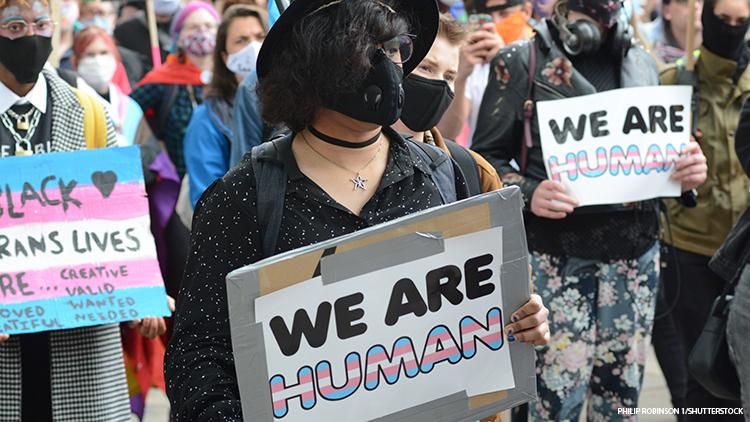
[ Republican Religious Extremists, always wanting to have their way, their beliefs.....By Force ]
hen it came down to it, Rick Colby called on his spirituality in deciding how to support his transgender child, Ashton.
It wasn’t a guarantee. Colby had dedicated his life to Republican politics, starting in 1984 on the field campaign to reelect Ronald Reagan. Reagan and the Republican Party with him and in the decades following would push anti-LGBTQ+ policies. But Colby’s Methodist church by comparison preached inclusivity and empathy, a message that conflicted with what he was hearing from Republicans.
Colby went with Ashton to his first endocrinologist appointment. He held Ashton’s hand the following year as Ashton awoke from gender-affirming top surgery.
WATCH: 2021 set a record for anti-transgender bills. Here’s how you can support the community
“You know, as a parent, you want to protect your child from the nastiness of the world,” Colby said. “I was so relieved as a parent that he was being accepted. And it was just wonderful.”
Survey after survey show that Americans support LGBTQ+ equality, and Republicans are no exception. Still, Republican-dominated states have seen a blitz of anti-LGBTQ+ legislation since 2020, particularly anti-transgender bills. That dissonance — between the reality of the electorate and the priorities of Republican lawmakers — may seem counterintuitive to many.
Randall Balmer, a Dartmouth professor who was raised evangelical, has spent much of his career researching those kinds of contradictions. His book, “Bad Faith: Race and the Rise of Religious Right” traces the rise of the evangelical voting bloc from nonexistent in the 1960s to the single most important interest group for any Republican candidate in the 1980s. In a conversation with The 19th, Balmer said that rise was driving Republican support for anti-trans legislation now.
“They have an interest in keeping the base riled up about one thing or another, and when one issue fades, as with same-sex relationships and same-sex marriage, they’ve got to find something else,” Balmer said. “It’s almost frantic.”
While many people believe that abortion was the issue that first galvanized evangelicals to the polls in the 1980s, Balmer points to a different issue. Paul Weyrich, an evangelical Christian who helped initially organize the “religious right,” had been testing out issues that would drive other evangelicals to the polls in the 1970s, Balmer says. Weyrich found it in Bob Jones University, a religious institution that was
facing the loss of its tax-exempt status for refusing to racially integrate.
Weyrich’s strategy worked. In 1980, evangelicals – a group of denominations separate from mainline churches like Colby’s – flocked to the polls to back what had been billed as the freedom of a religious school to operate without government interference. Reagan backed Bob Jones University, with
two-thirds of the evangelical vote, denied President Jimmy Carter, a Democrat and an evangelical himself, a second term. It cemented white evangelicals as the key ingredient to Republican wins.
Any Republican who wanted to cross the finish line would have to kneel at the feet of the evangelical base, Balmer says. Decades later, Donald Trump would initially campaign on welcoming LGBTQ+ people into his Republican platform, only to later adopt the ideology of the far-right evangelical base he needed to win.
While Trump appeared to start out a social moderate, far-right evangelical policies increasingly dominated his agenda. On the campaign trail, Trump briefly
vowed to be an ally to queer Americans. In office, his administration made so many policy moves against LGBTQ+ Americans that advocacy organizations branded his leadership “
The Discrimination Administration.”
The religious right’s fixation on “social issues” — abortion, religious-based education, LGBTQ+ rights — served two purposes. In addition to keeping evangelicals a cohesive voting unit, they also formed an ideological bedrock for the religious right. Before Weyrich died, he argued that conservatives should be fighting to return to family structures of the 1950s, a goal that has been picked up by leaders after him.
In his book “The Next Conservatism,” Weyrich wrote that the goal was to weed out “cultural Marxism,” and “restore a non-ideological American republic, which is what we had up until the wretched 1960s,” when women and Black and LGBTQ+ Americans pushed for and won greater rights.
After Reagan’s 1980 victory, Weyrich would continue to test issue after issue to keep evangelicals voting, including abortion. This idealized rewind to 1950s America would systematically challenge the basic rights gained by Black Americans, LGBTQ+ people and those with disabilities.
“As they were searching for different issues, I think they understood that any issue that had some sort of connection to sexuality or sexual behavior was going to work for them,” Balmer told The 19th.
The first issue was “sodomy laws,” which aimed to make gay sex illegal. The Supreme Court overruled the last of them in 2003 in Lawrence v. Texas. Next came marriage equality, which was granted nationwide by the Supreme Court’s Obergefell ruling in 2015. Still, according to the Public Religion Research Institute, evangelical Protestants were the only major religious group as of 2020 that opposed same-sex marriage:
just 34 percent of those surveyed support marriage equality.
The country, however, moved on.
“It’s staggering how quickly [marriage] disappeared as an issue,” Balmer said “And so, they almost frantically began looking for something else. And of course, the trans thing was the next thing on the horizon.”
(full article online)
The recent blitz of anti-trans bills may not align with what many Republicans believe, but party lawmakers pursue them on behalf of their most important interest group.

www.pbs.org


/cloudfront-us-east-2.images.arcpublishing.com/reuters/MV7SDXBIYJPELOI6EI76QAR7TQ.jpg)