There is a big difference between interest rates of 6%, 10%, or 20%, when one speaks of compound interest. The following are the sums that $1.00 will amount to in 100 years, loaned at the rates of interest mentioned and compounded annually:
at 1%............................$2.75
at 2%..........................$19.25
at 3%........................$340.00
at 10%..................$13,809.00
at 12%............ $1,174,406.00
at 18%............$15,145,207.00
at 24%..........$251,799,494.00
And at 50%, it would eat up the world! There is a formula to know approximately the amount of time it will take for an amount, at compound interest, to double; it is the “Rule of 72”: You divide 72 by the interest rate. It gives you the number of years it will take for the amount to double. Thus, an interest rate of 10% will cause a loan to double in 7.2 years (72 divided by 10).
Another example of compound interest: 1 cent borrowed at 1% compound interest at the birth of Christ would amount (in 1986) to a debt of $3,821,628.40 ($3.8 million). At 2%, it is not only twice this amount that would be owed, but 314 million times this amount: 1.2 followed by 15 zeros (one billion millions of dollars!)
All this is to show that any interest asked on money created out of nothing, even at a rate of 1%, is usury.
In his November 1993 report, Canada's Auditor General calculated that of the $423 billion in net debt accumulated from Confederation to 1992, only $37 billion went to make up the shortfall in program spending. The remaining $386 billion covered what it has cost to borrow that $37 billion. In other words, 91% of the debt consisted of interest charges, the Government having spent only $37 billion (8.75% of the debt) for actual goods and services.)
The public debt of the United States
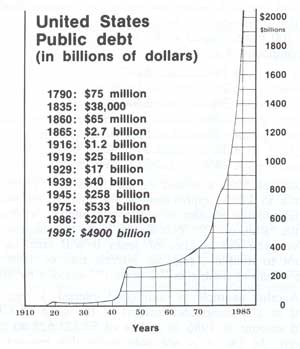 The public debt of the United States
 follows the same curve as Canada’s, but with figures ten times bigger
All the countries in the world are presently struggling with a debt problem. Third-World countries’ debt is over $1,300 billion (in 1986)

www.michaeljournal.org


