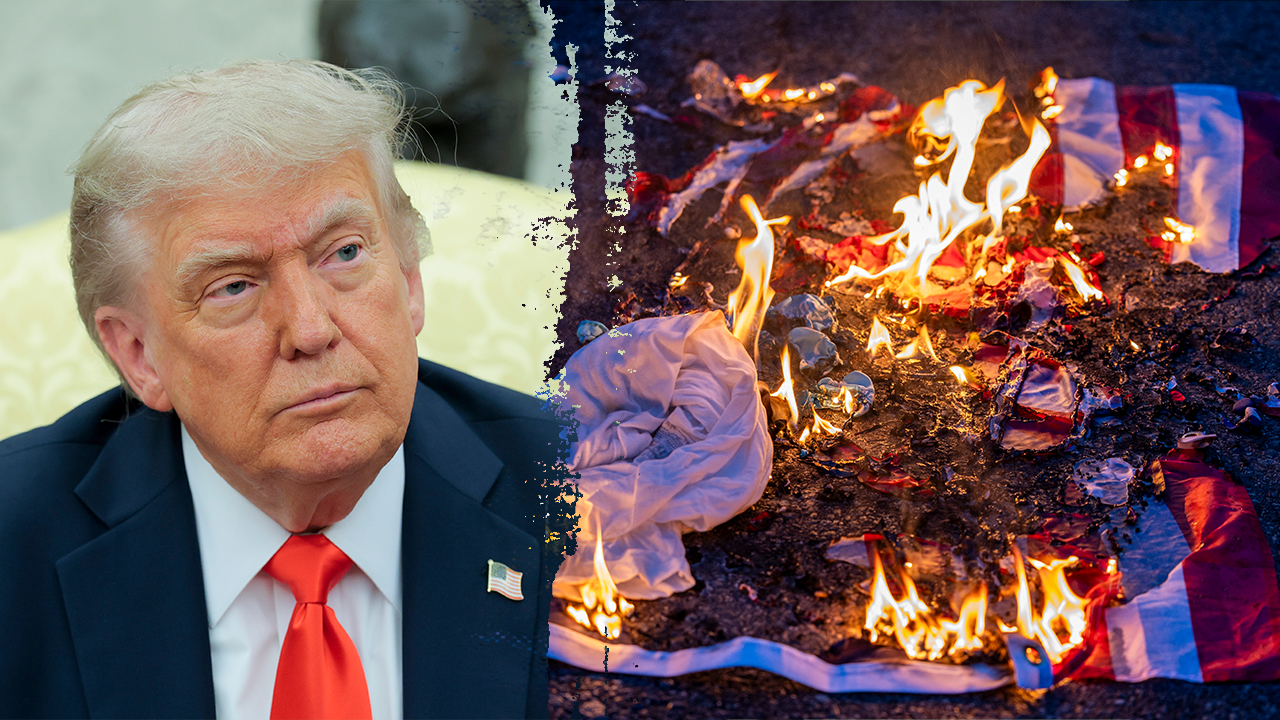
President Trump proposes one-year jail sentences for burning American flags and claims he's working with Congress on legislation, though flag burning remains constitutionally protected

www.foxnews.com
By
Ashley Oliver Fox
President
Donald Trump revived calls this week for people who burn American flags to go to jail after demonstrators in California were seen torching them and waving Mexican flags in protest of the administration carrying out immigration enforcement operations in the state.
"I happen to think if you burn an American flag, because they were burning a lot of flags in Los Angeles, I think you go to jail for one year, just automatic," Trump told the New York Post.
Flag burning in the United States is neither unlawful nor unconstitutional. Offenders can only be punished under the law for flag burning if they are committing another crime at the same time, such as violating fire safety laws or burning flags that they stole.
Learn how 18 USC 245 protects civil rights activities from interference, what penalties apply, and how federal hate crime prosecutions actually work.

legalclarity.org
Protected Classes
The law specifically protects individuals from violence or intimidation based on race, color, religion, or
national origin when such acts interfere with federally protected activities. These classifications reflect a longstanding commitment to combating discrimination in critical aspects of public life. Unlike some other federal hate crime statutes, this law does not cover bias-motivated crimes based on gender, sexual orientation, disability, or gender identity unless they intersect with other federal protections.
The inclusion of race and national origin builds upon prior civil rights legislation, such as the Civil Rights Act of 1964, which prohibited discrimination in public accommodations and employment. Courts have interpreted these provisions broadly, recognizing that racial animus often manifests in violent attempts to suppress participation in public life. For example, in United States v. Roof, federal prosecutors used hate crime laws to prosecute Dylann Roof for the racially motivated mass shooting at Mother Emanuel AME Church in Charleston.
Religious protections complement other federal statutes, such as the Church Arson Prevention Act, which criminalizes attacks on places of worship. Courts have upheld these protections, emphasizing that individuals must be free to practice their faith without fear of violence. Federal prosecutors have used this statute in cases involving attacks on synagogues, mosques, and churches, reinforcing the government’s role in addressing religiously motivated violence.
Comment:
Flag burning if protected under the 1st amendment.
However flag burning could be considered a hate crime against "national origin"
National origin is a protected class.