
Monk-Eye
Gold Member
- Feb 3, 2018
- 4,693
- 1,169
- 140
" Incidences Of Homogeneous Representation Shem Being Red "
* Due Point Historians Feigning To Integrate Religious Genealogy With Science "

 en.wikipedia.org
There are five basic types of melanin: eumelanin, pheomelanin, neuromelanin, allomelanin and pyomelanin.[2]
en.wikipedia.org
There are five basic types of melanin: eumelanin, pheomelanin, neuromelanin, allomelanin and pyomelanin.[2]
Eumelanin (lit. 'true melanin') has two forms linked to 5,6-dihydroxyindole (DHI) and 5,6-dihydroxyindole-2-carboxylic acid (DHICA). DHI-derived eumelanin is dark brown or black and insoluble, and DHICA -derived eumelanin which is lighter and soluble in alkali. Analysis of highly pigmented (Fitzpatrick type V and VI) skin finds that DHI-eumelanin comprises the largest portion, approximately 60–70%, followed by DHICA-eumelanin at 25–35%, and pheomelanin only 2–8%. Notably, while an enrichment of DHI-eumelanin occurs in during sun tanning, it is accompanied by a decrease in DHICA-eumelanin and pheomelanin.[11] A small amount of black eumelanin in the absence of other pigments causes grey hair. A small amount of eumelanin in the absence of other pigments causes blond hair.[12] Eumelanin is present in the skin and hair, etc.
Pheomelanins (or phaeomelanins, from Greek φαιός phaios, "grey") impart a range of yellowish to reddish colors.[13] Pheomelanins are particularly concentrated in the lips, nipples, glans of the penis, and vagina.[14] When a small amount of eumelanin in hair (which would otherwise cause blond hair) is mixed with pheomelanin, the result is orange hair, which is typically called "red" or "ginger" hair.
* Grey Matter Creatures *
Neuromelanin (NM) is an insoluble polymer pigment produced in specific populations of catecholaminergic neurons in the brain. Humans have the largest amount of NM, which is present in lesser amounts in other primates, and totally absent in many other species.[20]
Up until the 1960s, melanin was classified into eumelanin and pheomelanin. However, in 1955, a melanin associated with nerve cells was discovered, neuromelanin. In 1972 a water-soluble form, pyomelanin, was discovered. In 1976, allomelanin, the fifth form of the melanins, was found in nature.[2]
* Distributions Of Patriarchal Matriarchal Kindred Clad Codon Without AI For Physical Expression *
. Mitochondrial Eve - Wikipedia .
. Haplogroup X (mtDNA) - Wikipedia .
Haplogroup X diverged from haplogroup N roughly 30,000 years ago (just prior to or during the Last Glacial Maximum). It is in turn ancestral to subclades X2 and X1, which arose c.16-21 thousand and c.14-24 thousand years ago, respectively.[1]
. Human Y-chromosome DNA haplogroup - Wikipedia .
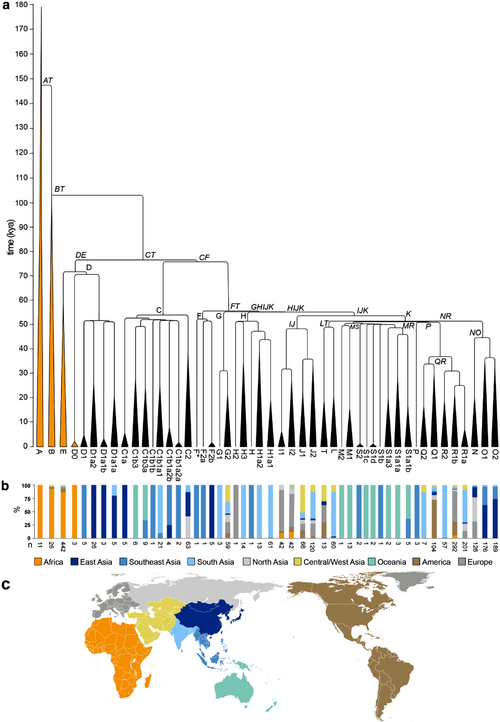

* Due Point Historians Feigning To Integrate Religious Genealogy With Science "
Are representations of y haploids from the eponymous patriarchs supposed to represent a fact for generalization about contemporary y haploids , or possibly to include x haploids as well , or about common clad of macrohaploidgroup ?Historians take the flood story seriously; thus Shem, Ham, and Japheth are still considered the forebearers of all ethnicities and are studied as such.
Melanin - Wikipedia
Eumelanin (lit. 'true melanin') has two forms linked to 5,6-dihydroxyindole (DHI) and 5,6-dihydroxyindole-2-carboxylic acid (DHICA). DHI-derived eumelanin is dark brown or black and insoluble, and DHICA -derived eumelanin which is lighter and soluble in alkali. Analysis of highly pigmented (Fitzpatrick type V and VI) skin finds that DHI-eumelanin comprises the largest portion, approximately 60–70%, followed by DHICA-eumelanin at 25–35%, and pheomelanin only 2–8%. Notably, while an enrichment of DHI-eumelanin occurs in during sun tanning, it is accompanied by a decrease in DHICA-eumelanin and pheomelanin.[11] A small amount of black eumelanin in the absence of other pigments causes grey hair. A small amount of eumelanin in the absence of other pigments causes blond hair.[12] Eumelanin is present in the skin and hair, etc.
Pheomelanins (or phaeomelanins, from Greek φαιός phaios, "grey") impart a range of yellowish to reddish colors.[13] Pheomelanins are particularly concentrated in the lips, nipples, glans of the penis, and vagina.[14] When a small amount of eumelanin in hair (which would otherwise cause blond hair) is mixed with pheomelanin, the result is orange hair, which is typically called "red" or "ginger" hair.
* Grey Matter Creatures *
Neuromelanin (NM) is an insoluble polymer pigment produced in specific populations of catecholaminergic neurons in the brain. Humans have the largest amount of NM, which is present in lesser amounts in other primates, and totally absent in many other species.[20]
Up until the 1960s, melanin was classified into eumelanin and pheomelanin. However, in 1955, a melanin associated with nerve cells was discovered, neuromelanin. In 1972 a water-soluble form, pyomelanin, was discovered. In 1976, allomelanin, the fifth form of the melanins, was found in nature.[2]
* Distributions Of Patriarchal Matriarchal Kindred Clad Codon Without AI For Physical Expression *
. Mitochondrial Eve - Wikipedia .
. Haplogroup X (mtDNA) - Wikipedia .
Haplogroup X diverged from haplogroup N roughly 30,000 years ago (just prior to or during the Last Glacial Maximum). It is in turn ancestral to subclades X2 and X1, which arose c.16-21 thousand and c.14-24 thousand years ago, respectively.[1]
. Human Y-chromosome DNA haplogroup - Wikipedia .


