IPPC’s global sea level rise estimates from 30 years ago:

I admit that it is true that the West Antarctic Ice Sheet is anchored below sea level but I did not know that a high percentage of other areas of Antarctica are in a similar situation.

Or am I misunderstanding?


Pretty accurate I say. Yet you believe that we don't understand the science and can't predict the future? lol


Total rise for that period was around 3.8 inches. That puts it towards the bottom of the chart and around half of what was predicted.

How is that "pretty accurate"? Is this science, horseshoes, or global thermonuclear war?
 
I admit that it is true that the West Antarctic Ice Sheet is anchored below sea level but I did not know that a high percentage of other areas of Antarctica are in a similar situation.

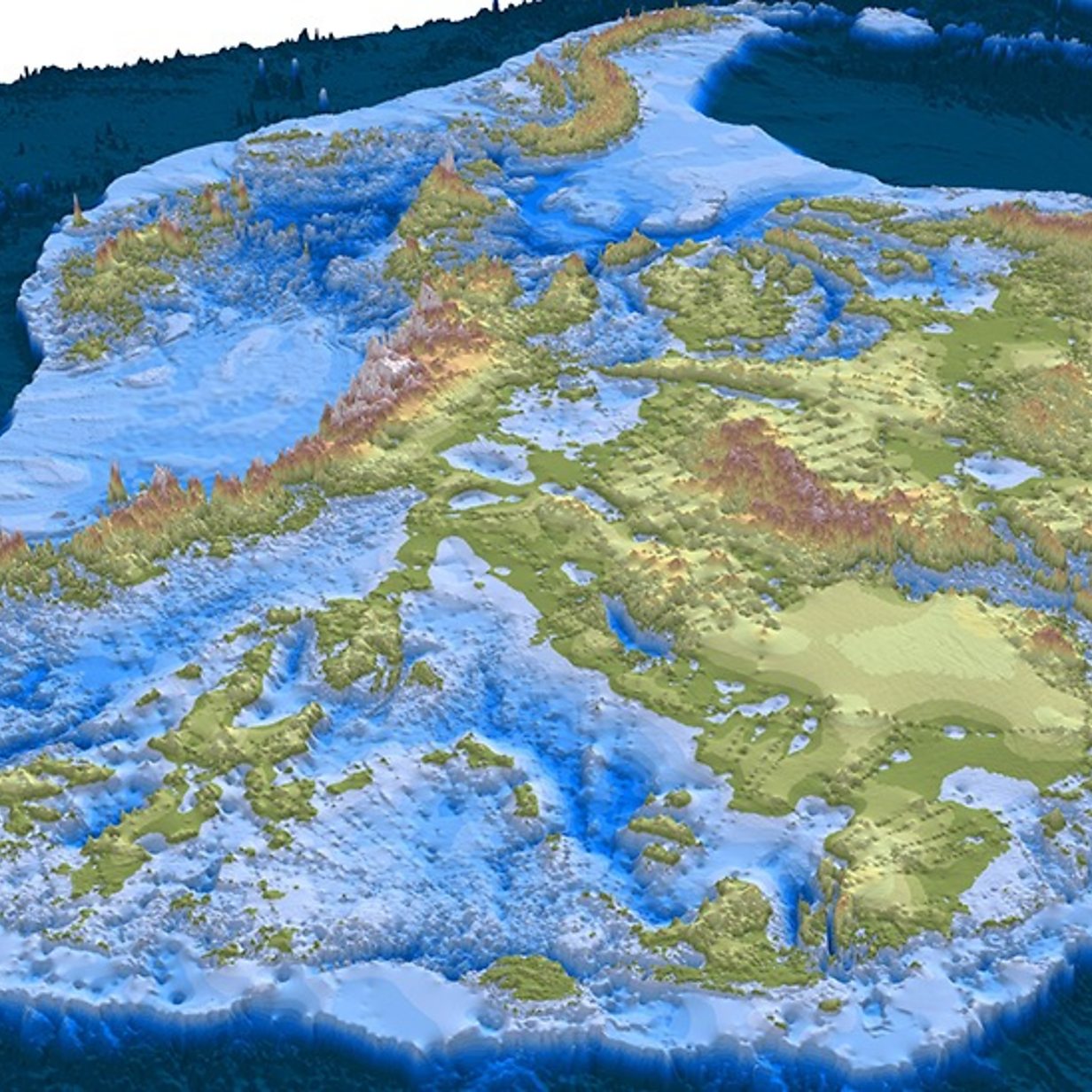
A huge chunk of Antarctica if all the ice was to melt and sea level remain unchanged would be underwater.

p07xmf1m.jpg


But it's clear that over half of what people think of "Antarctica" is actually below sea level.

But Antarctica is in no danger of "melting away". It has always grown and contracted, even during previous ice ages and interglacials.
 
A huge chunk of Antarctica if all the ice was to melt and sea level remain unchanged would be underwater.

p07xmf1m.jpg


But it's clear that over half of what people think of "Antarctica" is actually below sea level.

But Antarctica is in no danger of "melting away". It has always grown and contracted, even during previous ice ages and interglacials.
What about a statement that I read by Dr. James Hansen about fifteen years ago that the last time that atmospheric temperatures rose by three degrees, ocean levels rose by twenty meters over about four centuries?
 
Total rise for that period was around 3.8 inches.


FUDGE. The actual "rise" is absolute zero, which is why nobody can show us a photo of it.


But Antarctica is in no danger of "melting away". It has always grown and contracted, even during previous ice ages and interglacials.


That claim is 100% refuted by ice cores and the 600 miles to the pole law. Antarctica has grown ice for 40 million consecutive years.

Mushroom gets everything wrong by not understanding what a ICE AGE actually is...


What about a statement that I read by Dr. James Hansen about fifteen years ago that the last time that atmospheric temperatures rose by three degrees, ocean levels rose by twenty meters over about four centuries?


James Hansen is a fudgebaking liar.

What happens when Earth has no land near the poles and hence no ice?

Oceans rise
Planet warms
Surface Air Pressure goes way way up as melting AA and Greenland today would release way more trapped gas than is in atmosphere now.
Earth has rain almost all the time all over. If you saw Jurassic Earth from space, you'd just see clouds, no surface.


During the Jurassic Period, the Earth's climate was much warmer and wetter than it is today

Jurassic surface air pressure was likely higher than today's, possibly ranging from slightly more than current levels to as high as
3.7−5.0 bar according to some estimates.
 

Attachments

  • 1762604426449.gif
    1762604426449.gif
    43 bytes · Views: 8
  • 1762604426466.gif
    1762604426466.gif
    43 bytes · Views: 8
The ancient flying dinosaurs could not fly today, not enough air pressure.
 
James Hansen is a fudgebaking liar.

What happens when Earth has no land near the poles and hence no ice?

Oceans rise
Planet warms
Surface Air Pressure goes way way up as melting AA and Greenland today would release way more trapped gas than is in atmosphere now.
Earth has rain almost all the time all over. If you saw Jurassic Earth from space, you'd just see clouds, no surface.


During the Jurassic Period, the Earth's climate was much warmer and wetter than it is today

Jurassic surface air pressure was likely higher than today's, possibly ranging from slightly more than current levels to as high as
3.7−5.0 bar according to some estimates.
Wow!

Thank you for these very relevant details.

What you have described is a lot better than some of the "Warming Scenarios" that I had read in the past.
 
Wow!

Thank you for these very relevant details.

What you have described is a lot better than some of the "Warming Scenarios" that I had read in the past.


Earth climate change is all about land near the poles. It has parameters and rules/laws.

And it was fully busted in 2007, but Mukasey hid it.

homO then got it and went SILENT for two years, before hiding in IN THE CLOSET as usual..


Earth climate change is all about land near the poles. It has parameters and rules/laws.

And it was fully busted in 2007, but Mukasey hid it.

homO then got it and went SILENT for two years, before hiding in IN THE CLOSET as usual..


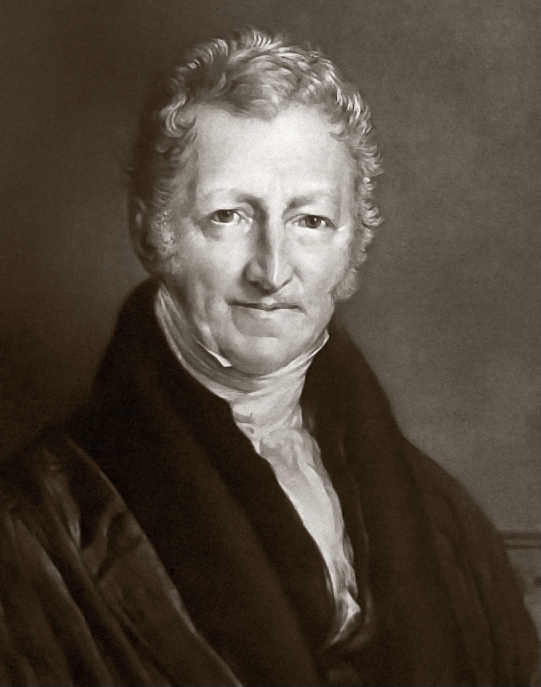
My guess is that influential people who believe firmly in "Neo-Malthusian Economic Philosophy" wanted the Al Gore, Carbon Tax, in order to accomplish the linking of the price and supply of oil to the fiat currencies of the leading world economies. A Carbon Tax accomplishes exactly that and sets up governments and bureaucracies with a plan that can lead to a very high level of bureaucratic control over the lives of ordinary citizens.
Neo-Malthusianism is the advocacy of human population planning to ensure resources and environmental integrities for current and future human populations as well as for other species.<a href="Malthusianism - Wikipedia"><span>[</span>2<span>]</span></a> In Britain the term "Malthusian" can also refer more specifically to arguments made in favour of family planning, hence organizations such as the Malthusian League.<a href="Malthusianism - Wikipedia"><span>[</span>8<span>]</span></a> Neo-Malthusians differ from Malthus's theories mainly in their support for the use of birth control. Malthus, a devout Christian, believed that "self-control" (i.e., abstinence) was preferable to artificial birth control. He also worried that the effect of contraceptive use would be too powerful in curbing growth; it was commonly believed in the 18th century (including by Malthus) that a steadily growing population remained a necessary factor in the continuing "progress of society", generally. Modern neo-Malthusians are generally more concerned than Malthus with environmental degradation and catastrophic famine than with poverty.
 
  • Thanks
Reactions: EMH
My guess is that influential people who believe firmly in "Neo-Malthusian Economic Philosophy" wanted the Al Gore, Carbon Tax, in order to accomplish the linking of the price and supply of oil to the fiat currencies of the leading world economies. A Carbon Tax accomplishes exactly that and sets up governments and bureaucracies with a plan that can lead to a very high level of bureaucratic control over the lives of ordinary citizens.


The UN IPCC always saw CO2 FRAUD as a way to empower the UN to tax.
 
What about a statement that I read by Dr. James Hansen about fifteen years ago that the last time that atmospheric temperatures rose by three degrees, ocean levels rose by twenty meters over about four centuries?

And here is the thing, that is an almost nonsensical statement, and makes not a lick of sense. Because that statement is absolutely missing the most important thing.

When such a temperature increase happens.

When talking about things like this, the "when" is often one of the most important things to mention, not the actual temperature increase itself. Because one has to understand the conditions of the baseline whenever a comparison like that is made.

If that temperature increase is during an ice age and there is a hell of a lot of ice on land that starts to melt, of course that is going to have a huge impact. However, if such an increase is to happen today then there will be much less of an impact. That is why the warming during the Bølling–Allerød interstadial had the largest impact to sea levels since the last Ice Age. And we have had other very similar warming period after the Younger Dryas, but they had nowhere near the level of impact because the majority of surface ice had already melted and flowed to the sea.

In other words, an increase of 3 degrees 15,000 years ago is going to have a huge impact. An increase of 3 degrees today would have a minimal impact, as the ice sheets that covered most of Europe and North America are already mostly gone.
 
And here is the thing, that is an almost nonsensical statement, and makes not a lick of sense. Because that statement is absolutely missing the most important thing.

When such a temperature increase happens.

When talking about things like this, the "when" is often one of the most important things to mention, not the actual temperature increase itself. Because one has to understand the conditions of the baseline whenever a comparison like that is made.

If that temperature increase is during an ice age and there is a hell of a lot of ice on land that starts to melt, of course that is going to have a huge impact. However, if such an increase is to happen today then there will be much less of an impact. That is why the warming during the Bølling–Allerød interstadial had the largest impact to sea levels since the last Ice Age. And we have had other very similar warming period after the Younger Dryas, but they had nowhere near the level of impact because the majority of surface ice had already melted and flowed to the sea.

In other words, an increase of 3 degrees 15,000 years ago is going to have a huge impact. An increase of 3 degrees today would have a minimal impact, as the ice sheets that covered most of Europe and North America are already mostly gone.
Yes, I definitely got the impression from the article that that comment was made in the context of a situation when the world environment was moving out of an "ice age."
 
Yes, I definitely got the impression from the article that that comment was made in the context of a situation when the world environment was moving out of an "ice age."

Therefore, implying that such an impact would have the same result today would be a false analogy.

That is the kind of thing I spot a hell of a lot, not unlike using a "baseline" for what they say temperatures "should be" right in the Little Ice Age. And doing thing like this they are able to be both completely honest, and completely misleading at the same time.

When talking about science, a hell of a lot of data involved is of critical importance. When talking about sea level rise, probably the biggest is how much water is sequestered as ice at that time. That is why if you jumped back to say the Cretaceous some 67 mya, such an increase in temperatures would have almost no impact on sea levels. Because there were very few ice sheets on the planet. Antarctica was a semi-tropical environment, not what we know today. The onle glaciers would have been those at higher elevations.
 
Therefore, implying that such an impact would have the same result today would be a false analogy.

That is the kind of thing I spot a hell of a lot, not unlike using a "baseline" for what they say temperatures "should be" right in the Little Ice Age. And doing thing like this they are able to be both completely honest, and completely misleading at the same time.

When talking about science, a hell of a lot of data involved is of critical importance. When talking about sea level rise, probably the biggest is how much water is sequestered as ice at that time. That is why if you jumped back to say the Cretaceous some 67 mya, such an increase in temperatures would have almost no impact on sea levels. Because there were very few ice sheets on the planet. Antarctica was a semi-tropical environment, not what we know today. The onle glaciers would have been those at higher elevations.
Good point, but is it logical for me to be concerned that a major volcanic eruption under Antarctica by any one of those 130 or so volcanoes that are beneath the Antarctic ice could shock the world economy as we scramble to attempt to protect vulnerable real estate.

I do not think that dikes are the best solution in a situation such as what is faced in Bangladesh, The Maldive Islands, Bermuda, Miami, New York, London, New Orleans or along the Bay of Fundy between Nova Scotia, and New Brunswick, Canada?

For the record, one of my motivations is to get people weaned off the Carbon Tax approach. If people think through the possibility of how and why ocean levels might just rise, they will soon know that a Carbon Tax will do essentially NOTHING to stop ocean levels from rising. At least mega-scale desalination of sea water is a logical step in the right direction.
 
Good point, but is it logical for me to be concerned that a major volcanic eruption under Antarctica by any one of those 130 or so volcanoes that are beneath the Antarctic ice could shock the world economy as we scramble to attempt to protect vulnerable real estate.

-chuckles-

Any why would it do anything even remotely like that? There are 9 known active volcanoes in Antarctica, one of them a large caldera that last erupted in 1970. And Mount Erebus had a rather sizable eruption just this year.

Once again, the amounts of ice that would melt in one is largely insignificant compared to the amount of water in the oceans. Even if in some kind of fantasy "what if" scenario, you are talking about maybe 10 to even 100 cubic miles of ice melting.

What is 100 cubic miles of water when added 352 quintillion gallons of water in the ocean? We are going right back to the "fart in the Mall of America" analogy once again. It actually takes an amazingly huge amount of water to raise ocean levels. As in, 2.43 quadrillion gallons of water to raise sea levels by a single inch.

And a cubic mile is 1,101,117,147,428.8 gallons.

You seem to be getting completely lost in the insane amounts of volume that make up things like the ocean. And yes, the "10-100 cubic miles" is indeed an insane fantasy volume, as in reality, even a large eruption will only melt in the neighborhood of .25 cubic miles of water. And that continent is so cold that most simply freezes again. Even the water released as steam in those conditions almost immediately freezes and simply falls back as snow.


That is why Antarctica is the driest continent on the planet. It literally is a continent sized desert, with liquid water really only existing in a few locations.
 
15th post
-chuckles-

Any why would it do anything even remotely like that? There are 9 known active volcanoes in Antarctica, one of them a large caldera that last erupted in 1970. And Mount Erebus had a rather sizable eruption just this year.

Once again, the amounts of ice that would melt in one is largely insignificant compared to the amount of water in the oceans. Even if in some kind of fantasy "what if" scenario, you are talking about maybe 10 to even 100 cubic miles of ice melting.

What is 100 cubic miles of water when added 352 quintillion gallons of water in the ocean? We are going right back to the "fart in the Mall of America" analogy once again. It actually takes an amazingly huge amount of water to raise ocean levels. As in, 2.43 quadrillion gallons of water to raise sea levels by a single inch.

And a cubic mile is 1,101,117,147,428.8 gallons.

You seem to be getting completely lost in the insane amounts of volume that make up things like the ocean. And yes, the "10-100 cubic miles" is indeed an insane fantasy volume, as in reality, even a large eruption will only melt in the neighborhood of .25 cubic miles of water. And that continent is so cold that most simply freezes again. Even the water released as steam in those conditions almost immediately freezes and simply falls back as snow.


That is why Antarctica is the driest continent on the planet. It literally is a continent sized desert, with liquid water really only existing in a few locations.

You are correct, I am somewhat lost in all of this information but Immanuel Velokivsky the author of "Worlds In Collision" not only got me worried about what could happen in the event of a significant wobble or flip in the magnetic north and south poles, but he even got his buddy Dr. Albert Einstein to be in agreement with him for a number of years until Dr. Albert Einstein gave in to the pressure. Living during the time of the Holocaust could inspire almost anybody to give up on an idea that they know has some validity.
 
That is why Antarctica is the driest continent on the planet

Earth climate change:
Colder = drier
Warmer = wetter

Those who blame the fires on "warming" are absolute morons who are wrong twice in the same sentence.


liquid water really only existing in a few locations.


Like... way under the ice, and when there is magma release on the Peninsula.

Antarctica is 100% ice and its "ice loss" is 100% from icebergs... which are STILL FROZEN when released...

There is NO "liquid water" on the surface.
 

New Topics

Back
Top Bottom