in common law systems fundamental law is created by Stare Decis, court made law, which may be, but is not restricted the black robed grim reaper on the bench,
Incorrect. The UK employs what is known as parliamentary supremacy which allows Parliament to override any right otherwise established by law or custom or common law. Indeed, even the Magna Carta and the English Bill of Rights are subject to the express intervention of Parliament. See,
Thoburn v Sunderland City Council, [2003] QB 151 (Div Ct). This is why the UK can legally convict you of a crime without providing a jury or try you twice for the same offense. Criminal Justice Act 2003 (2003, c.44) §75, §43, §44(UK). Further "stare decis and the system of precedent necessarily is that
black robed grim reaper (or reapers) on the bench , since it is based upon court opinions written by judges. Decisions of juries are not relied upon as precedent or stare decisis. If you disagree, please cite a jury decision which has been relied upon in subsequent cases.. Want to try again?
[Again I said:
The above cases only prove that equity has been used to usurp the will of the people by legal deception and cherry picking sections of the constitution that serves their ends NOT the ends of the people.
No, what it proves is that the Constituion does not support your position and you wish to excise those portions which do not comport to your whacky legal theories. You rely upon the the law of England to establish the right to jury trial in the first place, but willfully chose to ignore the extent of the right as known by the framers and as expressly adopted by the framers when they restricted the right to "suits at common law" .. Which only goes to prove you are a legal ignoramous who is totally unfamiliar with the 7th Amend.
So you agree with me and paint me in error in the same sentence. How fucked is that.
Pretty fucked that you can not even understand what I said, let alone what I meant, LOL
Neither are they REQUIRED BY LAW to inform jurors of the extent of their powers as jurors.
Correct., it is not required by law. Glad we agree. The idea is that jurors should disobey the law only when their conscience demands it not whenever the mood suits them. Did you know that cops do not have to inform suspects that they can refuse a requested search? Perfectly legit.
Hence judges instructing jurys by only disclosing half their duties are operating in bad faith and giving bad legal advice on the bench.
Again you are using one term then accusing a fault based upon another term, A power is not a duty. And judges are in fact empowered and required to give legal advice from the bench. Just because you think it is in "bad faith" that a total rendition of all their rights and responsibilities is not provided does not mean it is in bad faith. The Judge also does not inform them of their power to call for a potty break when necessary and thereby interrupt deliberations, is that bad faith as well? Now, regarding the failure to inform them of the power of jury nullification... if you wish to change that, you can have a law passed to provide for same, you do not even have to amend the Constitution. Good luck.
Sure I would be more than happy to assert the fact the "ORIGINAL" 13th vanished after the war of 1812 so everyone can have a great laugh at you.[/B]
Please do, since it was never ratified. The proposed amendment had accumulated only 12 state ratifications, the last in December 1812 by which time it would have required 14 to be adopted. The "mistake" first occured with the publication of the "Laws of the United States", by Bioren & Duane in 1815 and which printed the proposal as "Article 13" however in the volume's introduction, the editors had cautioned (on page ix), "There had been some difficulty in ascertaining whether the amendment proposed, which is stated as the thirteenth, has or has not been adopted by a sufficient number of the state legislatures.... It has been considered best, however, to publish the proposed amendment in its proper place, as if it had been adopted, with this explanation, to prevent misconception." Other publications mistakenly employed the work of Bioren & Duane without taking notice of the cautionary statement cotained in the introduction, this included several publishers of state laws. . The story is detailed in "
The Case of the Phantom Thirteenth Amendment: A historical and bibliographic nightmare" by Curt E. Conklin, 88 Law Library Journal 121 (winter 1996). In 1813, the Secretary of State, James Monroe, sent a circular letter to all the governors inquiring about further ratifications of this proposed amendment, without result. However, in 1817, the House of Representatives arranged to have a pocket edition of the Constitution printed up for distribution and when these copies arrived containing the so-called Thirteenth Amendment, the House on the last day of 1817 formally asked the President for verification of whether this was validly part of the Constitution. The President, James Monroe, presented the House with two reports of his Secretary of State, John Quincy Adams, which confirmed that there had been only twelve state ratifications, an insufficient number for adoption, and these were published as Messages from the President on February 6, and March 2, 1818. The Congress was apparently satisfied with these reports and thereafter the phantom 13th never again appears as part of the Constitution in any edition published by any part of the
federal government. As a result of this confusion, a law was passed in 1818 specifically designating the Secretary of State as the official repository for ratifications of amendments and this remained the law until 1951. The phantom amendment is not known to have appeared in more than two or three dozen books, out of literally thousands, that purport to reprint the Constitution, and these dropped off very sharply after 1845 when the Statutes at Large first appeared. Since then, the US Supreme Court very explicitly described the 1810 proposal as unadopted in several cases...
Waring v. Clarke (1847) 46 US (5 How.) 441 at 493;
Dillon v. Gloss (1921) 256 US 368 at 375; Coleman v. Miller (1939) 307 US 433 at 472; Afroyim v. Rusk (1967) 387 US 253 at 277-278.
However, prove me wrong name all of the states which adopted the phantom 13th and the dates they were adopted... I will even get you started:
1.Maryland (December 25, 1810)
2.Kentucky (January 31, 1811)
3.Ohio (January 31, 1811)
4.Delaware (February 2, 1811)
5.Pennsylvania (February 6, 1811)
6.New Jersey (February 13, 1811)
7.Vermont (October 24, 1811)
8.Tennessee (November 21, 1811)
9.North Carolina (December 23, 1811)
10.Georgia (December 31, 1811)[1]
11.Massachusetts (February 27, 1812)
12.New Hampshire (December 9, 1812)
The amendment was rejected by three state legislatures:
1.New York (March 12, 1812)
2.Connecticut (May 13, 1813)
3.Rhode Island (September 15, 1814)
So you are claiming not only the GPO but all the states legislatures that printed the original 13th are all misinformed dumb asses.
Yep, they repeated the publication of the phantom 13th found in the Bioren & Duane publication. Are you claiming that the literally thousands of volumes which did not contain the phantom 13th were printed by dumbasses?
claims of nonratification are non sequitor.
Then it should be quite easy for you to name the states which rataified same and the dates that they ratified it.

Even the modern originator of this whacky legal argument (David Dodge and Alfred Adask) could not do that. So you know what they claimed? They had nerve to claim that a mistaken inclusion the publication of the state laws in itself ACTED as a de facto (as opposed to a de jure) ratification... absurd, I know, but that is what is expected from whacky legal nit wits

The british won the war of 1812 as well since america is after all a british interest.
You get whackier with every minute, LOL
and esquire IS a title of nobility as previously shown.
You have shown nothing, LOL
Blackstone's Commentaries & Stephen's Commentaries state that Esquire is a title of commonalty and not of nobility and carries none of the characteristics or privileges of nobility, and the statement in Noah Webster's 1828 American Dictionary that "In the United States, the title ... is bestowed on any person at pleasure, and contains no definite description. It is merely an expression of respect." See also the unabridged Oxford English Dictionary for its entries on "esquire" and especially "esquiress". For the past three centuries (at least) there is no instance of the British monarch "bestowing" an Esquire on anyone, and the British courts have held that the title is altogether unregulated and anyone can adopt it at whim. Stephen's Commentaries on the Laws of England ranks it, emulating Blackstone's editors, between "gentleman" and "doctor", neither of those being either nobility nor bestowed by royalty. Apparently it became a mark of distinction for lawyers at a time when, and because, the lawyers had no academic titles or degrees to put either in front or after their names, and the Oxford English Dictionary notes that it is used only with the full name and without any other embellishments (e.g., Mr., Dr., Hon., Rev., LL.B., J.D., Ph.D.).
Court opinions re the phantom 13th:
D.A. Anderson v. US (ND IL 4/27/98)("These arguments may be amusing to some but are meritless and must be rejected"); See also and to the same effect:
Smith v. US President (D. Conn 11/6/96) ;
Wright v. Leasecomm Corp. (MD Fla 1993) 817 F.Supp 106;
Goode v. Sumner County Commissioners (D.Kan 2/17/95);
In re contempt of Mittower (Ind.Supm 1998) 693 NE2d 555;
Florida Bar v. Gordon (Fla.Supm 1995) 661 So.2d 295;
In re Wm. Patton (ED Penn 11/6/98). See these are what is known as stare decis... you know
fundamental law in common law, right?
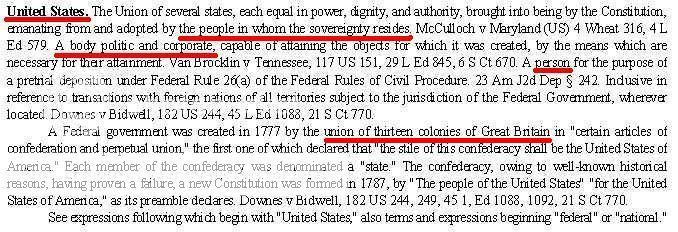
Union of 13 colonies of great britain?
[/B]
Could that be "The United States of America"?
Which created "The United States"?Under/by "its" jurisdiction.....Tell me its not twu!
Its not true... because the reference is made to the date 1777... they are referring to the the Articles of Confederation which created a union out of the 13
former colonies of Great Britan and was adopted in 1781. The distinction being the creation by the confederation of sovereingn states which was the Articles of Confederation as opposed to a creation by
We The People The present government was established by the
people of the United States in 1787 and ratified in 1789. You are not too good at history are you, LOL So tell us how we became a vassal of Great Britain following the War of 1812?
You are entitled to relief, unless you can empiracally prove that the constitution applies to the inhabitants of this nation generally.
Who says you are entitled to relief and who says that the constitution does not apply to to the inhabitants of the this nation generally? Got any authority to establish that the right of petitition means you get the relief for which you petition? If that was the case, I would petition for a a billion bucks... LOL You can demonstrate your correctness by citing stare decis as the fundamental law of our country, LOL
Simply stating the defacto is not dispositive of the dejure.
And simply stating that it is de facto is not dispositive of the de facto.
NO we cant that is bullshit of the highest order.
The bullshit of the hiigest order has been accomplished 27 times... 28 if you believe your bullshit of the hiigest order, LOL
I already informed you the legislatures/congress either state or federal is NOT obligated to vote in accordance with the will of their constituents.
Correct, and the constituants can vote them out, so your point is what? Now if we did not vote for tham, you would have a point... but otherwise your assertion is absurd.
HENCE THE [ONGOING] DISCONNECT between the governing and the government. ONGOING TAXATION WITHOUT REPRESENTATION.
LOL, we do have representation, your claim is that our representatives have the capacity to ignore us, what you fail to address is that if we do not like what they are doing we have the capacity to remove them at an election.... so we do have representation. and you are a loon
Immutable law?????? Who the hell ever said all that? Not me??? I do not know what you are talking about
There are plenty of whacky legal theories being advocated by loons such as yourself. Here is a partial list:
Refusing legal process
Submitting court pleadings titled "Refusal for fraud"
Renouncing or denying US citizenship
Pretending to be "sovereign"
Quibbling about 14th Amendment or Preamble Citizenship
Pretending to be from a "sovereign" state or outside the US
Pretending to be a diplomat or some other official with immunity
Cannot compel recusal of judge
Accusing judge (or other official) of "constructive treason"
Accusing or suing judge (or other official) for "perjury of oath"
In general, suing judge or prosecutor for unfavorable outcome
Trying to force policeman or other govt employee to fill out questionnaire
Objections to name typed in block letters (all-capitals)
Insisting on having name typed with strange punctuation
Arguments based on fringe on courtroom flag
Similarly, on eagle on flagpole
Similarly, on so-called "American Flag of Peace"
Jury nullification
Nuisance IRS Form 1099
Counterfeit or altered IRS Form 1040
Unsigned or uninformative Form 1040
Constitutional rights related to tax evasion
Argument that tax laws apply only to "federal" areas such as D.C.
- - mention of the Buck Act
That tax laws apply only to govt employees
That taxes are voluntary
That income tax is an excise or reciprocal to a govt benefit
That income tax is contractual
That the Sixteenth Amendment (income tax) was not adopted ("The Law that Never Was")
That Ohio was not a state for ratifying the Sixteenth Amendment
That the Internal Revenue Code (IRC) is not "positive" law
That disagreement with the tax laws is a good defense for tax evasion
That the IRS is not really a govt agency or is not authorized to enforce the tax laws
That the tables and index of the Code of Federal Regulations interprets the laws
That wages are not taxable income
That Federal Reserve Notes (FRNs) are not taxable as money
- - relying on the Coinage Act of 1792
- - quibbling about the meaning of the dollar sign ($)
- - that payments received in paper money are not taxable as income
- - that the amount received in paper money could be recalculated for tax purposes
Funny money; "Leroy checks" and the like
Allodial or allodium deeds to property
Land patents to property
Moorish Science Temple argument that black people are tax exempt
Talk about so-called Emergency War Powers Act
Various idiot demands, including ....
- - trying to enforce the order of a make-believe court
- - that judges, IRS agents, and other govt officials are foreign agents
- - that citizenship or legal responsibilities, including taxes, can be unilaterally revoked
- - the Phantom 13th Amendment (about titles of nobility)
- - that IRS forms are invalid without an OMB number
- - claiming "nonstatutory abatement"
--attempting to impose UCC provisions
- - relating to "unconstitutional" laws
You would be amazed what some of these loons come up with. Some even believe that the 11th US Congress was responsible for sending an amendment to the states which would have stripped the US citizenship of all lawyers and judges and insured that they could not have a government job even though the 11th US Congress was 78% composed of lawyers. Whacky to the nth degree, huh?
Your statement, if correct, proves the final say so of what goes on in this country as our governing law is NOT within the jurisdiction and venue of the jury.
Since it is my position that the jury does not have the final say so on all aspects of our government, the creation and enforcement of our laws, etc you would be correct. The jury has the final word in criminal cases in which they acquit the accused. The do not have the final say on anything else. The fact that you think that my opinion is incorrect is quite funny and establishes you as a whacky loon.
The people presumably created the federal constitution but only the states can amend the federal constitution not the inhabitants that live under it. How fucked is that?
Well since the states are required to have a republican form of government, and since the legislators of the state are elected by the people of the state it seems not fucked at all. What you want a jury to pass a constitutinal amendment or sumpin? 
Does any inhabitant have any right not recognized by the state? yes? or no?
Sure, a recent example was displayed in McDonald vs Chicago in 2010, where some laws in Illinois were found to infringe upon the right to keep and bear arms. Anything else?