Madeline asks if the unbridled slaughter of old men, women and little children in Hiroshima and Nagasaki was 'ethical'. One has to realise here that barbarity is the ethical standard which defines of the International Capitalist system. Just as we can recognise a tree by its fruits so can we determine a socio-economic method by its historical consequences.
The colours of Capitalism the world over are brutal and primitive. Chaos ensues from an extension of a system of class division and institutionalised greed, along with the protection of private property; the fierce competition for new markets, the subjugation and exploitation of international indigenous populations for super profits and the inevitable wars the ruling class demand in order to maintain their established hierarchies of Imperialist stranglehold.
Nothing in History is the result of 'accident' and everything a consequence of the fundamental economic and social structures we maintain by our political choices, or lack of therein.
So it is important to recognise that the ethic of an exploitative system is social chaos and war. And 'Behold', the societies in which Humanity now languish reflect this truth abundantly.
More specifically, in the context of Japan and the Nuclear attacks America unleashed upon the Japanese civilian population, the consensus of independent rational opinion realises that these atrocities were completely unnecessary, and the result of a malevolent Capitalist superpower besotted with displaying its aggressive abilities to the World so it could dominate post-war affairs with an iron fist, in a climate of fear. And it has. As is evidenced by America's exhaustive plethora of post WW2 invasions, interventions, all out wars and both covert and explicit funding of terrorism.
RetiredGySgt is, as usual, blinkered to any reality which shows up the nefarious nature of his beloved terrorist nation. Perhaps his own complicity as a servile military tool is too much to bear, if he were to ever open his eyes to the harsh light of day. And so it is his ilk that in fact revise history with Pavlovian synergy, every time the truth begins to dawn upon a new generation.
Dwight D. Eisenhower, Supreme Commander of the Allied Expeditionary Force and later president of the U.S., when informed of the decision to drop Atomic bombs on Hiroshima and Nagasaki stated:
"I voiced my misgivings, first on the basis of my belief that Japan was already defeated and that dropping the bomb was completely unnecessary, and secondly because I thought that our country should avoid shocking world opinion by the use of a weapon whose employment was, I thought, no longer mandatory as a measure to save American lives. It was my belief that Japan was, at that very moment, seeking some way to surrender with a minimum loss of "face."
Admiral William D. Leahy, Chief of Staff to Presidents Franklin D. Roosevelt and Truman, revealed to his biographer Jonathan Daniels:
"they went ahead and killed as many women and children as they could which was just what they wanted all the time."
[Alperovitz, Decision, p. 326.]
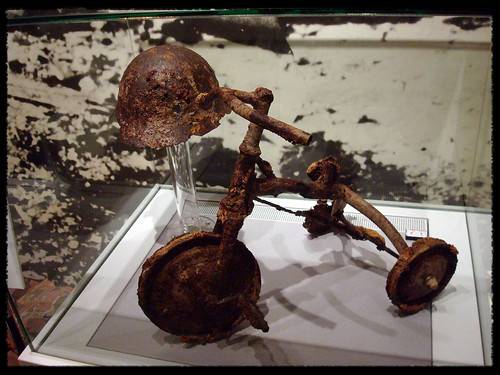
(Shinichi Tetsutani, almost 4 years old, was playing on his tricycle when the brave U.S.A.F. atomic-bombed his home. Such was the intensity of the nuclear glare all but the metallic frame melted.)
And in his autobiography, Admiral Leahy states:
"It is my opinion that the use of this barbarous weapon at Hiroshima and Nagasaki was of no material assistance in our war against Japan. The Japanese were already defeated and ready to surrender because of the effective sea blockade and the successful bombing with conventional weapons."
[Atomic Diplomacy: Hiroshima & Potsdam , by Gar Alperovitz, p. 14.]
General Douglas MacArthur, officer in charge of Pacific operations, questioned the military usefulness of the Hiroshima and Nagasaki bombings. His consultant Norman Cousins wrote in 1987:
"The war might have ended weeks earlier, [MacArthur] said, if the United States had agreed, as it later did anyway, to the retention of the institution of the emperor."
[Hoover and Cousins quoted in Alperovitz, Decision, pp. 349-50.]
Many military and government officials under Truman failed to fathom his decision to pursue the bombings when surrender was within their grasp. Joseph Grew, Under Secretary of State; John McCloy, Assistant to the Secretary of War; Ralph Bard, Under Secretary of the Navy; and Lewis Strauss, Special Assistant to the Secretary of the Navy, to name but a few.
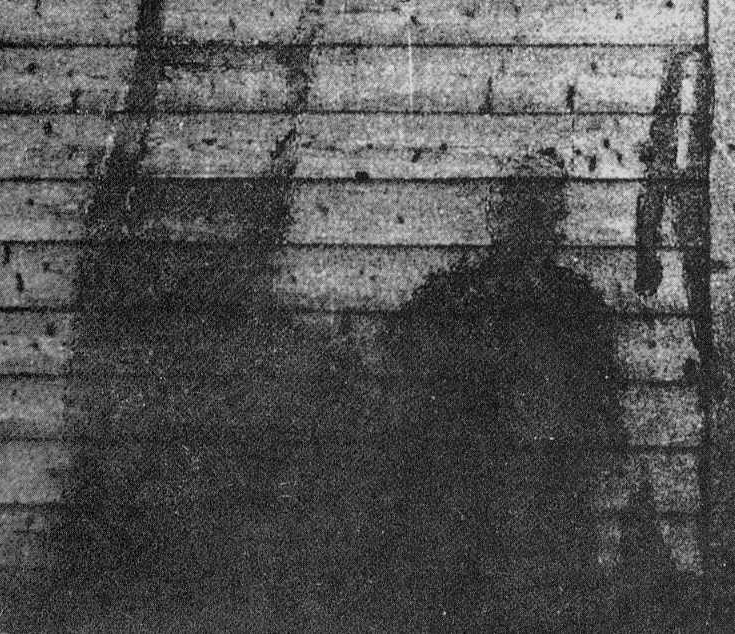
(ghostly shadows created by incinerating radiance are all that remained of some anonymous Japanese victims of American atomic-war barbarity.)
After the carnage was unleashed U.S. Strategic Bombing Survey concluded:
"certainly prior to 31 December 1945, and in all probability prior to 1 November 1945 [the date U.S. forces were to invade.], Japan would have surrendered even if the atomic bombs had not been dropped, even if Russia had not entered the war, and even if no invasion had been planned or contemplated."
[, Atomic Diplomacy: Hiroshima & Potsdam , by Gar Alperovitz, pp. 10-11.]