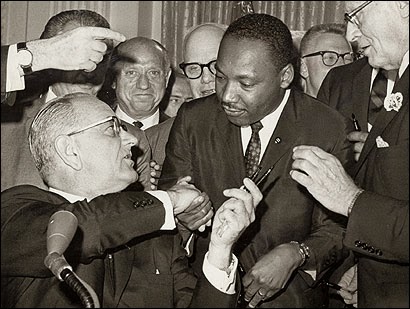
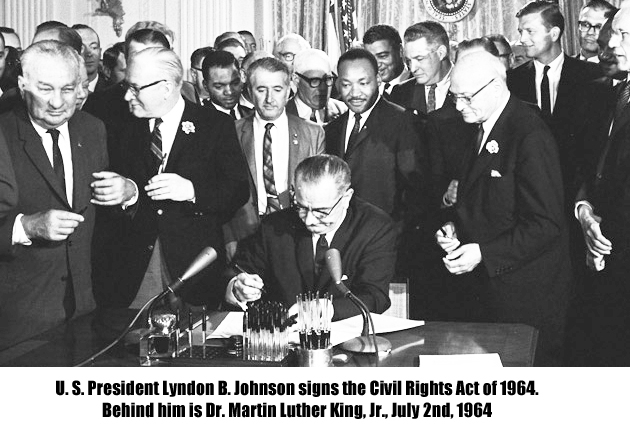
Democratic Party in the 1960s was divided between Southern Democrats, most of whom opposed civil rights legislation, and Democrats from outside the South who more often than not supported it.
/---- Here is some more FActs you can't refute other than labeling FUNNY.
Civil Rights Filibuster Ended
At 9:51 on the morning of June 10, 1964, Senator
Robert C. Byrd (DEMOCRAT) completed an address that he had begun 14 hours and 13 minutes earlier. The subject was the pending
Civil Rights Act of 1964, a measure that occupied the Senate for 60 working days, including seven Saturdays. A day earlier, Senate whips
Hubert Humphrey (D-MN) and
Thomas Kuchel (R-CA), the bill's floor managers, concluded they had the 67 votes required at that time to end the debate.
The Civil Rights Act provided protection of voting rights; banned discrimination in public facilities—including private businesses offering public services—such as lunch counters, hotels, and theaters; and established equal employment opportunity as the law of the land.
As Senator Byrd took his seat, House members, former senators, and others—150 of them—vied for limited standing space at the back of the chamber. With all gallery seats taken, hundreds waited outside in hopelessly extended lines.
Georgia Democrat
Richard Russell offered the final arguments in opposition. Minority Leader
Everett Dirksen, who had enlisted the Republican votes that made cloture a realistic option,
spoke for the proponents with his customary eloquence. Noting that the day marked the 100th anniversary of Abraham Lincoln's nomination to a second term, the Illinois Republican proclaimed, in the words of Victor Hugo, "Stronger than all the armies is an idea whose time has come." He continued, "The time has come for equality of opportunity in sharing in government, in education, and in employment. It will not be stayed or denied. It is here!"
Never in history had the Senate been able to muster enough votes to cut off a filibuster on a civil rights bill. And only five times in the 47 years since the cloture rule was established had the Senate agreed to cloture for any measure.