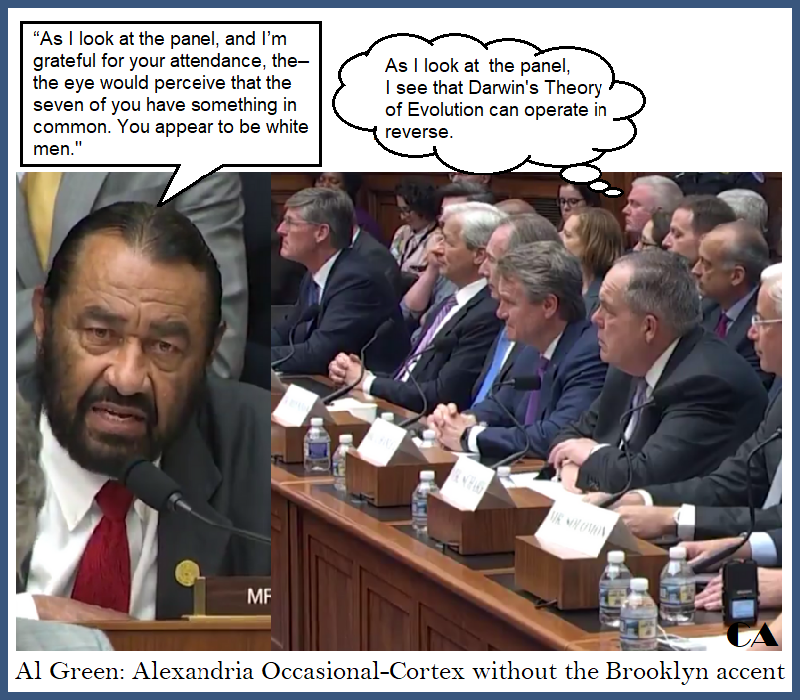
Yes, you may be missing something, Snouter.
Black people produced a very famous and amazing scientist, and I'll let Wikipedia do the talking about George Washington Carver:
George Washington Carver
From Wikipedia, the free encyclopedia
George Washington Carver

Photograph circa 1910
Born 1864
Diamond, Missouri, U.S.
Died January 5, 1943 (about 79 years old)
Tuskegee, Alabama, U.S.
Alma mater Iowa State University
Awards Spingarn Medal (1923)
George Washington Carver (1860s
[1][2] – January 5, 1943), was an American
agricultural scientist and inventor. He actively promoted alternative crops to cotton and methods to prevent
soil depletion.
[3]
While a professor at
Tuskegee Institute, Carver developed techniques to improve soils depleted by repeated plantings of cotton. He wanted poor farmers to grow alternative crops, such as
peanuts and
sweet potatoes, as a source of their own food and to improve their quality of life. The most popular of his 44 practical bulletins for farmers contained 105 food recipes using peanuts. Although he spent years developing and promoting numerous products made from peanuts, none became commercially successful.
[4]
Apart from his work to improve the lives of farmers, Carver was also a leader in promoting
environmentalism.
[5] He received numerous honors for his work, including the
Spingarn Medal of the
NAACP. In an era of very high racial polarization, his fame reached beyond the black community. He was widely recognized and praised in the white community for his many achievements and talents. In 1941,
Time magazine dubbed Carver a "Black
Leonardo".
[6]
And in addition to bilingual excellence very few Americans possess, Latino Americans have also contributed greatly to many fields, notably medical advancements, but other areas as well, of course:
10 Game-Changing Hispanic Scientists You Didn’t Learn About In School
BY Anna Green
October 6, 2016
1. CARLOS JUAN FINLAY
Today, the world recognizes Cuban doctor and scientist
Carlos Juan Finlay as a pioneer in the study of yellow fever. But back in 1881, when Finlay first presented his extensive research suggesting that mosquitoes transmitted the disease to Havana’s Academy of Sciences, he became a laughingstock. According to Finlay’s son, the speech was greeted with initial silence, followed by “universal ridicule.” It took another two decades before Finlay’s hypothesis became widely accepted. During that time, Finlay didn’t give up on his research. Instead, he spent those twenty years refining his theory, breeding mosquitoes, and conducting hundreds of tests to support this theory.
2. MARIO J. MOLINA
The first Mexican-born scientist to win a
Nobel Prize in Chemistry, Mario Molina discovered the serious
environmental threat posed by chlorofluorocarbon gases (CFCs). Along with fellow chemist Sherwood Rowland, Molina found that CFCs—chemicals commonly used as refrigerants, and colloquially known as Freon—released into the atmosphere were contributing to ozone depletion.
3. ELLEN OCHOA
In 1993, astronaut Ellen Ochoa became the first Hispanic woman to go to space. She first served on a nine-day mission aboard the space shuttle
Discovery, where she and a team of astronauts studied the Earth’s ozone layer, then returned to space three more times, spending nearly 1000 hours in orbit. Today, Ochoa, who holds NASA’s Distinguished Service Medal, serves as the director of the Johnson Space Center in Houston, Texas.
4. CÉSAR MILSTEIN
Nobel Prize winning biochemist
César Milstein opened new doors in the diagnosis and treatment of disease with his 1975 study on monoclonal antibodies. Milstein and his team developed a technique for the unlimited production of monoclonal antibodies, a type of antibody made by identical immune cells. Thanks to Milstein’s work, monoclonal antibodies are now used in everything from diagnostic tests to the treatments of several autoimmune diseases.
5. FRANCE A. CÓRDOVA
Astrophysicist
France A. Córdova is the director of the National Science Foundation, a federal agency that develops programs to advance all fields of scientific discovery. She was nominated for the position in 2014 by President Barack Obama. Before she spent her days overseeing America’s science and scientific education programs, Córdova
conducted important research on x-ray and gamma ray sources, accretion discs, and black holes, publishing more than 150 scientific papers. Back in 1993, she also became the first woman to hold the position of NASA Chief Scientist.
6. YNES MEXIA
Mexican-American botanist
Ynes Mexia discovered two new plant genera and 500 new plant species—and she didn’t even start collecting plants until she was 51 years old. Born in 1870 in Washington D.C. to a Mexican diplomat father,
Mexia spent many years as a social worker before enrolling as an undergraduate at the University of California Berkeley and discovering her passion for botany. In the 1910s and 1920s, she traveled thousands of miles around Mexico, South America, and Alaska, collecting some 145,000 plant specimens in just 13 years. Today, 50 plant species are named for her.
7. JUAN M. MALDACENA
Born in Buenos Aires in 1968, physicist
Juan M. Maldacena studies the relationship between quantum gravity and quantum field theories. Currently a faculty member at the Institute for Advanced Studies, he has been awarded the Fundamental Physics Prize (2012) and appeared on the “Einstein’s Dream” episode of PBS’s
Big Ideas. Maldacena’s research on the duality of conjecture was so groundbreaking, the participants of a 1998 string theory conference wrote a song to honor him called “The Maldacena” (sung and danced to the tune of “The Macarena.” It was the 1990s, after all). While much of Maldacena’s work is tough reading for non-physicists, he has also written several explanations of his work on quantum theory for general audiences, including a popular 2007
Scientific American article tantalizingly entitled “The Illusion of Gravity.”
8. ALBERT BAEZ
Father of singers Joan Baez and Mimi Fariña, Mexican-American physicist
Albert Baez was the co-inventor of the X-ray reflection microscope. Though he created the device, which allows scientist to examine living cells, in 1948, it’s still considered a crucial scientific tool to this day. A pacifist, he refused a series of defense industry positions during the Cold War arms race, instead conducting research and teaching physics at the University of the Redlands, Baghdad University, MIT, and Harvey Mudd College.
9. HELEN RODRÍGUEZ TRÍAS
Born in New York City in 1929, Puerto Rican-American pediatrician and healthcare advocate
Helen Rodríguez Trías helped improve access to public health services for women and children in both the United States and Puerto Rico. She was the first Hispanic president of the American Public Health Association as well as a founding member of the Committee to End Sterilization Abuse, an organization that fought against the practice of forced sterilization. In 2001, she was awarded the Presidential Citizen’s Medal for her work on behalf of people with HIV and AIDS.
10. TED TAYLOR
Nuclear physicist Ted Taylor worked at the Los Alamos National Laboratory in the 1940s and 1950s, where he helped design small nuclear weapons and reactors, as well as the Super Oralloy Bomb, which was the largest pure fission bomb ever detonated. While detonating a test bomb in the Nevada desert, Taylor once suavely
lit a cigarette off of the blast using a parabolic mirror.
After observing the damage nuclear weapons could do, Taylor ultimately had a change of heart. He went on to serve as a consultant to the International Atomic Energy Agency in Vienna, where he worked to
against the use of nuclear weapons. “He was ten or twenty years ahead of the rest of us,” Freeman Dyson, famed physicist and Taylor’s colleague once said, “I think he is perhaps the greatest man that I ever knew well. And he is completely unknown.”