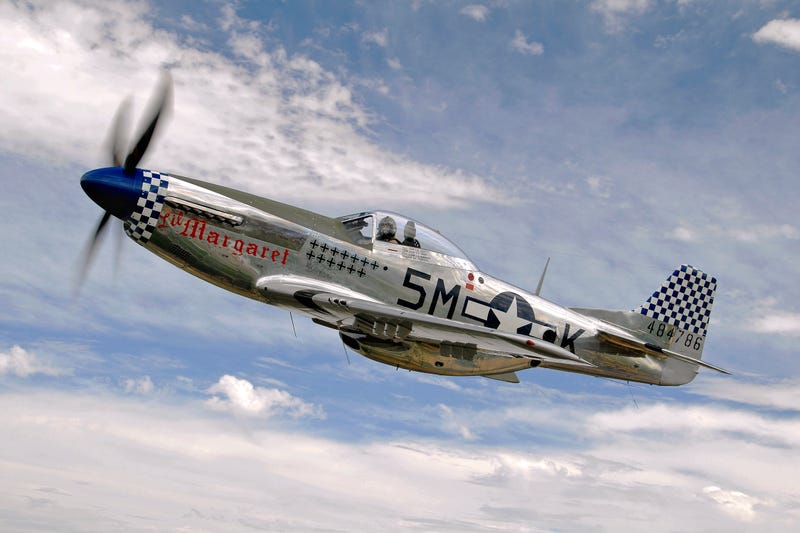
I chose the P-38 due to it being the most versatile of the 3.
The P-51 is slightly better at high altitudes as a pure fighter, second comes the P-38 as long as the altitude is below 20,000 feet. Below 20,000 feet, the P-38 rarely gets into the compression ability problem. Above that, it can get a newbie pilot killed fast in a dive. But above 25K, the P-47 is far superior to the other 3.
As for claiming the P-51 was the "Only" long ranged fighter, the P-38J+ had a much longer range. The first fighters above Berlin were P-38G models. They were supposed to escort bombers but the bombers were scrubbed. Since the P-38s were already over Germany, they proceeded to Berlin and did strafing runs. This was mid 1943.
If you are doing Recon, the P-38 wins hands down. It's counter rotating props made it very, very smooth in comparison (the P-47 was the rough one). It meant the pictures could be taken at a higher altitude and be clearer due to the lack of motion on the camera. Even so, there was a 75% loss on the P-38 recon birds since they were not armed and had to fly at specific altitudes without changing their altitude or direction while filming. And they were 2000 lbs lighter with all the armor removed. They relied on speed but still.....
As for strafing, the P-47 barely edges out the P-38. The P-47 packed 8 50 cals and could take severe damage from the the ground forces. Meanwhile, the P-38 carried 4 50 cals and was the only WWII Usaf fighter to carry a cannon. The P-47 used convergent fire meaning the bullet paths crossed at about 250 yards. But if you are operating at less than that in ground attack, it doesn't mean a thing. The P-38 had straight trajectories meaning all guns were aimed directly forward including the cannon. At longer Ranges the P-38 was superior but a closer range (due to the rugged construction) the P-47 gets the nod. The P-51 was also used for ground attack but it wasn't nearly as effective as the other 2 due it only having 6 50 cals and it's inability to absorb damage.
Now, let's go onto being able to absorb punishment and still get home. The King is the P-47 with it's radial engine and heavy armor hands down. Hitting his engine may reduce his power but he can be flinging oil with a couple of jug blown off and still get home. The P-38 has two engines. The only way to get him not to come home due to engines is to take out both since he is still very flight worthy on only one (find a cloud bank and boogie home). The worst is the P-51 since he has only one engine. He can be taken out just by hitting his radiator. To give you an idea, more P-51s were lost due to this than either the P-38 or the P-47 combined.
You also have to look at the period of the War. Until the P-47 arrived in mass in early 1943, the only long ranged fighter was the P-38. In 1942, the P-38 faced experienced Luftaffe Pilots at a 11-1 rate. And they tried to use the P-38 by having him fly with the bombers. Here the P-38 is flying in a zig zag formation with the bombers at 200 kts when they are jumped by the 109 doing a dive zoom at 320 kts. The P-38 has to spool up to get up to speed. During that time, bombers are lost and so are the lumbering P-38s. Same goes for the P-47 flying the same mission. Early 1944, that doctrine was changed and allowed the fighters to fly ahead of the bombers and disrupt Luftwaffen Fighters. Early 1944 was when the bulk of the P-51s came into service. And you have to know that the flight training of a P-38 pilot was extremely poor until 1944. By the time the P-51B/C showed up, the heavy lifting was already done and the Luftwaffen was running low on experienced pilots and had a shortage of fuel. Not having the P-51 at all would have changed nothing except a lot of P-38 and P-47 pilots lives.
The P-38 was not the only US fighter to mount a cannon. The P-39 Aircobra mounted a 37mm cannon firing through the hub. The 51 and the 47 both used harmonizing on their guns to generate a cone of fire, and that was adjustable based on the pilots preference. Some wanted the cone closer, some farther. The P-38 had constant problems with the Allison engines, the intercoolers and turbos were constantly breaking due to their inability to handle the freezing at higher altitudes they were forced to fly in Europe, and maintenance was always a problem. The P-38 was probably the best overall fighter the US fielded in WWII, but it was incredibly complex so there were few pilots who were able to wring the maximum performance from it.
The P-47 was easily the most robust fighter we had, also probably the first to break the sound barrier while in a dive as the thing weighed a TON. Well several tons! It could take enormous punishment thanks to its air cooled radial engine, and in the fighter bomber role, probably had no competitor.
The '51 was on the other hand, a relatively benign aircraft. Forgiving in all areas save high bank, at low air speed,, which could invoke a tip stall which almost always resulted in an inverted flat spin which was unrecoverable. In the hands of competent pilots it made them better, and the Merlin was arguably the finest engine of the era, easy to maintain compared to the Allison, with useful firepower, and incredibly long legs. For mass combat the '51 was the superior bird for the majority of the pilots flying it.
Let's look at the ETO. The P-38 required better fuel than the fuel that the Brits offered. Until 1944, the only fuel was 100 Octane. The P-38 had to use an octane booster that would seperate from the gas at low temperatures. This caused back firing which were hell on the turbochargers. There were two things fixed in 1944. First was the US started to get the 115(145) fuel so the octane booster was not needed. This also affected the P-47 as well. Also, the new series 33 turbocharger was introduced. With the introduction of the P-38LO-25, the 38 was just as good as every other front line heavy fighter for Air to Air regardless of altitude.
As for the 37mm Cannon, how about we say that the P-38 (20mm) was the only cannon in the US inventory that actually worked. They tried the 37mm on the 38 but it jammed all the time. It also jammed in the 39 in hard turns. Having a 37mm is like adding extra weight just for the hell of it and no other reason.
When the 1425 (1600 in military) was put into the J models of the 38, the engine problems went away along with running the hotter fuel. To say the P-38 didn't like cold weather, it was the primary fighter out of Alaska and didn't experience those problems even with the lower power allison engines. It got decent fuel so the Turbochargers were less prone to go bang. But it wasn't until the J model that the fridged cockpit was addressed by introducing heated flight suits. Of course, this didn't help that the 38s cockpit was hotter than hell in the Pacific. Just wear your tidy whities, jump boots and a smile got around that.
The problems with the coolers on the early 38s is that it was only good on the 1000 hp Allisons. The initial engine was the 1125 hp engine and you had to use the throttle stops to keep you from running it up. Most Pilots had the blocks removed as they thought they new better. They were inexperienced and didn't know better. The leading edge radiators were used from the E through the H model. The J went to the cowling version and it could use the 1425 hp with no problems for cooling of the intercooler and engine temp and oil. But the initial J lost about 25 mph in the process as the cowl cooler was not as streamlined as the leading edge cooler. For the first time, though, the 38 could use all it's HP. There were other fixes as well. By late 1943, the J model was out and by late 43 it was out in numbers.
BTW, the 38 did have a problem of compression but the way to get out of it was chop the power on ALL models until the J-25 version and L. Inexperienced pilots would try and handle it like a single engine by adding power. Had the chopped power and let the bird fly out of it, not a single one of the compression deaths would have occurred. A Pilot only made that mistake once.
Few pilots? In the beginning of the war, pilots were taken from single seaters and dumped into the 38 where they had NO twin engine experience at all. Really poor training. They would come off a P-39 training bird (and others) directly into combat with the 38. It became a "Get Good or get Dead" situation. Most got good fast. Once they learned to use the throttles in a turn, the 38 could turn with anything. The addition of the fowler flaps meant that an experienced pilot could out turn even a Zero. The Military finally owned up to the poor training problem in 43 and the 38 started to really run the numbers up. The P-38 had more air to air kills than the P-47 and the P-51 by the end of the war. That brand new trainer with the piggy back seat was worth it's weight in gold.
The P-47 would be rated #2 in almost all areas except for ground attack. One battle the P-47s hit a German Armor division so hard that the enemy wanted to surrender to the P-47s. You can't surrender to any aircraft so they just pounded even harder. The same thing happened in DS1 when a flight of Buffs hit an Iraqi Armor Division. Those folks were trying to surrender to anyone not Iraqi wearing a green suit. They even tried to surrender to the Press. They got as far away from their armor as they could. Yes, the P-47 wins for ground attack.
Now, the P-51. It was less than half the cost of the P-38 and 2/3rds cost of the P-47. This is NOT a reason for it to be voted #1. The only thing it had was is that it was 2% better than the 190 in a dog fight. I will admit it was easier to fly. The more you take away from the pilot to do the better they will perform. But that only applies in the 51s case in dog fights. And that is only one part of being a fighter.