Do you support Principle before what is humane and reasonable like the conservatives Harry Hopkins chastised during the Depression Intense?
During the Great Depression conservatives raised the same objections to F.D.R.s programs. They said the economy must be left alone and it would correct itself in the long run. Commerce Secretary Harry Hopkins shot back: People dont eat in the long run. They eat every day.
Preaching Salvation through Subjugation 101 again?

Good one.
I didn't live through the 1st Depression, only this one. I have mixed feelings about programs designed to help people that burn and plow over crops in the field, on their way to and in the market places. Destroying Inventories of mass goods, Paying Farmers to not grow food. All to artificially inflate the retail price of goods keeping poor people alive, to insure better Salaries for Union Workers and Civil Servants. You ended Share Cropping, you caused, it seems, anyone who was not on your list to lose everything and get thrown under the bus. You did establish Bread Lines for those you disenfranchised. That was mighty decent of you.

Did Roosevelt's plan hurt the poorest more? Did his policies prolong the Depression? Hard questions to answer. did Roosevelt have good ideas? Yes. Did Roosevelt have bad ideas? Yes. What were His priorities, The National Interest or Progressivism. I think he crossed the line.
I am not preaching salvation, I am preaching that a humane government is in the best interests of We, the People. A nation is measured by how the people are doing, not by doctrinaire.
I have been around since Truman was President, so I have witnessed the drastic changes in my country brought about by the conservative era that followed the liberal era that ran from the New Deal through the Great Society. The conservative era has been a disaster for all but the very wealthy. Conservatives have built nothing.
Honestly, I see today's conservatives being no different from communists in Russia...where strict doctrinaire trumps humane government, where ideology has reached the level of insanity. History has proven that a mixed economy outperforms those run on strict doctrinaire, be it communism or Laissez faire.
MYTHS OF THE FREE MARKET - Blind Faith
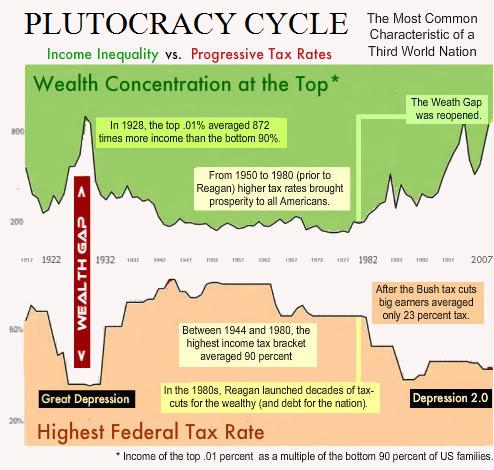
The gap between rich and poor is now the widest in US history. This is disturbing, for if history is any guide we have unwittingly placed ourselves in grave danger.
Over the last millennium Europe has witnessed long cycles of widening and narrowing economic disparity. In each cycle, once the gap between the rich and the rest widened beyond a certain point, it presaged decline and disaster for all of society, the rich as well as the poor. Could we be seeing the first tremors of a new cycle, the outliers of the next menacing storm? In recent decades, many US citizens have come under increasing financial pressure. Since the 1970s, our number of working poor has increased sharply. Nearly all of our much-vaunted newly-created wealth has gone to the richest.
For a country that has prided itself on its resourcefulness, the inability to address such problems suggests something deeper at work. There is something, powerful but insidious, that blinds us to the causes of these problems and undermines our ability to respond. That something is a set of beliefs, comparable to religious beliefs in earlier ages, about the nature of economies and societies.
These beliefs imply the impropriety of government intervention either in social contexts (libertarianism) or in economic affairs (laissez faire).
The faithful unquestioningly embrace the credo that the doctrine of nonintervention has generated our most venerated institutions: our democracy, the best possible political system; and our free market economy, the best possible economic system. But despite our devotion to the dogmas that libertarianism and free market economics are the foundation of all that we cherish most deeply, they have failed us and are responsible for our present malaise.
The pieties of libertarianism and free markets sound pretty, but they cannot withstand even a cursory inspection. Libertarianism does not support democracy; taken to an extreme, it entails the law of the jungle. If government never interferes, we could all get away with murder. Alternatively, if the libertarian position is not to be taken to an extreme, where should it stop? What is the difference between no government and minimal government? Attempts to justify libertarianism, even a less than extreme position, have failed. Laissez faire, or free market economics, characterized by minimal or no government intervention, has a history that is long but undistinguished. Just as the negative effects of a high fever do not certify the health benefits of the opposite extreme, hypothermia, the dismal failure of communism, seeking complete government control of the economy, does not certify the economic benefits of the opposite extreme, total economic non-intervention.
It may seem odd, given the parabolic arc of our financial markets and the swelling chorus of paeans to free market economics, but despite the important role of the market, purer free market economies have consistently underperformed well-focused mixed economies. In the latter part of the nineteenth century the mixed economies of Meiji Japan and Bismarcks Germany clearly outperformed the free market economies of Britain and France. Our own economy grew faster when we abandoned the laissez faire of the 1920s and early 1930s for the proto-socialist policies of Franklin D. Roosevelt. It has become increasingly sluggish as we have moved back to a purer free market. Data of the past few decades show that our GNP and productivity growth have lagged those of our trading partners, who have mixed economies characterized by moderate government intervention.


 Who's controlling Oil, Gas, Power? Good one.