Campi Flegrei, an incipient caldera event?

Correct. Just to give you an idea of the scale involved, and why the expansion must take place first, Long Valley Caldera, which erupted approximately 750,000 years ago is 20 miles long, by 11 miles wide, but over a period of about a week it erupted over 600 cubic kilometers of ash. That deposit, called the Bishop Tuff, has measurable quantities in the Mid Atlantic Ridge.

Wow, I had not heard of Long Valley before but that sounds like a big one. I just did a little reading up on the matter and the area sounds like it is still in question. Based on its location, I'm guessing that the caldera there is being driven by subduction of the Pacific plate meaning that this far inland and the driving magma feeding it all must be very DEEP. And deep means large.

I saw a picture of Hot Creek (part of Mammoth Creek) all stained with colored minerals like sulfur, and just about a decade ago, several people died there, apparently they fell down into a depression in the landscape that had filled up with inert heavy gases suffocating them.

That's all I need to know that whatever force is there is far from over and there will almost certainly be big fireworks there again at some point in the future.
 
Wow, I had not heard of Long Valley before but that sounds like a big one. I just did a little reading up on the matter and the area sounds like it is still in question. Based on its location, I'm guessing that the caldera there is being driven by subduction of the Pacific plate meaning that this far inland and the driving magma feeding it all must be very DEEP. And deep means large.

I saw a picture of Hot Creek (part of Mammoth Creek) all stained with colored minerals like sulfur, and just about a decade ago, several people died there, apparently they fell down into a depression in the landscape that had filled up with inert heavy gases suffocating them.

That's all I need to know that whatever force is there is far from over and there will almost certainly be big fireworks there again at some point in the future.
Doubtful that another calderic eruption will occur there, plinian for sure, they had one of those about 200 years ago in Mono Lake, but not the massive type. Those seem to be one offs in any particular region.
 
Wow, I had not heard of Long Valley before but that sounds like a big one.

That's actually a "small" one in the area of supervolcanos, but it is worrisome because of the location, and slightly puzzling because it does not appear to be located above a fixed hotspot that the crust moves over like Yellowstone and because it is located in an area that should already be "dead" when it comes to volcanos.

From what we understand about how volcanos are formed, the majority are inland of an active subduction zone. That is why the volcanos north of San Francisco up to Canada are all still active, and those south of there are all dead. The mountains of the Sierras north of SF are active, with various forms of stratovolcanoes resting above pools of magma in various states.

And to the south, increasingly what is seen are "ghost volcanos". The volcano is no longer there, it has been eroded away and all that is left is a giant chunk of granite sitting where the magma chamber used to be.


That is why Long Valley is a bit of a puzzle, it does not match what we understand of such features. The subduction of the Farallon Plate to the west ended over 30 million years ago, so there should no longer be a slab down there melting to create more volcanos. Yet there it is, still active. Only a single eruption that they have discovered, but a resurgent magma dome and continuing activity in the magma chamber.

In a way, the reverse of a puzzle over the Yellowstone Hotspot. That has been throwing out multiple highly explosive eruptions, even when it was sitting over an area that should have been throwing out much more docile eruptions and creating stratovolcanoes.

So is Long Valley in the process of dying, or is something still fueling it and it can erupt again? They simply do not know, so are keeping a close eye on it.

The Valles Caldera in New Mexico is much the same as the Long Valley. At least two eruptions between 1.2 and 1.6 mya, and once again sitting in an area that it should not exist. Where off-shore subduction had ended over 45 mya, and there should be nothing that we know of that is driving it. And it also is dormant but still active.
 
but it is worrisome because of the location, and slightly puzzling because it does not appear to be located above a fixed hotspot that the crust moves over like Yellowstone and because it is located in an area that should already be "dead" when it comes to volcanos.

As I recall, that caldera is near the Ca/NV border, so obviously, there must be some feature or flaw far underground there that is susceptible to magma pooling and collecting there as the pacific plate is forced under north america.
 
What amazes me is that in a region populated by some of the biggest, worst volcanos on the planet, they are shocked at the formation of a geologic caldera.

I'm no geologist, but none of this seems surprising and is following right along the laws of entropy.

It seems clear that in the future, releases of pressure will go up, some of which could be catastrophic.

I'd be moving out of Italy right now.

It's the rich soils produced by these volcanoes ... Naples is one of the finest wine-growing regions in the world ... Gomo is The Congo is another example of folks gathering where soils are abundant ... my own garden is Holocene deposits from Mt Mazama (aka Crater Lake) ...

People get rich farming the slopes of active volcanoes ... and today we'll have plenty of warning ... Yellowstone is a caldera because the magma chambers is empty ... if it takes 10,000 tears to fill, we're still on schedule for an "imminent" eruption (and review mushroom's post #17) ...

If you're interested in Yellowstone, the USGS provides monthly updates on the active there ... I've been subscribed now a few years so that's how I know Yellowstone is completely quiet ... no eruptions for the foreseeable future ...
 
that's how I know Yellowstone is completely quiet ... no eruptions for the foreseeable future ...

Last I heard, there was still some upwelling of the land there and one body of water is slowly tipping to the side burying trees in water and killing them off.
 
That's actually a "small" one in the area of supervolcanos, but it is worrisome because of the location, and slightly puzzling because it does not appear to be located above a fixed hotspot that the crust moves over like Yellowstone and because it is located in an area that should already be "dead" when it comes to volcanos.

From what we understand about how volcanos are formed, the majority are inland of an active subduction zone. That is why the volcanos north of San Francisco up to Canada are all still active, and those south of there are all dead. The mountains of the Sierras north of SF are active, with various forms of stratovolcanoes resting above pools of magma in various states.

And to the south, increasingly what is seen are "ghost volcanos". The volcano is no longer there, it has been eroded away and all that is left is a giant chunk of granite sitting where the magma chamber used to be.


That is why Long Valley is a bit of a puzzle, it does not match what we understand of such features. The subduction of the Farallon Plate to the west ended over 30 million years ago, so there should no longer be a slab down there melting to create more volcanos. Yet there it is, still active. Only a single eruption that they have discovered, but a resurgent magma dome and continuing activity in the magma chamber.

In a way, the reverse of a puzzle over the Yellowstone Hotspot. That has been throwing out multiple highly explosive eruptions, even when it was sitting over an area that should have been throwing out much more docile eruptions and creating stratovolcanoes.

So is Long Valley in the process of dying, or is something still fueling it and it can erupt again? They simply do not know, so are keeping a close eye on it.

The Valles Caldera in New Mexico is much the same as the Long Valley. At least two eruptions between 1.2 and 1.6 mya, and once again sitting in an area that it should not exist. Where off-shore subduction had ended over 45 mya, and there should be nothing that we know of that is driving it. And it also is dormant but still active.

Long Valley sits at the edge of a major fault system
As I recall, that caldera is near the Ca/NV border, so obviously, there must be some feature or flaw far underground there that is susceptible to magma pooling and collecting there as the pacific plate is forced under north america.
Long Valley sits at the edge of a geomorphic province known as the Basin and Range (also known as horst und graben). That region extends from the Sierra Nevada mountains, all the way to the Colorado Plateau, another geomorphic province.

A feature of basin and range topography is basaltic volcanism along the fault lines, where the Earth's crust is both thin, and weak. So the fact that there is active volcanism in the Owen's Valley today is normal. It is not in any way peculiar.
 
Last I heard, there was still some upwelling of the land there and one body of water is slowly tipping to the side burying trees in water and killing them off.

Is that what the video from the USGS says? ... the graph offered shows sinking ... the opposite of upwelling ... maybe your information is old, the video is from a month ago ...

Long Valley isn't associated with any subduction zone ... Cascadia ends at Mt Lasson far to the north ... the Sierras used to be volcanic, but that ended 30 million years ago, Long Valley started erupting just 3 million years ago ... so there's no known connection ...
 
As I recall, that caldera is near the Ca/NV border, so obviously, there must be some feature or flaw far underground there that is susceptible to magma pooling and collecting there as the pacific plate is forced under north america.

That's the thing, the Pacific Plate is not being forced under the North American Plate. That was the Farallon Plate, and that fully subducted some 30 MYA.

Where the Pacific and North American Plates meet there is no subduction. That is why we have the Strike-Slip San Andreas Fault. With the Pacific Plate moving NW in relation to the North American Plate.

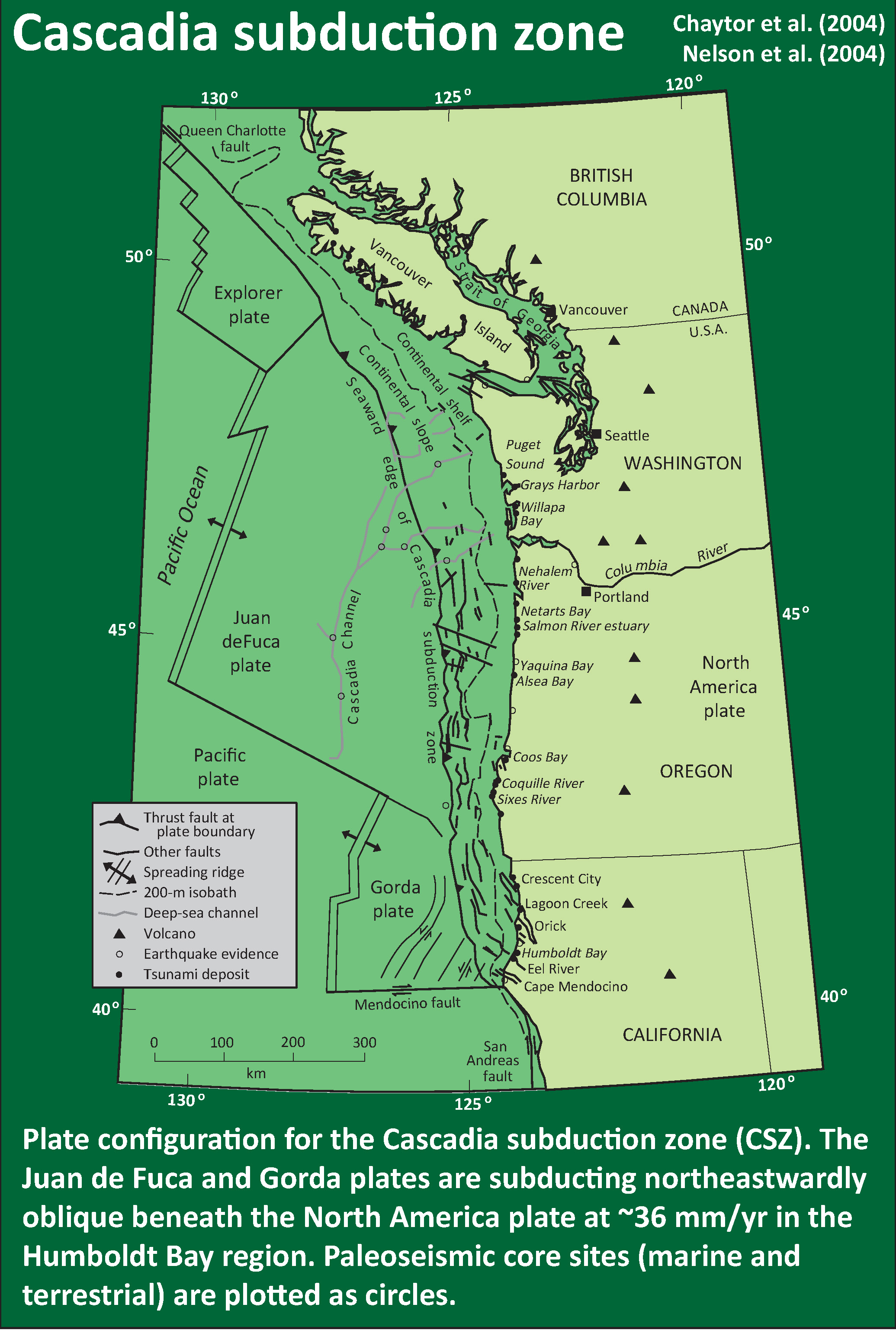
That is why the volcanos end just north of San Francisco. The last remnant of the Farallon Plate is the Juan de Fuca Plate, and the Mendocino Fracture Zone is the furthermost subduction area still occurring with another remnant known as the Gorda Plate.

Cascadia_subduction_zone.jpg


You can pretty much draw a straight line from the Gorda and JdF plates, and to the east there are active volcanos. South of there, the volcanos are all dead. Because from that point north there is still subduction, from that point south there is no more subduction and a strike-slip fault exists between the two plates.
 
Last I heard, there was still some upwelling of the land there and one body of water is slowly tipping to the side burying trees in water and killing them off.

Yes, geologists are watching Yellowstone Lake with particular interest. As it keeps "breathing", with differing areas of the lake rising and falling because of movement in the magma chamber below.

There was a great video I saw about five years ago about that change, but the problem is that I can't find it now. There are so damned many "junk science" clickbait AI crap videos now that it is becoming almost impossible to find the real ones. But it featured the geologist that discovered that some two or three decades earlier, and the changes that had been observed since the 1980s.

This has especially been true since the Biscuit Basin event last year. And most of that crap AI clickbait has included just enough actual information that it's choking out the actual scientific videos.
 
Is that what the video from the USGS says? ... the graph offered shows sinking ... the opposite of upwelling ... maybe your information is old, the video is from a month ago ...

Long Valley isn't associated with any subduction zone ... Cascadia ends at Mt Lasson far to the north ... the Sierras used to be volcanic, but that ended 30 million years ago, Long Valley started erupting just 3 million years ago ... so there's no known connection ...
The Sierra Nevada batholith was intruded into the country rock 30 million years ago, but the orogenic event that created the mountain range occurred 5 million years ago. The whole batholith has been tilting to the west since then.

The eastern fault scarp region is only about 6 to 7 miles wide, but high, then descends to the west over a distance of around 45 to 60 miles.

ALL igneous rock is "volcanic" in origin. The delineation is between "intrusive" ie, emplaced underground, where cooling takes a very long time, figure one degree of cooling per million years, and "extrusive" where you have your typical volcanic eruptions, basaltic as seen in Hawaii, andesitic as seen in subduction zones, most recognizable in Japan, the Cascades, the Phillipines, and where the type gets its name, the Andes mountains of South America, and then the final type, rhyolitic, these are the most dangerous and are responsible for the giant calderic eruptions.

No rhyolite, and you have no calderic eruptions.

Full stop.
 
The Sierra Nevada batholith was intruded into the country rock 30 million years ago, but the orogenic event that created the mountain range occurred 5 million years ago. The whole batholith has been tilting to the west since then.

The eastern fault scarp region is only about 6 to 7 miles wide, but high, then descends to the west over a distance of around 45 to 60 miles.

ALL igneous rock is "volcanic" in origin. The delineation is between "intrusive" ie, emplaced underground, where cooling takes a very long time, figure one degree of cooling per million years, and "extrusive" where you have your typical volcanic eruptions, basaltic as seen in Hawaii, andesitic as seen in subduction zones, most recognizable in Japan, the Cascades, the Phillipines, and where the type gets its name, the Andes mountains of South America, and then the final type, rhyolitic, these are the most dangerous and are responsible for the giant calderic eruptions.

No rhyolite, and you have no calderic eruptions.

Full stop.

Right now ... none of that is happening under Yellowstone ... and there doesn't seem to be any magma movement either ...

In ten generations we'll know more ...
 
Thanks, that is a useful diagram.

What can I say, geology has been a love of mine for over five decades. And now that I'm semi-retired, I have a lot of time to dedicate towards learning as much about it as I can.

Here is one of my favorite animations covering that area of the continent.


And this is really cool for all the geology it packs in. Like you can see the terranes that were on the Farallon Plate docking with and joining North America. And the rise of the Rocky Mountains and cascade range.

And at about 60 mya (1:42) they put in the plate boundaries of the Farallon Plate, so you can see it disappearing as it dives below the North American Plate. And although on this animatic the end of subduction and the forming of the San Andreas Fault in Southern California is at around 22 mya and not 30 mya, it still gives a good idea of what was going on.

So the next time you watch Jurassic Park, the "America" that Dilophosaurus was roaming around looked like it does at the start of the video, not as it looks today.
 
What can I say, geology has been a love of mine for over five decades. And now that I'm semi-retired, I have a lot of time to dedicate towards learning as much about it as I can.

Here is one of my favorite animations covering that area of the continent.

I like how it took us forward into the future as well.

For me, Earth Science (geology, chemistry, biology, etc.) in just a hobby, things I were always interested in, but never had any time to pursue professionally or formally. But I know a little. Probably by age 10 I knew the three kinds of rock, the general construction and dynamics of the earth, and knew about things like hornblende and orthoclase, and I'm still picking up tidbits of knowledge here and there.

But I'm pretty old now, retired, and I know I'll never have time to learn all that I'd like to know, but it is nice to see a legit thread for a change here instead of the usual BS and mind rot.

What is often most interesting is how details of one field eventually tie into another even if superficially unrelated.
 
Last edited:
15th post
I like how it took us forward into the future as well.

Oh, this one did not take us into the future, it played the same clip backwards. That is obvious when you see the Farallon Plate reappearing and Siletzia breaking away.

But here is one by the same creator that does show that on a global scale.


Myself, I avoid all of the political areas in here like the plague. I really only have any interest in science, history, and military. I have more interest in the fungus on my feet that I have been fighting for the last 15 years than I do in politics.

If you are interested in a fun series, Nick Zentner is a geology professor who every year gives one hour lectures on geology for free to the public. And they really are college level lectures, but given in a way that almost anybody can understand. He has 22 of them on his youtube, and they are well worth watching.


For me, the interest in geology started with my family taking vacations to places like Yellowstone as well as living in places like California and Idaho. Actually experiencing or seeing such forces and wanting to know more about them.
 
Myself, I avoid all of the political areas in here like the plague. I really only have any interest in science, history, and military.

I actually came here for the political discussion. Years ago I used to moderate and administer a science forum where I'd often make some political comment in disgust, and the group was pretty good about it because many agreed and we were all professional, but then I decided to come here to get stuff off my chest hoping to keep the politics out of my own forum discussions.

But many of the political threads here now are just getting ridiculous especially now that Trump is back in office.
 
I actually came here for the political discussion. Years ago I used to moderate and administer a science forum where I'd often make some political comment in disgust, and the group was pretty good about it because many agreed and we were all professional, but then I decided to come here to get stuff off my chest hoping to keep the politics out of my own forum discussions.

But many of the political threads here now are just getting ridiculous especially now that Trump is back in office.

And I could not care less about him. And I see Trump Derangement Syndrome II as the exact same thing as Biden Derangement Syndrome, Trump Derangement Syndrome I, Obama Derangement Syndrome, Bush Derangement Syndrome, and Clinton Derangement Syndrome.

And as somebody that served in the military under seven different Presidents, I simply shake my head in despair.

But the moment somebody starts to bring up politics in a science discussion (of either flavor), I almost immediately disregard almost anything they have to say. The same way when they drag in contemporary politics in what is supposed to be a discussion about history.

90% of the time that is just some partisan political hack venting their spleen in an area it simply does not belong.
 
And I see Trump Derangement Syndrome II as the exact same thing as Biden Derangement Syndrome, Trump Derangement Syndrome I, Obama Derangement Syndrome, Bush Derangement Syndrome, and Clinton Derangement Syndrome.

Well, to be fair, there never was any Biden/Obama/Bush/or Clinton derangement syndrome.

Those four all did stuff that deserved legitimate criticism. TDS exists because even if Trump walked on water or cured cancer tomorrow, democrats would rail against him.
 
Back
Top Bottom