Our findings, summarized in Figure 2, show the compar-
ison between NH temperature reconstruction for the past
400 years and the phenomenological solar temperature sig-
nature obtained with the smooth curves of the TSI proxy
reconstructions (shown in Figure 1) and Eqs. (4,7).
Since the 17th century minimum the sun has induced a
warming of ¢T ¼ 0:7K. This warming is of the same mag-nitude of the cooling of ¢T ¼ 0:7K from the medieval maxi-
mum to the 17th century minimum. Because anthropogenic
contributions to climate change are unlikely before 1800-
1900 AD, this ¯nding suggests the presence of a millenarian
solar cycle, with two medieval and contemporary maxima,
driving the climate of the last millennium [Eddy, 1976].
In any case, as some authors have already noted [Dou-
glass and Clader, 2002, Scafetta and West, 2005 and 2006],
solar change e®ects are greater than what can be explained
by several climate models [Steven and North, 1996; IPCC,
2001; Hansen et al., 2002; Foukal et al., 2004]. For example,
Douglass and Clader [2002] and Scafetta and West [2005]
found that the amplitude of the 11-year solar signature on
the temperature record seems to be 3 times larger than the
theoretical predictions and similar or larger factors are likely
to persist at lower frequencies as well.
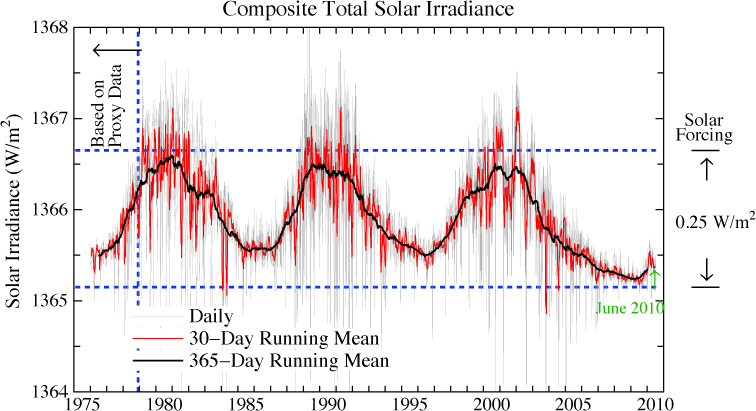
A comparison between the
curves indicates that the sun might have contributed ap-
proximately 50% of the total global surface warming since
1900 [Scafetta and West, 2006]. Since 1975 global warming
has occurred much faster than could be reasonably expected
from the sun alone.
In conclusion, a solar change might significantly alter cli-
mate. It might trigger several climate feedbacks and alter
the GHG (H2O, CO2, CH4, etc.) concentration, as 420,000
years of Antarctic ice core data would also suggest [Petit et
al., 1999]. Most of the sun-climate coupling mechanisms are
probably still unknown.




 You deniers are a hoot


