You need to read you own links FuckBoi. It says that the number of fossil fuel plants has been declining rapidly, and that construction of plants previously announced has been changed to green energy because the costs have come down so much, and fossil fuels are on the way out.
It says while 40 nations still have some fossil fuel plants, only 15 nations are still building them.
This article confirms what I said, you moron.
The smart ones are building them America and China. The green fanatics are destroying their economies. Green energy can never cost less because the the solar doesnt work at night ad the wind stops. Wind turbines onoy kast 10 years and cost to much to build
The Complete List of Solar Bankruptcies and Business Closures
June 3, 2026
The solar industry experienced
exponential growth over the last decade as costs fell and favorable policies helped drive mass adoption.
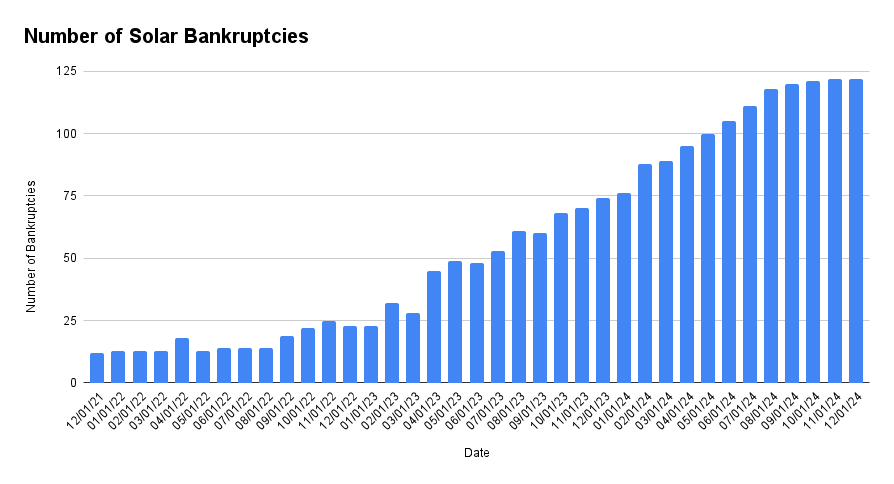
However, there have been immense challenges, with higher interest rates, tighter financing, and adverse policy shifts in key states contributing to over 100 solar bankruptcies based on our industry data, a number unseen before in our almost 20 years in the solar sector.
California was particularly hard hit due to new net metering rules under NEM 3.0 that radically reduced system economics. Adverse state and federal policy impacts exacerbated shifts in financing, triggering a plummet in demand and an 80% decrease in rooftop solar installation volume. The California Solar & Storage Association reports that the fallout includes thousands of stalled projects, over
17,000 industry layoffs, and a wave of high-profile bankruptcies.
While stronger players demonstrate some resilience, impacted homeowners and solar employees face prolonged uncertainty. The outright collapse of many once fast-growing solar firms provides a sobering case study on the potential unintended consequences of incentive transitions.
Table of Contents
Recently Closed: Major Solar Contractors That Went Out of Business
Major Solar Bankruptcies as of May 2026:
- Sunnova – Multiple States
- SunPower – Multiple States
- Pink Energy – Multiple States
- MC Solar – Modern Concepts – Florida
- Harness Power – California
- NM Solar Group – New Mexico
- ASA – American Solar Advantage – California
- Kuubix Energy – California
- Erus Energy – Arizona
- Infinity Energy – California
- Suntuity Renewables – Per Sunova – NJ, CA , TX
- ADT Solar – Multiple States
- Vision Solar – Multiple States
- Solcius – CA, NM, AZ, NV
- Sunworks, Inc. – CA
- Kayo Energy – AZ, CA, TX, FL
- iSun – CT
- Titan Solar Power – Multiple States
- Lumio Solar – Utah
- Expert Solar – Florida, Texas
- Shine Solar – LA, AK
- Posigen – Multiple States
- Pure Light Power – Multiple States
- Freedom Forever – Multiple States
California Company Closures:
- Altair Solar
- ASA – American Solar Advantage – CA
- Bratton Solar- CA
- Canapoy Energy – CA
- Charged Up Energy – CA
- Enver Solar – CA
- Harness Power – CA
- GCI Solar – CA
- Green Nrg – CA
- Kuubix Energy – CA
- Peak Power USA – CA
- Penguin Home- CA
- Polar Solar – CA
- Professional Roofing and Solar – CA
- Sigora Home Solar – CA
- Solsun USA – CA
- Solar 360
- Solar Advantage – CA
- Sullivan Solar Power – CA
- Sungrade Solar – CA
- SunPower – CA
- Sunstor Solar – CA
- RGS Energy – CA
- Solar Spectrum – CA
- Sunworks, Inc. – CA
- Swell Energy – CA
- United Solar Inc. – CA
Texas Company Closures:
Other States:
- 3D Solar – Florida
- AAA Certified Solar – Nevada
- Accept Solar – MA
- ACE Solar Systems – AZ
- Arizona Solar Concepts – AZ
- Brimma Solar – WA
- Code Green Solar – NJ
- EcoMark Solar – CO
- Elan Solar – UT
- Electriq Power – FL
- Encor Solar – UT
- Gulf South Solar – LA
- Moxie Solar – IA
- Refresh Energy Group – CO
- Saveco Solar – UT
- Solar Is Freedom – OH
- Solar Direct – FL
- Solar Titan USA – TN
- SolarDot – FL
- Solarworks – AZ
- Solular, LLC – NJ
- Utah Solar Group – UT
- Voltage Solar Power – FL
- Zenernet – AZ
Why Solar Companies Go Out Of Business
In 2023 – 2025, the solar industry saw many contractors go out of business, a trend driven by a confluence of economic and policy factors.
Higher Interest Rates
Federal Reserve’s Rate Hike: The Federal Reserve raised interest rates to combat inflation, inadvertently affecting the solar sector. Higher interest rates have made borrowing more expensive, discouraging consumers from investing in solar energy systems. This drop in consumer demand hit solar contractors hard, as their business model relies heavily on a steady flow of new installations.
Consumer Sentiment and Solar Investments: With increased borrowing costs, the allure of solar energy as a cost-saving investment diminished. Potential customers became more hesitant to undertake large expenditures, especially for systems perceived as long-term investments.
Escalating Working Capital Costs
Borrowing Challenges for Solar Companies: Solar contractors typically rely on borrowed capital to finance their operations and projects. The rise in interest rates significantly increased their cost of capital. This surge in working capital costs strained their financial resources, leading to cash flow issues and, for some, insolvency.
Impact on Small and Medium Contractors: Smaller contractors, in particular, struggled to absorb these increased costs, lacking the financial buffers of larger firms. This disparity led to a disproportionate impact on these smaller players, many of whom were forced to close their doors.
Changes in Solar Lending Practices
A shift in Milestone Payments: Solar lenders, responding to the riskier financial environment, altered their payment structures. Previously, contractors received payments at various project milestones M1, M2. M3, depending on the state of the solar installation. Generally, full payment was obtained from the lenders during M1 and M2 which was after the installation was complete. Now, lenders typically delay full payment to M3, which is PTO. The new structures delayed these payments, exacerbating cash flow challenges for contractors.
Balance Sheet Stress: These changes placed additional pressure on the balance sheets of
solar contractors. The delayed cash inflows hindered their ability to manage operational expenses and invest in new projects, leading to a vicious cycle of financial stress.
Policy Shifts and Their Consequences
Case Study: NEM 3 in California: California’s Net Energy Metering (NEM) 3 policy is a prime example of policy impact. This policy revision reduced the net metering rates paid to solar consumers, extending the payback period of solar investments.
Effect on Consumer Decisions: The reduced financial attractiveness of solar investments under NEM 3 made consumers reconsider solar installations. This policy change directly impacted contractors’ business, as California is one of the largest solar markets in the U.S.
Understanding the Impact of Solar Bankruptcies
The closure of numerous solar contractors in 2024 has sent ripples through various facets of the solar market, affecting customers, ongoing projects, and the industry.
Impact on Customers and Projects
- Homeowners with ongoing installations face uncertainty and potential delays.
- Customers with warranty or service agreements may find themselves without support.
- The reduction in active contractors could lead to less competition, potentially impacting pricing and service quality in the short term.
Solar Market Dynamics
- These closures could temporarily slow down the rate of new solar installations.
- The supply chain for solar components may experience fluctuations due to changes in demand patterns.
- Industry consolidation might occur, with larger players absorbing defunct companies’ client base and assets.
Homeowner Concerns
- Homeowners may worry about the longevity and maintenance of their solar systems.
- Questions about warranty claims and service continuation are prevalent among those whose contractors are on the closure list.
What Homeowners Can Do About Solar Bankruptcies
For homeowners affected by these closures, there are several steps to mitigate the situation:
- Warranty Claims and Service Continuations:
- Review your contract for warranty details and any clauses about service disruptions.
- Contact the manufacturer of your solar panels or system components for warranty support.
- Seek alternative local contractors who might take over service agreements.
- Utilizing SolarDetect, By Solar Insure
- Solar Detect by Solar Insure offers a system health check and an extended service agreement to maintain your system after your solar installer is gone.
- This warranty can be a safety net, providing peace of mind and ensuring system upkeep.
In addition, there are several documents that solar homeowners should keep on file in case their installer goes out of business. These include contracts, permit packets, data sheets, interconnection agreements, and other relevant documents. We published a full guide on what to do if your installer goes out of business that can be found here:
What To Do When Your Solar Company Goes Out of Business
Expert solar support for homeowners who have been abandoned by an installer and need service and long-term warranty support.
Industry Resilience and Looking Forward
Despite these challenges, the solar industry demonstrates remarkable resilience and offers significant long-term benefits.
Resilience Factors:
- Technological advancements continue to make solar energy more efficient and cost-effective.
- Growing environmental consciousness and government incentives support the industry’s growth.
- Diversification in services and business models within the industry enhances its adaptability.
While the closure of several solar contractors in 2023 poses immediate challenges, the solar industry’s underlying strength and potential remain intact. Homeowners affected by these closures have avenues for support, and the long-term outlook for solar energy remains bright and promising.
Explore Additional Articles About Solar Bankruptcies and Business Closures
 www.carbonbrief.org




 Isn't the Earth already supposed to be gone or nearly gone with her subject-matter-expert predictions?


