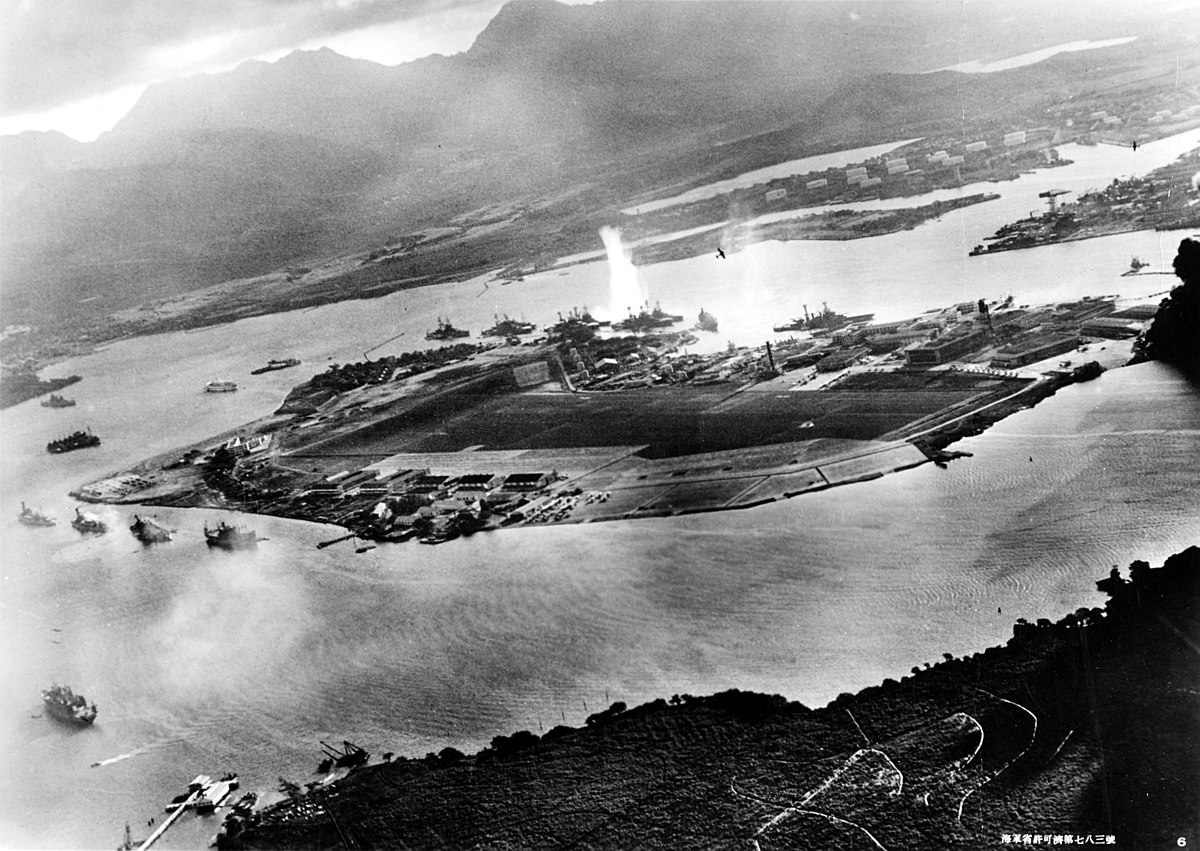
A single move that could have changed WWII

For general reference, this Wiki provides a basic overview and more information than it seems was taught in school to most Americans in the past 80+ years.
I'll excerpt parts when making key points.
 
Actually, it was not. It could have been much worse.
Exactly!
I intend to present and examine how that could have been.
A clue often over looked is that advanced and accurate warning could have been one of the avenues to attack results being worse than historical.
 
1) First item to appreciate is that the attack on Pearl Harbor was not an isolated endeavor;

In addition to Pearl Harbor, over seven hours Japan launched coordinated attacks on the U.S.-held Philippines, Guam, and Wake Island; and on the British Empire in Malaya, Singapore, and Hong Kong.
...

For context, this map of the Pacific is approxamate acurate other than slightly more territoy in China had been captured and French IndoChina was in Japanese hands;

1765251013688.webp
 
2) ...
Preliminary planning for an attack on Pearl Harbor to protect the move into the "Southern Resource Area", the Japanese term for the Dutch East Indies and Southeast Asia generally, began early in 1941 under the auspices of Admiral Isoroku Yamamoto, then commanding Japan's Combined Fleet. He won assent to formal planning and training for an attack from the Imperial Japanese Navy General Staff only after much contention with Naval Headquarters, including a threat to resign his command. Full-scale planning was underway by early spring 1941, primarily by Rear Admiral Ryūnosuke Kusaka, with assistance from Commander Minoru Genda and Yamamoto's Deputy Chief of Staff, Captain Kameto Kuroshima. The planners studied the 1940 British air attack on the Italian fleet at Taranto intensively.

Over the next several months, pilots were trained, equipment was adapted, and intelligence was collected. Despite these preparations, Emperor Hirohito did not approve the attack plan until November 5, after the third of four Imperial Conferences called to consider the matter. ... Final authorization was not given by the emperor until December 1, after a majority of Japanese leaders advised him the Hull note would "destroy the fruits of the China incident, endanger Manchukuo and undermine Japanese control of Korea".
....
However;
... The American counter-proposal of November 26 (November 27 in Japan), the Hull note, required Japan to completely evacuate China without conditions and conclude non-aggression pacts with Pacific powers. On November 26 in Japan, the day before the note's delivery, the Japanese task force left port for Pearl Harbor. ...


As we see, the attack(s) were already in motion before final authorization from the Emperor. :confused:
 
3) The US lacked any real spy network in Japan or other means to be aware of the Japanese Strike Force/Fleet sailing, or that it's destination would be Pearl Harbor. Note that this fleet, and others, were in motion for their attacks before final approval by the Emperor.

This in addition to not even knowing such an attack was actually planned and in motion, with a target date.

As it was the Fleet would require mid-ocean refueling from the tankers(oilers) accompanying in order to reach Hawaii and begin the return to Japan. Also would require another mid-ocean refueling to return.

Also note that the North Pacific in Winter can be rather rough sailing at times which would be another reason for the US not to expect an attack, especially using aircraft launched from carriers at the time it occurred.

1765252179206.webp
 
How was the evidence "doctored?" (I didn't watch the video.) From my research, the Navy was expecting an attack in the Western Pacific, but considered Pearl Harbor to be too far away to be a likely target. That does not mean that the split Army/Navy defense of the island were in any way an adequate protection plan.
We maybe did not count on the 6 Japanese aircraft carriers that brought their planes from 'too far away' to right next door.
 
Intercepting and countering the IJN (Imperial Japanese Navy) attack on Pearl Harbor, Dec.7, 1941

As shown already, the USA had little prospect of knowing there would be an actual attack at Pearl Harbor by the IJN main aircraft carrier fleet until about two weeks before such happened. Lacking an effective spy/'secret agent' network in Japan, or any other Intel system to know what was in the works, most optimistic foreknowledge to act upon in countering the attack would have been under two weeks. However that is a stretch~fantasy since there is almost no means/method the US could have had such precise, advance knowledge.

Best case scenario is that there might have been a few to several hours advance notice to prepare for responding to the attack.

However, we'll examine those varied options.

A) US knew about 2 weeks (or under) that IJN Fleet - Kido Butai - had sailed with plans to attack Pearl Harbor. [Almost no chance of this, but ...]

In real time the USN battle fleet, 8 battleships, BBs + cruisers and destroyers had been at sea practicing battle training the week prior to Dec. 7th. They had just put into harbor for the weekend to refuel, refit and give some of the crew liberty (time off in leave to town). Hence the BBs were anchored/tied-up in harbor.

This scenario will assume that they knew an attack was coming and would have gone to sea to head North to intercept the IJN's Kido Butai before it could reach striking range to Hawaii/Pearl Harbor. Also that the aircraft carriers - CVs- Enterprise and Lexington, in the process of taking Marine aircraft to Wake and Midway islands have scrubbed those missions and are now joining the BBs to head North and intercept the IJN Kido Butai.

This will require extensive search flights by the aircraft of the 2 CVs plus PBYs out of Oahu to search North and find the IJN Strike Fleet.

No guarantee that the Kido Butai would have been found, but if they were, or worse yet the IJN found the USN fleet first, then an aerial battle would likely have ensued. With the USN having only 2 CVs and IJN having 6 CVs odds would have been that most to all of the USN task force would have been damaged and/or sunk at sea, since Japan would be sending about three times as many aircraft to attack than what the USN could use. Ships sunk and crews lost would have no chance of being salvaged/saved as occurred when in harbor at Pearl, so loses and destruction would have been greater than historical and likely set the war in the Pacific back one or two years !

Bottom line is that it is fortunate that such a scenario did not offer itself to play out since the disaster would have been several times greater than what really happened.

Before going on to the next optional scenario, this bit on where the USN CVs were on Dec. 7, 1941;
...
Pearl Harbor Attack, 7 December 1941
Carrier Locations


B) On 7 December 1941, the three Pacific Fleet aircraft carriers were USS Enterprise (CV-6), USS Lexington (CV-2), and USS Saratoga(CV-3).

Enterprise: On 28 November 1941, Admiral Husband E. Kimmel sent TF-8, consisting of Enterprise, the heavy cruisers Northampton(CA-26), Chester (CA-27), and Salt Lake City (CA-24) and nine destroyers under Vice Admiral William F. Halsey, Jr., to ferry 12 Grumman F4F-3 Wildcats of Marine Fighting Squadron (VMF) 211 to Wake Island. Upon completion of the mission on 4 December, TF-8 set course to return to Pearl Harbor. Dawn on 7 December 1941 found TF-8 about 215 miles west of Oahu.

Lexington: On 5 December 1941, TF-12, formed around Lexington, under the command of Rear Admiral John H. Newton, sailed from Pearl to ferry 18 Vought SB2U-3 Vindicators of Marine Scout Bombing Squadron 231 to Midway Island. Dawn on 7 December 1941 found Lexington, heavy cruisers Chicago (CA-29), Portland (CA-33), and Astoria (CA-34), and five destroyers about 500 miles southeast of Midway. The outbreak of hostilities resulted in cancellation of the mission and VMSB-231 was retained on board [they would ultimately fly to Midway from Hickam Field on 21 December].

Saratoga: The Saratoga, having recently completed an overhaul at the Puget Sound Navy Yard, Bremerton, Washington, reached NAS San Diego [North Island] late in the forenoon watch on 7 December. She was to embark her air group, as well as Marine Fighting Squadron (VMF) 221 and a cargo of miscellaneous airplanes to ferry to Pearl Harbor.

Yorktown (CV-5), Ranger (CV-4) and Wasp (CV-7), along with the aircraft escort vessel Long Island (AVG-1), were in the Atlantic Fleet; Hornet (CV-8), commissioned in late October 1941, had yet to carry out her shakedown. Yorktown would be the first Atlantic Fleet carrier to be transferred to the Pacific, sailing on 16 December 1941.
...

Of the seven Fleet size CVs in the USN inventory, only two were really available to the Pacific, and likely any from the Atlantic to transfer would still be en route before Dec. 7.

Note also that the IJN had more than the six CVs of the Kido Butai in their inventory.
 
Last edited:
We maybe did not count on the 6 Japanese aircraft carriers that brought their planes from 'too far away' to right next door.
Such was on the outer edge of probabilities considered at the time.

Eventually the US/USN would realize there was a flip side and we could do the same to Japan and their bases/holdings. There was a significant learning curve happening during the first couple years of war in the Pacific where both sides were discovering the potentials and capabilities actually offered by Naval Aviation from Aircraft Carriers.

In addition to "just scouting for the fleet", actual heavy striking power was showing to be a real potential. While Taranto and Pearl Harbor showed vulnerabilities in port, those also portent such at sea, as shown when RN Repulse and Prince of Wales were sunk.

Quickly air power become a major concern and threat to Sea Power, and Navies around the world were going to have to adjust.
 
An alternative, and more probable scenario is that there may have been a few to several hours of advance notice of the attack coming.

On an early Sunday morning it's any guess how much that might have mattered.

First would go out the call ashore for crew members on leave/liberty to return to ship. Mixed results there most likely.

More significantly would be to 'relight' boilers to build up steam to get power to run ship's functions and be able to get the shafts going for momentum. This would depend much on how shut-down, reduced for the weekend and would it take a few to several hours to build up steam.

Then the question would be if they could be moved out of the narrow channel to the harbor before being hit and damaged/sunk to block same, along with what to do once out. Alternative would be to putter about the confines of the harbor which would only slightly reduce chances of being hit while increase those of blocking more of the passages should they be hit and sunk/beached.

Added to this is that this early on in the war, anti-aircraft weapons were rather minimumal in number and effectiveness, so ship defense would be a bit limited. Odds were that the Japanese attacks would be only slightly reduced in effectiveness ~ damage.

We are left where what happened historically may have been the best possible results to have hoped for.
 
Back
Top Bottom