5 Common Myths about "The Settlements".

Land ownership facts not propaganda:

UNITED
NATIONS
A

0.3CBA


  • General Assembly
ecblank.gif

ecblank.gif
ecblank.gif
A/364
3 September 1947
OFFICIAL RECORDS OF THE SECOND SESSION OF
THE GENERAL ASSEMBLY


SUPPLEMENT No. 11


UNITED NATIONS
SPECIAL COMMITTEE
ON PALESTINE


REPORT TO THE GENERAL ASSEMBLY

VOLUME 1


Lake Success
New York
1947


164. The Arab population, despite the strenuous efforts of Jews to acquire land in Palestine, at present remains in possession of approximately 85 per cent of the land. The provisions of the land transfer regulations of 1940, which gave effect to the 1939 White Paper policy, have severely restricted the Jewish efforts to acquire new land.

A/364 of 3 September 1947

This official document speaks of the Arab population. Recently, Tinmore claimed that the Palestinians aren't Arab.

The Palestinians are not Arabians, but like any of the people that adopted the Arabic language and culture they are considered Arabs, e.g. a black from Sudan that speaks Arabic and has adopted the Arabian culture considers him/herself an Arab, but they certainly are not Arabians. Much like the people of the Maghreb call themselves Arabs and speak Arabic, but are actually mostly Berbers ethnically. Ethnically, the Palestinians are the native people of the area whose ancestors were almost all converts to Christianity, after Christianity became the state religion of Rome in 380 AD.

Prior to that the ancestors of the Palestinians practiced Judaism, Samaritanism, Roman religions, Zoroastrianism, i.e. the religions permitted by Roman law and the outlawed Christian religion as practiced by the Jewish converts.
 
P F Tinmore, montelatici, et al,

You explain this so badly, that it is almost impossible to repair.

The League of Nations, similar to the UN, was established after WWI to promote peace. It was replaced by the UN in1945.
In the context of the subject we are speaking of?
Article 22 of the League of Nations Covenant applies to the new states separated from the Turkish Empire after WWI. Article 20 is also applicable.

Avalon Project - The Covenant of the League of Nations
League of Nations Trumped the Hague. And, the USA was not a member of the League so it is irrelevant. Not to mention it does not exist today, so again irrelevant.

Seems the jewish settlements can not be contested by international law or by organizations that no longer exist.
The law exists separate from any organization like the LoN or the UN. These organizations merely adopted existing international law.
(COMMENT)

Yes, the structural organizations are just a framework from which to hang binding agreement; and the sense of trust and confidence expressed by the International Community.

Article 22 is not a binding agreement with the Arabs of Palestine. It is a historical agreement that dissolved with the demise of the League; applying to the action of League members. The intent of the League was to establish a Jewish National Home; not withstanding any interpretation made by non-members.

The Allied Powers did explain the intent of Article 22; what it meant and how they planned to implement it. That was the Mandate for Palestine.

However, the Arab Palestinians (West Bank) in April 1950, DID exercise self-determination and approve the Annexation by Jordan.

"Israel’s Settlements Have No Legal Validity,................. Constitute Flagrant Violation of International Law"
UNSC Resolution 2334
(COMMENT)

The UN Security Council 2334 is not Law. Whether of not Israel has broken some law is a matter to be adjudicated.

Tell me again. What "International Law" was applicable in 1967 that Israel violated?

For seven consecutive decades the Arabs of Palestine have demonstrated a continuous propensity for hostilities and violence. It may take just as long to establish a reasonable measure of peaceful actions before the security containment feature put in place since 2002 are dismantled. But, to date, the Arabs of Palestine have not given any clear sign that they want to engage in discussions that will lead to a peaceful solution.

Most Respectfully,
R
 
But, to date, the Arabs of Palestine have not given any clear sign that they want to engage in discussions
The only discussions there have ever been is for the Palestinians to negotiate away their rights. It is the wrong framework. That is why these fake peace talks always fail and always will.
 
P F Tinmore, et al.

I think it is not this matter of "rights." It is a good excuse, and a damn hard concept to understand, let along argue over. No this is your "Red Herring."

But, to date, the Arabs of Palestine have not given any clear sign that they want to engage in discussions
The only discussions there have ever been is for the Palestinians to negotiate away their rights. It is the wrong framework. That is why these fake peace talks always fail and always will.
(COMMENT)

First, the talks fail because the Arab Palestinians think they are entitled to something; and extend demands that just cannot possibly be met.

I think it is absolutely unreasonable for the Arabs of Palestine, having been the proximate case for three conflicts and two Intifata, should come to the Peace Table (a defeated people) thinking that they are going to walk away free and clear, that they are not going to be require to make concessions, war reparations, restitution for 70 years of terrorism activities, redress, compensation and recompense for their part in the provoking multiple conflicts.

It is a wonder that the Palestinian Leaders (Gaza and West Bank --- terrorist and civil) are not presented with a Unconditional Surrender and a Treaty of Versailles style agreement which brings the Arab-Israeli to a conclusion.

Most Respectfully,
R
 
The League of Nations, similar to the UN, was established after WWI to promote peace. It was replaced by the UN in1945.
In the context of the subject we are speaking of?
Article 22 of the League of Nations Covenant applies to the new states separated from the Turkish Empire after WWI. Article 20 is also applicable.

Avalon Project - The Covenant of the League of Nations
League of Nations Trumped the Hague. And, the USA was not a member of the League so it is irrelevant. Not to mention it does not exist today, so again irrelevant.

Seems the jewish settlements can not be contested by international law or by organizations that no longer exist.
The law exists separate from any organization like the LoN or the UN. These organizations merely adopted existing international law.
Good, the law sides with the Jews, thanks for clarifying.
 
I used to be “anti-settlement” until I visited one by accident. Since then, I’ve learned a lot about how the settlement issue is misunderstood and often twisted.


Myth 1: They’re on stolen Palestinian land
Most of the land that the Jewish communities in Judea and Samaria were built on was Jewish-owned. In 1948, thousands of Jews who lived over the Green Line on land they had bought were forcibly removed from their homes when the Land became an Arab state – Jordan. Between 1948 and 1967, the Jordanians were desperate to fill that land with Arabs so that if the Jews got it back, they wouldn’t be able to live there because of all the land that was literally “given away” to Arabs. However, the “settlements” that are legal under Israeli law were not built on such land, even though it was literally handed out by Jordan to prevent future Jewish settlement. Amona is an example of a town that was evacuated by the Israeli government when it was determined that the land belonged to an Arab (who was an absentee land owner who didn’t care about it until leftist NGOs told him he should). It was an “illegal settlement” because part of it was on Arab-owned land. The current legal settlements under Israeli law are all built on Jewish-owned land, or within Area C as designated by Oslo.

5 Common Myths About “The Settlements”
I toured Gaza and the West Bank a few years ago and just about everything stated in this racist, right-wing, anti-Palestinian article is false.
 
P F Tinmore, montelatici, et al,

You explain this so badly, that it is almost impossible to repair.

The League of Nations, similar to the UN, was established after WWI to promote peace. It was replaced by the UN in1945.
In the context of the subject we are speaking of?
Article 22 of the League of Nations Covenant applies to the new states separated from the Turkish Empire after WWI. Article 20 is also applicable.

Avalon Project - The Covenant of the League of Nations
League of Nations Trumped the Hague. And, the USA was not a member of the League so it is irrelevant. Not to mention it does not exist today, so again irrelevant.

Seems the jewish settlements can not be contested by international law or by organizations that no longer exist.
The law exists separate from any organization like the LoN or the UN. These organizations merely adopted existing international law.
(COMMENT)

Yes, the structural organizations are just a framework from which to hang binding agreement; and the sense of trust and confidence expressed by the International Community.

Article 22 is not a binding agreement with the Arabs of Palestine. It is a historical agreement that dissolved with the demise of the League; applying to the action of League members. The intent of the League was to establish a Jewish National Home; not withstanding any interpretation made by non-members.

The Allied Powers did explain the intent of Article 22; what it meant and how they planned to implement it. That was the Mandate for Palestine.

However, the Arab Palestinians (West Bank) in April 1950, DID exercise self-determination and approve the Annexation by Jordan.

"Israel’s Settlements Have No Legal Validity,................. Constitute Flagrant Violation of International Law"
UNSC Resolution 2334
(COMMENT)

The UN Security Council 2334 is not Law. Whether of not Israel has broken some law is a matter to be adjudicated.

Tell me again. What "International Law" was applicable in 1967 that Israel violated?

For seven consecutive decades the Arabs of Palestine have demonstrated a continuous propensity for hostilities and violence. It may take just as long to establish a reasonable measure of peaceful actions before the security containment feature put in place since 2002 are dismantled. But, to date, the Arabs of Palestine have not given any clear sign that they want to engage in discussions that will lead to a peaceful solution.

Most Respectfully,
R

1. Article 22 is binding on the signers. The Mandates were a product of the Covenant of the League of Nations. The Covenant states:


"To those colonies and territories which as a consequence of the late war have ceased to be under the sovereignty of the States which formerly governed them and which are inhabited by peoples not yet able to stand by themselves under the strenuous conditions of the modern world, there should be applied the principle that the well-being and development of such peoples form a sacred trust of civilisation and that securities for the performance of this trust should be embodied in this Covenant.

The best method of giving practical effect to this principle is that the tutelage of such peoples should be entrusted to advanced nations who by reason of their resources, their experience or their geographical position can best undertake this responsibility, and who are willing to accept it, and that this tutelage should be exercised by them as Mandatories on behalf of the League."

The people inhabiting Palestine were overwhelmingly Muslims or Christians, Article 22 applied to them.

2. Israel started the 1967 war:

"Helms was awakened at 3:00 in the morning on 5 June by a call from the CIA Operations Center. The Foreign Broadcast Information Service had picked up reports that Israel had launched its attack. (OCI soon concluded that the Israelis— contrary to their claims—had fired first.) "

The CIA assessed that Nasser’s military presence in the Sinai was defensive, stating that “Armored striking forces could breach the UAR’s double defense line in the Sinai in three to four days and drive the Egyptians west of the Suez Canal in seven to nine days. Israel could contain any attacks by Syria or Jordan during this period”

CIA Analysis of the 1967 Arab-Israeli War — Central Intelligence Agency

Note: Chapter 7 of the UN Charter prohibits armed attacks.
 
I used to be “anti-settlement” until I visited one by accident. Since then, I’ve learned a lot about how the settlement issue is misunderstood and often twisted.


Myth 1: They’re on stolen Palestinian land
Most of the land that the Jewish communities in Judea and Samaria were built on was Jewish-owned. In 1948, thousands of Jews who lived over the Green Line on land they had bought were forcibly removed from their homes when the Land became an Arab state – Jordan. Between 1948 and 1967, the Jordanians were desperate to fill that land with Arabs so that if the Jews got it back, they wouldn’t be able to live there because of all the land that was literally “given away” to Arabs. However, the “settlements” that are legal under Israeli law were not built on such land, even though it was literally handed out by Jordan to prevent future Jewish settlement. Amona is an example of a town that was evacuated by the Israeli government when it was determined that the land belonged to an Arab (who was an absentee land owner who didn’t care about it until leftist NGOs told him he should). It was an “illegal settlement” because part of it was on Arab-owned land. The current legal settlements under Israeli law are all built on Jewish-owned land, or within Area C as designated by Oslo.

5 Common Myths About “The Settlements”
I toured Gaza and the West Bank a few years ago and just about everything stated in this racist, right-wing, anti-Palestinian article is false.

Can you elaborate? I like to hear of first-hand experiences. Most of the posters here have never set foot over there.
 
I used to be “anti-settlement” until I visited one by accident. Since then, I’ve learned a lot about how the settlement issue is misunderstood and often twisted.


Myth 1: They’re on stolen Palestinian land
Most of the land that the Jewish communities in Judea and Samaria were built on was Jewish-owned. In 1948, thousands of Jews who lived over the Green Line on land they had bought were forcibly removed from their homes when the Land became an Arab state – Jordan. Between 1948 and 1967, the Jordanians were desperate to fill that land with Arabs so that if the Jews got it back, they wouldn’t be able to live there because of all the land that was literally “given away” to Arabs. However, the “settlements” that are legal under Israeli law were not built on such land, even though it was literally handed out by Jordan to prevent future Jewish settlement. Amona is an example of a town that was evacuated by the Israeli government when it was determined that the land belonged to an Arab (who was an absentee land owner who didn’t care about it until leftist NGOs told him he should). It was an “illegal settlement” because part of it was on Arab-owned land. The current legal settlements under Israeli law are all built on Jewish-owned land, or within Area C as designated by Oslo.

5 Common Myths About “The Settlements”
I toured Gaza and the West Bank a few years ago and just about everything stated in this racist, right-wing, anti-Palestinian article is false.

Can you elaborate? I like to hear of first-hand experiences. Most of the posters here have never set foot over there.
No problem. It was miserable over there because the Palestinians are outraged over the settlements and the land that was stolen from them. They're pissed off and for good reason. I guess the best way to describe my trip (Which is a lie because I didn't really go there) is if you just read the article that OP posted and picture the opposite of that.
 
I used to be “anti-settlement” until I visited one by accident. Since then, I’ve learned a lot about how the settlement issue is misunderstood and often twisted.


Myth 1: They’re on stolen Palestinian land
Most of the land that the Jewish communities in Judea and Samaria were built on was Jewish-owned. In 1948, thousands of Jews who lived over the Green Line on land they had bought were forcibly removed from their homes when the Land became an Arab state – Jordan. Between 1948 and 1967, the Jordanians were desperate to fill that land with Arabs so that if the Jews got it back, they wouldn’t be able to live there because of all the land that was literally “given away” to Arabs. However, the “settlements” that are legal under Israeli law were not built on such land, even though it was literally handed out by Jordan to prevent future Jewish settlement. Amona is an example of a town that was evacuated by the Israeli government when it was determined that the land belonged to an Arab (who was an absentee land owner who didn’t care about it until leftist NGOs told him he should). It was an “illegal settlement” because part of it was on Arab-owned land. The current legal settlements under Israeli law are all built on Jewish-owned land, or within Area C as designated by Oslo.

5 Common Myths About “The Settlements”
Israeli-Jewish settlements are in occupied Palestine and therefore illegal under international law.

speaking of "illegal" ...ewwwww, "illegal" "terrorist" governments...... ...how 'bout them ?


A world joke....​


Government "terrorists."


.....should be "ILLEGAL."
 
I used to be “anti-settlement” until I visited one by accident. Since then, I’ve learned a lot about how the settlement issue is misunderstood and often twisted.


Myth 1: They’re on stolen Palestinian land
Most of the land that the Jewish communities in Judea and Samaria were built on was Jewish-owned. In 1948, thousands of Jews who lived over the Green Line on land they had bought were forcibly removed from their homes when the Land became an Arab state – Jordan. Between 1948 and 1967, the Jordanians were desperate to fill that land with Arabs so that if the Jews got it back, they wouldn’t be able to live there because of all the land that was literally “given away” to Arabs. However, the “settlements” that are legal under Israeli law were not built on such land, even though it was literally handed out by Jordan to prevent future Jewish settlement. Amona is an example of a town that was evacuated by the Israeli government when it was determined that the land belonged to an Arab (who was an absentee land owner who didn’t care about it until leftist NGOs told him he should). It was an “illegal settlement” because part of it was on Arab-owned land. The current legal settlements under Israeli law are all built on Jewish-owned land, or within Area C as designated by Oslo.

5 Common Myths About “The Settlements”
I toured Gaza and the West Bank a few years ago and just about everything stated in this racist, right-wing, anti-Palestinian article is false.

Can you elaborate? I like to hear of first-hand experiences. Most of the posters here have never set foot over there.

I've been all over the West Bank, before Arafat invaded and caused all the trouble.
 
montelatici, et al,

You are trying to cherry pick and align the facts that best suits your argument.

1. Article 22 is binding on the signers. The Mandates were a product of the Covenant of the League of Nations. The Covenant states:

"To those colonies and territories which as a consequence of the late war have ceased to be under the sovereignty of the States which formerly governed them and which are inhabited by peoples not yet able to stand by themselves under the strenuous conditions of the modern world, there should be applied the principle that the well-being and development of such peoples form a sacred trust of civilisation and that securities for the performance of this trust should be embodied in this Covenant.

The best method of giving practical effect to this principle is that the tutelage of such peoples should be entrusted to advanced nations who by reason of their resources, their experience or their geographical position can best undertake this responsibility, and who are willing to accept it, and that this tutelage should be exercised by them as Mandatories on behalf of the League."

The people inhabiting Palestine were overwhelmingly Muslims or Christians, Article 22 applied to them.

2. Israel started the 1967 war:

"Helms was awakened at 3:00 in the morning on 5 June by a call from the CIA Operations Center. The Foreign Broadcast Information Service had picked up reports that Israel had launched its attack. (OCI soon concluded that the Israelis— contrary to their claims—had fired first.) "

The CIA assessed that Nasser’s military presence in the Sinai was defensive, stating that “Armored striking forces could breach the UAR’s double defense line in the Sinai in three to four days and drive the Egyptians west of the Suez Canal in seven to nine days. Israel could contain any attacks by Syria or Jordan during this period”

CIA Analysis of the 1967 Arab-Israeli War — Central Intelligence Agency

Note: Chapter 7 of the UN Charter prohibits armed attacks.
(COMMENT)

• Article 22 does not specifically mention "ALL INHABITED PEOPLE."
• The Arab Palestinians have never demonstrated their ability to "stand alone."
• The Arab Palestinians encouraged annexation over the West Bank, and the Military Governorship in Gaza.
• Conflict ignition: After 1945, there are two exception on the matter of "use of force" ---

§ The matter of threat Chapter I, Article 2(4): The threat to use of force against the territorial integrity or political independence of Israel. The Arab Palestinian threats against Israel are a matter of record. This was supported by the offensive actions: (i) Demanded the UN Emergency Force withdraw, (ii) Egyptian 3d Army rushes through the UNEF lines with 800,000 troops, 1000 tanks and 900 Artillery Pieces. The UNEF I was established to secure and supervise the cessation of hostilities, including to serve as a buffer between the Egyptian and Israeli forces.
§ The authorized self-defense under Chapter VII, Article 51, the inherent right of individual or collective self-defence --- taken measures necessary to maintain international peace and security.

The CIA Analysis of the 1967 Arab-Israeli War was an after the fact view, with the CIA as center stage.
The Reconstructing A Shattered Egyptian Army: War Minister Gen. Mohamed Fawzi’s Memoirs, 1967–1971 puts the Egyptian Army on center stage.

There is more to the way in which the view was seen. In any event, several echelons of intelligence collectors understood that a was was eminent. Egypt, Syria and Jordan were all pushing the right buttons to ignite the conflict.

The Arab-Israeli Six-Day War, June 1967

There were many indications of the coming of this conflict. From 22 May, when Nasser closed the Gulf of Aqaba to Israeli shipping, tensions had been mounting, and the possibility of war was universally recognized. Both sides had mobilized and taken numerous other military preparedness measures. Before 1 June US intelligence was on record that Israel was capable of and ready to launch a preemptive and successful attack with little or no warning, and that there was no indication that the UAR was planning to take the military initiative. The US predictions of the likelihood and probable success of an Israeli assault were highly accurate, although the precise timing and tactics of the operation, of course, were not known to US .

The Israelis nonetheless achieved almost total tactical surprise against the Arabs in their attacks on the morning of 5 June, particularly in the decisively effective air strikes. The Israelis screened their plans by a combination of rigid security (there was no leak of their decisions or final military preparations) and an exceptionally well-planned and effective deception campaign. There were several facets of the deception plan, one of which was to lead Egypt to believe that the attack, if it occurred, would be in the southern Sinai rather than the north. In addition, numerous measures were taken in the several days prior to the attack to create the impression that attack was not imminent. These included public statements by newly appointed Defense Minister Moshe Dayan that Israel would rely on diplomacy for the present, the issuance of leave to several thousand Israeli soldiers over the weekend of 3-4 June, public announcements that concurrent Israeli cabinet meetings were concerned only with routine matters, and so forth. In addition, the attack was planned for an hour of the morning when most Egyptian officials would be on their way to work and when the chief of the Egyptian Air Force usually took his daily morning flights.


Most Respectfully,
R
 
15th post
Many of those Jews You single out (as opposed to Palestinian and EU illegal settlements)...have been living there before the Zionist immigration started.

What You call "illegal" and "law" are basically subjects of Your opinion.

I't the continuation of the al-Husseini agenda- who officially demanded land bought by Jews returned to Arabs for the sole reason of them being Jews. The same reason one can demand a Juderein Palestine while demanding Israel to give Palestinians in Gaza and Rammallah the same rights as Israeli Arab and Jewish citizens have.
I thought you would know I was referring to the Israeli-Jewish settlements established on the best land of the West Bank, including East Jerusalem since 1967.

"best lands" - any facts yet?

When You decide to address ANY of my points, rather than push some slogans- I'd gladly read those :)
After the 1967 War, Jordan became responsible for the West Bank and Egypt for Gaza.
In 1993, Israeli Prime Minister Yitzhak Rabin and Palestine Liberation Organization (PLO) Negotiator Mahmoud Abbas signed a Declaration of Principles on Interim Self-Government Arrangements (Oslo Accord). Israel accepted the PLO as the representative of the Palestinians, and the PLO renounced terrorism and recognized Israel’s right to exist in peace.

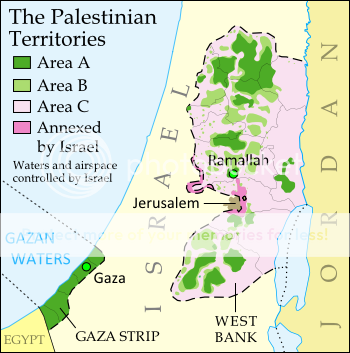
The Israeli-Jordanian peace treaty of 1994 was signed. The Cairo Agreement of 1994 finalized Israel’s withdrawal from most of Gaza and Jericho and then came the Taba (Oslo II) Agreement in 1995. The latter agreement divided the West Bank into separate areas under Israeli control, Palestinian control, and Israeli military responsibility with Palestinian civil administration, respectively.

palestine_oslo_areas%201_zpsar7cbp4b.png

Area A (Palestinian Control) 18%
Area B (Palestine civil administration/Israeli military responsibility) 22%
Area C
(Israeli military control) 60%

You took exception to my claim that the settlers were taking the best land. By best I am, of course, referring to agriculture water, and minerals. The settlements are all in Area C or land which has been annexed by Israel. This current arrangement makes it impossible for the Palestinians in the West Bank, including East Jerusalem to develop an economy. The majority of the West Bank's agricultural land is in Area C as well as the water and mineral resources. Palestinians are severely restricted from accessing these resources The settlements continue to grow in Area C, giving the settlers the best land.

"Every time a settlement is built, Palestinians say, a little more is taken away from a future Palestinian state. The possibility of peace seems to grow less and less likely, and Palestinians accuse Israel of confiscating lands and taking away resources from the areas that Palestinians want for their statehood."
Israeli settlements controversy explained, and why it matters

No where in Your answer was an explanation about "best lands" You claim being stolen from Palestinians.

-How is that different from Haj Amin al-Husseini's motive behind the demand to evict Jews from lands they lawfully bought or owned even before the 1st Zionist immigration?

stein_land.jpg


"The control of land remains the crucial issue in the Arab-Israel conflict. Kenneth Stein investigates in detail and without polemics how and why Jews acquired land from Arabs in Palestine during the British Mandate, and he reaches conclusions that are challenging and surprising.

Stein contends that Zionists were able to purchase the core of a national territory in Palestine during this period for three reasons: they had the single-mindedness of purpose, as well as the capital, to buy the land; the Arabs, economically impoverished, politically fragmented, and socially atomized, were willing to sell the land; and the British were largely ineffective in regulating land sales and protecting Arab tenants.

Neither Arab opposition to land sales nor British attempts to regulate them actually limited land acquisition. There were always more Arab offers to sell land than there were Zionist funds. In fact, many sales were made by Arab politicians who publicly opposed Zionism and even led agitation against land acquisition by Jews. Zionists furthered their own ambitions by skillfully using their understanding of the bureaucracy to write laws and to influence key administrative appointments. Further, they knew how to take advantage of social and economic cleavages within Arab society..."


Yes there is an explanation and proof that the settlers in Area C (80% of the West Bank) with the best agricultural land, water and mineral resources. Perhaps you missed that.
But you know something? You are not a dope but I have to admit that I am quite tired of providing all sorts of documentary evidence for what I post only to have you dismiss it all.
I will let you have the last word.
Bye bye.

Sorry You've got insulted.
Maybe we're just acting from completely opposite presumptions:

I understand the concept and the word "proof" as something factual You have to present in regards to Your claim.
On the other hand it seems You're convinced that copying Your claim once again establishes a fact.

Until then I'm waiting to see You address any of my original points, You so carefully try to neglect.

Basically the fact that thousands of Jews lived in that territory, and have been massacared, expelled from numerous times before Zionism came to be. It takes a lot of hypocrisy to demand a Judenrein Palestine. Especially in Judea Samaria.

Do You know how the arabs call the area near Jerusalem? 'Sahara Yahudan' :)
 
Last edited:
montelatici, et al,

You are trying to cherry pick and align the facts that best suits your argument.

1. Article 22 is binding on the signers. The Mandates were a product of the Covenant of the League of Nations. The Covenant states:

"To those colonies and territories which as a consequence of the late war have ceased to be under the sovereignty of the States which formerly governed them and which are inhabited by peoples not yet able to stand by themselves under the strenuous conditions of the modern world, there should be applied the principle that the well-being and development of such peoples form a sacred trust of civilisation and that securities for the performance of this trust should be embodied in this Covenant.

The best method of giving practical effect to this principle is that the tutelage of such peoples should be entrusted to advanced nations who by reason of their resources, their experience or their geographical position can best undertake this responsibility, and who are willing to accept it, and that this tutelage should be exercised by them as Mandatories on behalf of the League."

The people inhabiting Palestine were overwhelmingly Muslims or Christians, Article 22 applied to them.

2. Israel started the 1967 war:

"Helms was awakened at 3:00 in the morning on 5 June by a call from the CIA Operations Center. The Foreign Broadcast Information Service had picked up reports that Israel had launched its attack. (OCI soon concluded that the Israelis— contrary to their claims—had fired first.) "

The CIA assessed that Nasser’s military presence in the Sinai was defensive, stating that “Armored striking forces could breach the UAR’s double defense line in the Sinai in three to four days and drive the Egyptians west of the Suez Canal in seven to nine days. Israel could contain any attacks by Syria or Jordan during this period”

CIA Analysis of the 1967 Arab-Israeli War — Central Intelligence Agency

Note: Chapter 7 of the UN Charter prohibits armed attacks.
(COMMENT)

• Article 22 does not specifically mention "ALL INHABITED PEOPLE."
• The Arab Palestinians have never demonstrated their ability to "stand alone."
• The Arab Palestinians encouraged annexation over the West Bank, and the Military Governorship in Gaza.
• Conflict ignition: After 1945, there are two exception on the matter of "use of force" ---

§ The matter of threat Chapter I, Article 2(4): The threat to use of force against the territorial integrity or political independence of Israel. The Arab Palestinian threats against Israel are a matter of record. This was supported by the offensive actions: (i) Demanded the UN Emergency Force withdraw, (ii) Egyptian 3d Army rushes through the UNEF lines with 800,000 troops, 1000 tanks and 900 Artillery Pieces. The UNEF I was established to secure and supervise the cessation of hostilities, including to serve as a buffer between the Egyptian and Israeli forces.
§ The authorized self-defense under Chapter VII, Article 51, the inherent right of individual or collective self-defence --- taken measures necessary to maintain international peace and security.

The CIA Analysis of the 1967 Arab-Israeli War was an after the fact view, with the CIA as center stage.
The Reconstructing A Shattered Egyptian Army: War Minister Gen. Mohamed Fawzi’s Memoirs, 1967–1971 puts the Egyptian Army on center stage.
There is more to the way in which the view was seen. In any event, several echelons of intelligence collectors understood that a was was eminent. Egypt, Syria and Jordan were all pushing the right buttons to ignite the conflict.

The Arab-Israeli Six-Day War, June 1967

There were many indications of the coming of this conflict. From 22 May, when Nasser closed the Gulf of Aqaba to Israeli shipping, tensions had been mounting, and the possibility of war was universally recognized. Both sides had mobilized and taken numerous other military preparedness measures. Before 1 June US intelligence was on record that Israel was capable of and ready to launch a preemptive and successful attack with little or no warning, and that there was no indication that the UAR was planning to take the military initiative. The US predictions of the likelihood and probable success of an Israeli assault were highly accurate, although the precise timing and tactics of the operation, of course, were not known to US .

The Israelis nonetheless achieved almost total tactical surprise against the Arabs in their attacks on the morning of 5 June, particularly in the decisively effective air strikes. The Israelis screened their plans by a combination of rigid security (there was no leak of their decisions or final military preparations) and an exceptionally well-planned and effective deception campaign. There were several facets of the deception plan, one of which was to lead Egypt to believe that the attack, if it occurred, would be in the southern Sinai rather than the north. In addition, numerous measures were taken in the several days prior to the attack to create the impression that attack was not imminent. These included public statements by newly appointed Defense Minister Moshe Dayan that Israel would rely on diplomacy for the present, the issuance of leave to several thousand Israeli soldiers over the weekend of 3-4 June, public announcements that concurrent Israeli cabinet meetings were concerned only with routine matters, and so forth. In addition, the attack was planned for an hour of the morning when most Egyptian officials would be on their way to work and when the chief of the Egyptian Air Force usually took his daily morning flights.


Most Respectfully,
R

You are hilarious.

"• Article 22 does not specifically mention "ALL INHABITED PEOPLE."

So, Article 22 excluded all non-Jews as being inhabitants of Palestine. Grow up, you have the mind of a teenager, a stupid one at that. Go debate stupid teenagers.
 
"Israel’s Settlements Have No Legal Validity,................. Constitute Flagrant Violation of International Law"

UNSC Resolution 2334
The United Nations is an obsolete political body which will not stand the test of time. We can ignore the UN

That's what Apartheid South Africa thought. LOL
No, that is not what South Africa thought. You do not know history.

That's exactly what the white-rulership believed and acted on, this is just one example of the Union of South Africa ignoring the U.N.. This lasted 30 or more years, but eventually the UN, forced the end of Apartheid. The link provides a history of how the slowly turned the screw on white ruled South Africa.

1956
27 November, South Africa's Minister for External Affairs, Eric Louw, announced during the general debate in the General Assembly of the United Nations that in the face of the continued interference by the General Assembly of the United Nations in South Africa's domestic affairs in violation of Article 2, paragraph 7 of the Charter, the Union of South Africa, while as yet continuing to be a Member of the United Nations, would in future maintain only token representations at the meetings of the General Assembly of the UN and at the Headquarters of the Organisation.

United Nations and Apartheid Timeline 1946-1994 | South African History Online
 
Back
Top Bottom