1. You grasp the fundamental problem. Government is spending money with little to no return. It's investing our tax dollars in deadbeats, union bailouts, corporate bail outs, unemployment benefits and other low value but very visible projects. We need a 4 to 1 spending cut for every dollar of taxes raised, IF we allow taxes TO be raised.
2. No, tax increases have never... EVER increased economic activity. The depression of 1920, yes, the Wilson caused depression was solved not with increasing taxes, but by cutting all government spending by 50% and then letting the market do it's job. The result? One of the biggest economic booms in history, till bad ethics and business models caused it to go bust again. Classic free market system in action. But thanks to Keynsian economic theory and socialist programs based on 'we gotta do SOMETHING', that stretched out the crash into the Great Depression, because the market wasn't allowed to function normally.
But, in the world of taxation, the economy IS a zero sum game, while the economy is not. For every dollar you take out of private hands, is money that cannot go towards paying wages or investing, or upgrading a business. The government then spends it on a project that may or may not have any reciprocal economic value, because they aren't held to the same 'profit or die' standard as the rest of the free market. That is why money in government hand is more wasteful AND harms the private sector. So, if you strip money out of the private sector, there can be no growth, or rather the growth if it occurs will be of lesser size and quality than if the private sector did it.
3. If we increase revenues, somehow, to the federal government, what are they going to do with it? since they've been living essentially consequence free for the last 50 years on this ever increasing taxation attitude congress seems to have marinated in, they'll keep doing the same damn things. What's that? Spend it on NEW social programs and votes, like they always do. This process will continue and grow until it has no choice BUT to collapse. That result will happen no matter what we do. It's only a question of how big it will be. And right now, it's astronomically big and bad.
So, although I can see why you'd think you'd want increased taxes, are you the one willing to pay them? You willing to pony up double, triple the dough when you have no idea how it's being spent or a very good idea it's being spent poorly or on things you are against?
Just things to consider while you tout higher taxes for irresponsible governance.
2. I don’t claim that additional taxes will increase economic activity. I believe tax rates have little effect. The belief that cutting taxes will stimulate the economy and lead to real growth is based on the belief that investors will use their tax savings to invest in American industry. In the past most all investments did go to build our industries. Today much of these investments flow oversea building industries in competing nations. Of course tax savings also make dollars available to increase consumption, but so does government spending.
3. The argument against spending money on social programs seem be that the nation draws no economic benefit from these programs. My belief is that these programs are inherently wasteful, but that does not mean there is no benefit.
2. well that's good, but increasing existing taxes is the same thing. What you are suggesting is a distinction without a meaning.
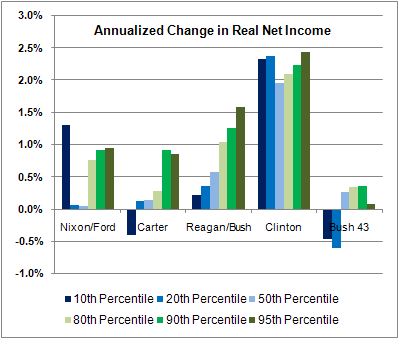
Trickle down economics aka Supply Side economics has worked every time it's tried. In the 20th century, we did so on 3 occasions to phenomenal success. 1920 with Harding/Coolidge, 1960 under Kennedy and the 1980's under Reagan. When you leave money in the hands of the individual, they don't sit there stuffing it into mattresses, for that only loses them money and they know it. So they invest it. Even the little hausfraus and working class schlubs who earned a little extra cash they want to hang on to for a rainy day.
How do they save this surplus cash? They buy stock, bonds, treasuries... something. The money benefits them in their interest and dividend rates as well as then being loaned out by the person they bought the financial product from. The effect is called an economic multiplier. For a small amount of interest, lenders get to invest in bigger projects that earn them more money and allow them to make a profit. This is the nature of banking and investment and it's open to everyone.
Now why does cutting taxes on the rich work best? Because they have the most to spread around. You don't get employed by poor people. The rich also consume the most, and if they decide to blow all that extra dough on toys and services, this stimulates the economy too.
For example, Carver Yachts for instance out of Sheboygan, WI. During the 1970's when Carter was busy punishing the rich almost went out of business. There were luxury taxes that made it too damn expensive to buy American built yachts, regardless of desire. Carver Yachts had betwee 250-400 full time employees on the verge of losing all their jobs. But not only would the loss of those good paying jobs hurt them and their families, it would hurt the community at large because all the services would lose consumer spending as people had no money. The grocery store, the hairdresser, the gas station, the fishing supplies store, the movie theaters. All the little shops and symbiotic businesses that require a productive manufacturer surviving on luxury purchases by the rich who have more money and no idea what to do with it support a community of 30,000 at that time. You end up helping tens of thousands... not just one rich guy or family.
3. Have you ever considered a cost effect analysis of say Welfare? Or unemployment insurance? Or Medicare? Or food stamps? Or school lunch? Or social security?
How exactly do these things help society? Now mind you, it is good to help those in need. But at what point does help become enabling? Yes, we should help those who lost their job. But for how long? When does help become better than working? How does this help society? Case in point. I have a friend who has stated flatly, they are not getting a job till their unemployment benefits are near running out because they make better money on unemployment than they do by getting some interim job that pays half as much. It's like a paid vacation!
I've been on unemployment, and maybe I'm the freak, but I was revolted by it. I hated it. I wanted a job. I've had to use assistance on a few occasions of my life, but realize that I do not belong there, but they make it sooooo tempting to just keep lining up for the benefits. Best example was when I got food help from a private charity. Every week, I was able to go get groceries donated from all over. You would not believe this, but I ate BETTER on this than I could on my own. I had food to give away to others because I couldn't eat my allotment fast enough! I comforted myself knowing that my local area was so abundantly blessed that people could give with such generosity, and I should not take advantage of it. But like I said, I think I'm the freak.
That is the ultimate crux of all social spending. Finding that sweet spot of helping without enabling. Right now, it has been foisted by a local radio host that MN social services could be slashed 40% and there would be little to no degradation in service to the community. Most of the savings would be culled from abuse and fraud and over staffing. The state of Florida is #1 in medicare payments. They receive over 1 BILLION dollars in aid, and almost all of that in the Miami/Dade area. This one area is sucking down over half of all payouts from Medicare, if the information I've see is correct. Do you think this nation could benefit from better policing of the charity for fraud and waste? I do.
You must not confuse kindness for weakness and charity for duty. We are called to help those in need, but we cannot be made slaves to the needy.