I said extreme weather generally. You're talking about specific long range hurricane forecasts.
Thats the claim that you have to support.
I said extreme weather generally.
Hurricanes aren't extreme weather generally?
You're talking about specific long range hurricane forecasts.
Long range? It was 1-5 years later. And it was wrong. Why?
"All of them. Including you." over generalizations like this are the very thing that keeps you in the dark about reality, Todd. Intelligent understanding of the world isn't grounded in abstractions and generalizations. It is grounded in specific details.
I haven't seen any actual link to back up this claim that hurricanes were predicted to be more extreme. So, I did a search on the IPCC 2007 report. The page is
10.3.6.3 Tropical Cyclones (Hurricanes) - AR4 WGI Chapter 10: Global Climate Projections
The reason, it seems, the the UN convened the IPCC is to have an official clearinghouse for climate science relative to global warming. To pick some individual, out of some 7 billion people, and apply their statement to being indicative of climate science is simple stupidity.
On the other hand, we can turn to an official source
It says;
A synthesis of the model results to date indicates that, for a future warmer climate, coarse-resolution models show few consistent changes in tropical cyclones, with results dependent on the model, although those models do show a consistent increase in precipitation intensity in future storms. Higher-resolution models that more credibly simulate tropical cyclones project some consistent increase in peak wind intensities, but a more consistent projected increase in mean and peak precipitation intensities in future tropical cyclones. There is also a less certain possibility of a decrease in the number of relatively weak tropical cyclones, increased numbers of intense tropical cyclones and a global decrease in total numbers of tropical cyclones.
So, it appears that as of 2007, the word is "Earlier studies ... showed that future tropical cyclones would likely become more severe.... " "A synthesis of the model results to date indicates that, for a future warmer climate, coarse-resolution models show few consistent changes in tropical cyclones,"
That all says that, at best, some indicate higher severity would be LIKELY. Specifically, "likely" equals "> 66% probability". That is, a 2 in 3 probability. Not great odds, but better than 50:50. At worse, a synthesis of models few consistent changes. Taken together, that is a very weak prediction, if any, of an increase in storm intensity.
Taking a look at NOAA, we find
Due to the Federal government shutdown, NOAA.gov and most associated web sites are unavailable. crap!!!
Additionally, we find
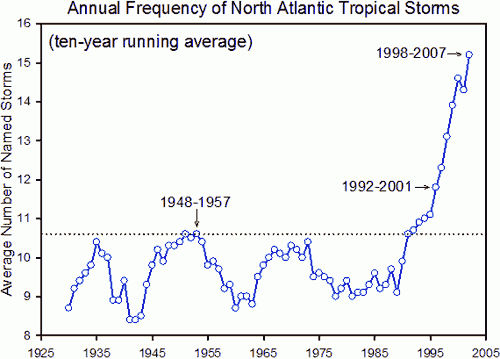
"But while the numbers are not contested, their significance most certainly is. Another study considered how this information was being collected, and research suggested that the increase in reported storms was due to improved monitoring rather than more storms actually taking place.
And to cap it off, two recent peer-reviewed studies completely contradict each other. One paper predicts considerably more storms due to global warming. Another paper suggests the exact opposite that there will be fewer storms in the future."
What is the link between hurricanes and global warming?
This is just a sampling of the wealth of info about global warming and hurricanes. It includes ocean area, storm strength, frequency, and precipitation.
All in all, I find no reason to conclude that there was a strong consensus on predicting future increases in intensity or frequency. This in light of the data that tends to show increased frequency and intensity without claiming statistical significance, depending on the type of measure considered.
I think we would better serve our understanding if we first detail the number of measures before going off and making some general claim that "All of them."