In less than five minutes, Greg Gutfeld explains why Conservative is simply better for the individual, and for society, than Liberal
And, by investing the five minutes in this vid...you get course credit in Prager University.....
Why the Right is Right - Prager University
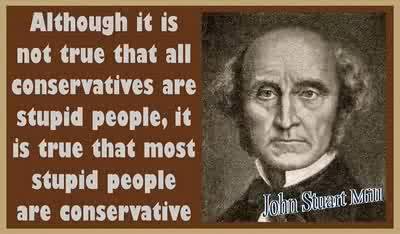
Well it is a great way to make money for sure having to pay to see the stuff being sold. I kinda go with the tried and true axiom that as a person gets more education they become more liberal in thought. Frankly I do not care for conservative people and avoided them like the plague when in business. They always complained and tried to get out of paying for services rendered. Then there are the conservative workers. That is a joke. They do not work they just complain and listen to gush pimpballs on the radio.
" I kinda go with the tried and true axiom that as a person gets more education they become more liberal in thought."
Fact:
. The more education one has in the social sciences, the dumber one becomes.
Liberalism, atheism, male sexual exclusivity linked to IQ - CNN.com
(CNN) -- Political, religious and sexual behaviors may be reflections of intelligence, a new study finds.
Evolutionary psychologist Satoshi Kanazawa at the the London School of Economics and Political Science correlated data on these behaviors with IQ from a large national U.S. sample and found that, on average, people who identified as liberal and atheist had higher IQs. This applied also to sexual exclusivity in men, but not in women. The findings will be published in the March 2010 issue of Social Psychology Quarterly.
The IQ differences, while statistically significant, are not stunning -- on the order of 6 to 11 points -- and the data should not be used to stereotype or make assumptions about people, experts say. But they show how certain patterns of identifying with particular ideologies develop, and how some people's behaviors come to be.
The reasoning is that sexual exclusivity in men, liberalism and atheism all go against what would be expected given humans' evolutionary past. In other words, none of these traits would have benefited our early human ancestors, but higher intelligence may be associated with them.
"The adoption of some evolutionarily novel ideas makes some sense in terms of moving the species forward," said George Washington University leadership professor James Bailey, who was not involved in the study. "It also makes perfect sense that more intelligent people -- people with, sort of, more intellectual firepower -- are likely to be the ones to do that."
Bailey also said that these preferences may stem from a desire to show superiority or elitism, which also has to do with IQ. In fact, aligning oneself with "unconventional" philosophies such as liberalism or atheism may be "ways to communicate to everyone that you're pretty smart," he said.
The study looked at a large sample from the National Longitudinal Study of Adolescent Health (Add Health), which began with adolescents in grades 7-12 in the United States during the 1994-95 school year. The participants were interviewed as 18- to 28-year-olds from 2001 to 2002. The study also looked at the General Social Survey, another cross-national data collection source.
Kanazawa did not find that higher or lower intelligence predicted sexual exclusivity in women. This makes sense, because having one partner has always been advantageous to women, even thousands of years ago, meaning exclusivity is not a "new" preference.
For men, on the other hand, sexual exclusivity goes against the grain evolutionarily. With a goal of spreading genes, early men had multiple mates. Since women had to spend nine months being pregnant, and additional years caring for very young children, it made sense for them to want a steady mate to provide them resources.
Religion, the current theory goes, did not help people survive or reproduce necessarily, but goes along the lines of helping people to be paranoid, Kanazawa said. Assuming that, for example, a noise in the distance is a signal of a threat helped early humans to prepare in case of danger.
"It helps life to be paranoid, and because humans are paranoid, they become more religious, and they see the hands of God everywhere," Kanazawa said.
Participants who said they were atheists had an average IQ of 103 in adolescence, while adults who said they were religious averaged 97, the study found. Atheism "allows someone to move forward and speculate on life without any concern for the dogmatic structure of a religion," Bailey said.
"Historically, anything that's new and different can be seen as a threat in terms of the religious beliefs; almost all religious systems are about permanence," he noted.
The study takes the American view of liberal vs. conservative. It defines "liberal" in terms of concern for genetically nonrelated people and support for private resources that help those people. It does not look at other factors that play into American political beliefs, such as abortion, gun control and gay rights.
"Liberals are more likely to be concerned about total strangers; conservatives are likely to be concerned with people they associate with," he said.
Given that human ancestors had a keen interest in the survival of their offspring and nearest kin, the conservative approach -- looking out for the people around you first -- fits with the evolutionary picture more than liberalism, Kanazawa said. "It's unnatural for humans to be concerned about total strangers." he said.
The study found that young adults who said they were "very conservative" had an average adolescent IQ of 95, whereas those who said they were "very liberal" averaged 106.
It also makes sense that "conservatism" as a worldview of keeping things stable would be a safer approach than venturing toward the unfamiliar, Bailey said.
Neither Bailey nor Kanazawa identify themselves as liberal; Bailey is conservative and Kanazawa is "a strong libertarian."
Vegetarianism, while not strongly associated with IQ in this study, has been shown to be related to intelligence in previous research, Kanazawa said. This also fits into Bailey's idea that unconventional preferences appeal to people with higher intelligence, and can also be a means of showing superiority.
None of this means that the human species is evolving toward a future where these traits are the default, Kanazawa said.
"More intelligent people don't have more children, so moving away from the trajectory is not going to happen," he said.
Find this article at:
Liberalism, atheism, male sexual exclusivity linked to IQ - CNN.com