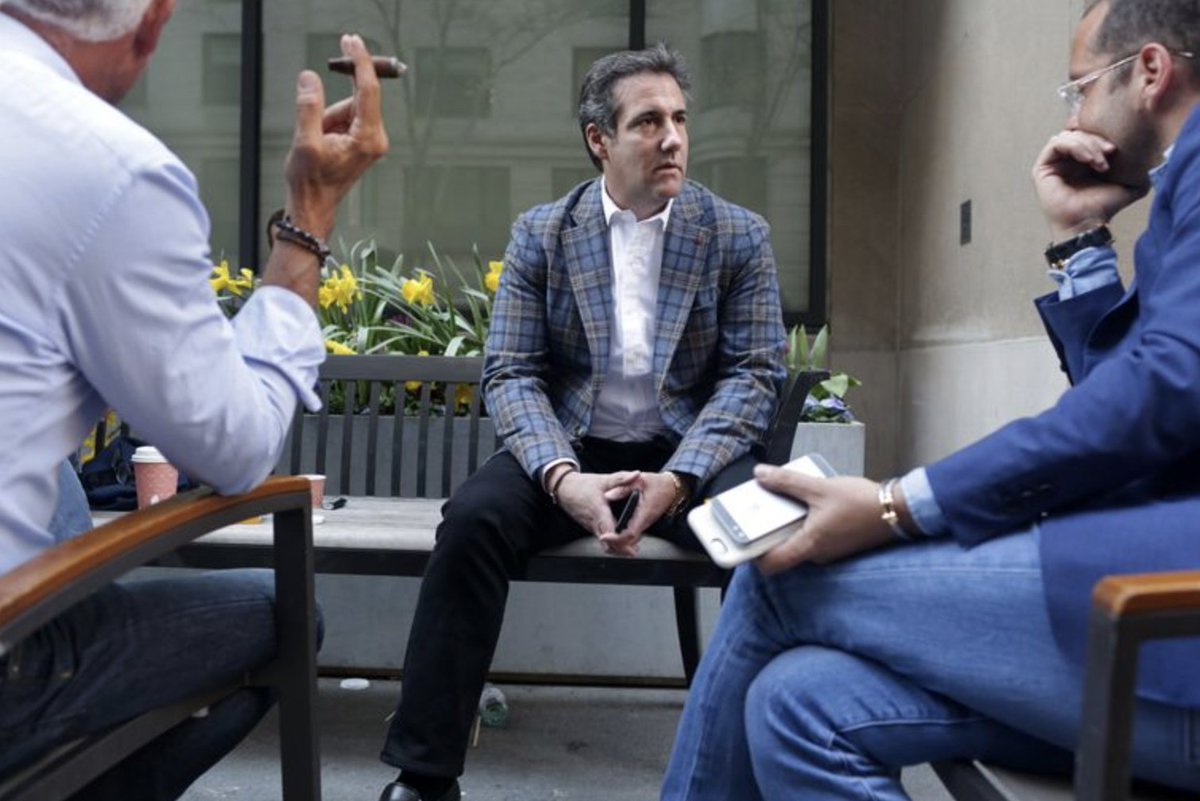
The more the public learns about the raid this week on Michael Cohen’s office, home, and room at a New York hotel, the more it seems Cohen is in deeper and deeper trouble, and the harder and harder it becomes to tell what in particular the federal government is looking for from Cohen.
Unlike actions taken by special counsel Robert Mueller, this raid, conducted by federal agents in New York City, has produced a quick series of leaks. We know, for example, that the raid
targeted information about Cohen’s arrangements with two women, Stormy Daniels and Karen McDougal, who have alleged affairs with Donald Trump, in which they were paid for silence. This is no great surprise, since both have sued to get out of their non-disclosure agreements.
Related Story
Michael Cohen Has a Big Problem
Yet since then we have learned of other things the agents were seeking. Another focus is reportedly
Cohen’s involvement in the New York City taxi business, through the valuable (though depreciating) medallions required for cabs. Evgeny Friedman, a Russian-born businessman who managed Cohen’s fleet, is in
trouble for alleged tax evasion related to taxis.
On Wednesday,
The New York Times reported that agents also sought records related to the
Access Hollywood tape, leaked in October 2016, in which Trump boasted of sexually assaulting women. Although many women have come forward with allegations of abuse, Trump insists those comments were empty braggadocio, or “locker-room talk.” It’s unclear what Cohen’s involvement in that episode might have been, or what crime could have been committed.
That’s a wide range of areas for investigation, and there may still be more, since the warrant is not public. The range is the more remarkable because such a raid required approval from multiple high-ranking Justice Department figures, including, reportedly, Deputy Attorney General Rod Rosenstein. The legal journalist Ben Wittes
writes, “There is no way that the U.S. Attorney’s Office for the Southern District of New York would have sought or executed a search warrant against the president’s lawyer without overpowering evidence to support the action.” Some of the matters involved have clearer connections to the special counsel’s investigation and to Trump than others. The fact that all of them are of interest to federal prosecutors examining Trump raises a great deal of questions, but perhaps the central one is this: What precisely was Michael Cohen doing for Donald Trump in the first place?
Cohen is often described as Trump’s “personal lawyer,” but that doesn’t really seem to illuminate his work. It’s helpful to start at the beginning. The Associated Press retold the origin story of the Trump-Cohen relationship, also told elsewhere, on Tuesday: Cohen was a resident at a Trump building and a member of the condo board in the early 2000s when he intervened in a dispute and impressed Trump. “So Trump said, ‘Who is this guy? My lawyers that I give thousands of dollars to couldn’t do it. I’d like to meet him,’”
Cohen’s uncle told the AP.
That incident is telling: Cohen wasn’t acting as a lawyer, so much as a mediator and troubleshooter. And at many stages in his association with Trump since then, he also has been doing work that doesn’t really seem primarily legal in nature.
Trump himself was—is—famously litigious. On real-estate matters, however, Trump Organization attorney Alan Garten
tended to speak for the company.
Marc Kasowitz, who briefly represented Trump in the Russia matter last year, often represented Trump in big cases, from the Trump University suit to an unsuccessful libel case against journalist Timothy O’Brien. Cohen, by contrast, has made light of his own poor performance at a lesser law school, a classmate
told the AP. And while he practiced law for a time, Cohen made his fortune as a real-estate and taxi mogul, not in courtrooms.
Adam Davidson, who has reported at length on Trump Organization deals overseas, notes that Cohen was heavily involved in projects abroad, some of which have since come under scrutiny over whether Trump did insufficient due diligence. “He was not part of the Trump Org legal team in any real sense,”
Davidson writes. “Trump Org lawyers either set up contracts for deals others had brought or they handled litigation. Cohen did neither. He was a deal maker. The only non-Trump deal maker doing all those international deals.”
Consider Cohen’s three most prominent appearances connected to the Trump campaign. One came in August 2016, when, on CNN, Brianna Keillar confronted Cohen with the fact that polls showed his boss trailing. Cohen demanded to know which polls, to which Keillar replied, “
All of them.” Whatever role Cohen was playing there, it wasn’t legal, nor was it politically informed.
More telling were the other two. In 2015,
The Daily Beast uncovered an old anecdote in which Ivana Trump had accused Donald of marital rape. (She later backed away from the claim—and
signed a sweeping gag order in her divorce agreement.) Cohen’s threat to the
Beast was less legal than brutal: “I will make sure that you and I meet one day while we’re in the courthouse. And I will take you for every penny you still don’t have. And I will come after your Daily Beast and everybody else that you possibly know. So I’m warning you, tread very ******* lightly, because what I’m going to do to you is going to be ******* disgusting. You understand me?” On matters of law, however, he was shaky, arguing that one could not legally rape a spouse—which hasn’t been true in New York since 1984.
The other was the agreement with Daniels, which came shortly before the election. The details and legality of that agreement remain up for dispute, but Trump has said that he was unaware of the agreement, and Cohen says he paid Daniels out of his own pocket, raising questions about whether Cohen was serving as Trump’s personal lawyer or something else. Daniels has also accused Cohen of sending a man to threaten her, which would be, to put it delicately, extra-legal.
Indeed, both of these cases show Cohen more in a “fixer” role than as a lawyer. It’s a label he’s embraced in the past. Cohen has compared himself to the TV character Ray Donovan, and
told ABC in 2011, “If somebody does something Mr. Trump doesn't like, I do everything in my power to resolve it to Mr. Trump's benefit. If you do something wrong, I'm going to come at you, grab you by the neck and I'm not going to let you go until I'm finished.” In 2017, he told
The Wall Street Journal, “I am the fix-it guy … Anything that he needs to be done, any issues that concern him, I handle.”
It can’t hurt to have a J.D., but those aren’t the kinds of skills you need to go to law school to learn. Cohen filled the void in Trump’s circle left by Roy Cohn, the
infamous lawyer who had once represented Joe McCarthy, but while Cohen has a similarly bellicose personality, he lacks Cohn’s accomplishments as an attorney.