St. Nicholas Center ::: Who is St. Nicholas?
"Under the Roman Emperor
Diocletian, who ruthlessly persecuted Christians, Bishop Nicholas suffered for his faith, was exiled and imprisoned. The prisons were so full of bishops, priests, and deacons, there was no room for the real criminals—murderers, thieves and robbers. After his release, Nicholas attended the
Council of Nicaea in AD 325. He died December 6, AD 343 in Myra and was buried in his cathedral church, where a unique
relic, called
manna, formed in his grave. This liquid substance, said to have healing powers, fostered the growth of devotion to Nicholas. The anniversary of his death became a day of celebration,
St. Nicholas Day, December 6th (December 19 on the Julian Calendar)."
"
• Participation in the Council of Nicaea
Although Bishop Nicholas does not appear on all lists of attenders, his name appears on the oldest Greek list and on five other lists.
• Saving three condemned innocents
This story is the oldest and most genuine recorded episode from the life of St. Nicholas. Historical documentation confirms the many references to place names and people."
"The ancient sources cited to substantiate this information are Michael the Archimandrite, Sinaitic and Ethiopian manuscripts, Gratianus'
Decretum, Theodore the Lector, Andrew of
Crete, Eustratios of
Constantinople, AD 583;
Passionarium Romanum, 650 AD; and
Praxis de tributo."
"St. Nicholas' remains are buried in the
crypt of the
Basilica di San Nicola in
Bari, Italy."
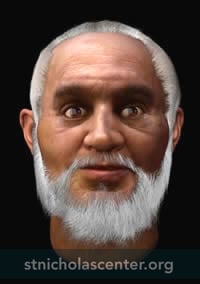
Wow, he looks like Santa Claus, lol.
"At the Vatican's request, anatomy professor Luigi Martino from the University of Bari, took thousands of minutely-detailed measurements and x-ray photographs (roentgenography) of the skull and other bones.
The current professor of forensic pathology at the University of Bari, Francesco Introna, knew advancements in diagnostic technique could yield much more from the data gathered in the 1950s. So he engaged an expert facial anthropologist, Caroline Wilkinson, at the University of Manchester in England, to construct a model of the
saint's head from the earlier measurements.
Using this data, the medical artist used state-of-the-art computer software to develop the model of St. Nicholas."
http://www.stnicholascenter.org/pages/real-face/