Navigation
Install the app
How to install the app on iOS
Follow along with the video below to see how to install our site as a web app on your home screen.
Note: This feature may not be available in some browsers.
More options
Style variation
You are using an out of date browser. It may not display this or other websites correctly.
You should upgrade or use an alternative browser.
You should upgrade or use an alternative browser.
We're losing soil organic matter.
- Thread starter Woodznutz
- Start date

Woodznutz
Diamond Member
- Dec 9, 2021
- 34,282
- 17,460
- 1,788
- Thread starter
- #22
All the more reason to care for our soils.Russia can easily stop this trade if the US continues to be stupid over worthless Ukraine.
Nitrogen (72%) is the choke point as US gets most of it from Russia and little anywhere else.
Does the US Import Russian Fertilizer? Top Fertilizer Importer in USA
Apr 24, 2025
Excerpt:
Does the US Import Russian Fertilizer? Top Fertilizer Importer in USA
Discover whether the US imports fertilizer from Russia, explore the role of Russian fertilizer in US markets, and learn about the top fertilizer importer in USA.
US Imports Blogs Apr 24, 2025 0 5181 Add to Reading List
With the ongoing geopolitical tensions between the US and Russia, many may wonder if the US continues to import fertilizer from its European counterpart. According to the US import data and USA fertilizer import data, the US fertilizer imports reached a total value of $9.37 billion in 2024, a 5% decline from the previous year. The US imports the most fertilizers from Canada, followed by Russia. In recent years, there has been growing concern about the United States’ dependency on foreign countries for key resources such as fertilizers. With Russia being a major player in the global fertilizer market, many are wondering: Does the US import fertilizer from Russia in 2024-25, and how much fertilizer does the US import?
Yes, the US imports fertilizers from Russia as per the US-Russia bilateral trade data. The US fertilizer imports from Russia in 2024 accounted for $1.30 billion, a 2% decline from 2023, as per the Russia export data and US trade data. Let's take a closer look at the current situation and prospects. In this article, we will dive into the current status of fertilizer imports from Russia to the United States, specifically focusing on the years 2024-25.
LINK

Sunsettommy
Diamond Member
- Mar 19, 2018
- 16,342
- 14,072
- 2,400
All the more reason to care for our soils.
We already do, as my sources have been telling you or the lands would have failed long ago.
Your ignorance is hurting you as it doesn't take long for soils to be depleted yet they keep going for decades an indication they are being cared for via fallow, fertilization, crop rotation and other strategies you are obviously unaware of.
Sunsettommy
Diamond Member
- Mar 19, 2018
- 16,342
- 14,072
- 2,400
I'm not addressing the past.
That is why you lack the scale of land use effects that goes back 150 years, you forget the terrible 1930's already.

Woodznutz
Diamond Member
- Dec 9, 2021
- 34,282
- 17,460
- 1,788
- Thread starter
- #25
Don't conflate research on soils that aren't being depleted with those that are. Chemicalized fertilizers are just a form of life support for many soils. It's actually a form of hydroponic farming.We already do, as my sources have been telling you or the lands would have failed long ago.
Your ignorance is hurting you as it doesn't take long for soils to be depleted yet they keep going for decades an indication they are being cared for via fallow, fertilization, crop rotation and other strategies you are obviously unaware of.
Woodznutz
Diamond Member
- Dec 9, 2021
- 34,282
- 17,460
- 1,788
- Thread starter
- #26
The topic is the lands that are being depleted. And, we haven't learned much from the Dust Bowl days. We're still not preserving our grasslands as we should.That is why you lack the scale of land use effects that goes back 150 years, you forget the terrible 1930's already.
Last edited:
Sunsettommy
Diamond Member
- Mar 19, 2018
- 16,342
- 14,072
- 2,400
The topic is the lands that are being depleted. And, we haven't learned much from the Dust Bowl days. We're still not preserving our grasslands as we should.
Now this is where I KNOW you are indeed ignorant since they did learn a lot from the dust bowl days since then as bad farming practices were discovered and addressed which is why there have been no recurrence in the 1950's when a similar drought pattern and bad weather came along.
Read and learn!
Us History Timeline
Agriculture and the Dust Bowl: Lessons from the Past
Excerpt:
The Dust Bowl, a period of severe dust storms during the 1930s, remains one of the most significant environmental disasters in American history. This catastrophic event, which devastated large portions of the Great Plains, was not only a result of natural phenomena but also a consequence of agricultural practices that disregarded the delicate balance of the ecosystem. As we reflect on this tumultuous time, it is essential to explore the intricate relationship between agriculture and environmental stewardship, and how the lessons learned can inform our practices today.
Understanding the Dust Bowl's historical context provides a foundation for recognizing the impact of human actions on the environment and the critical need for sustainable practices in agriculture. The era serves as a stark reminder of how neglecting soil health and proper land management can lead to dire consequences, both economically and ecologically. By examining the factors that contributed to this disaster, we can better appreciate the importance of cultivating a resilient agricultural framework that prioritizes sustainability and conservation.
LINK

ReinyDays
Platinum Member
And dopes like you should know that food isn't "made".
Thank you for demonstrating my point ... do you think food is magically created in shipping crate? ...
I know ... cityslicking flatlanders think mRNA is just for vaccines ...
Does this mean I should poop in the front yard from now on?There is nothing on earth more important than healthy soils for growing our food, however, thanks to the brainiacs that run our agricultural systems we are depleting our soils of needed organic matter. This despite obvious ways to increase it.
Low Organic Matter :: Soil Health
soilhealth.ucdavis.edu
The economy of scale mindset that comes with capitalism is going to become civilization's undoing, and this is just another symptom of that.

EMH
Diamond Member
- Apr 5, 2021
- 32,119
- 18,991
- 2,788
Your question is a rhetorical comment, meaning you don't believe it.
The regions experiencing significant soil depletion include:
- Sub-Saharan Africa: This region is particularly affected by drought and erosion, leading to food insecurity and famine.
1- North America: The U.S. is predicted to see 95% of its soil degraded in less than 30 years due to intensive farming practices.
1- Southeast Asia: This region is also facing soil degradation, with over 40% of soils degraded, primarily due to farming practices.
1- Europe: The European Union is facing challenges with soil degradation, particularly in the Mediterranean region.
1- Asia: Soil degradation is a significant issue in Asia, with various forms of degradation affecting agricultural productivity and ecosystem health.
1
These regions highlight the global nature of soil depletion and the need for sustainable practices to mitigate its impact.
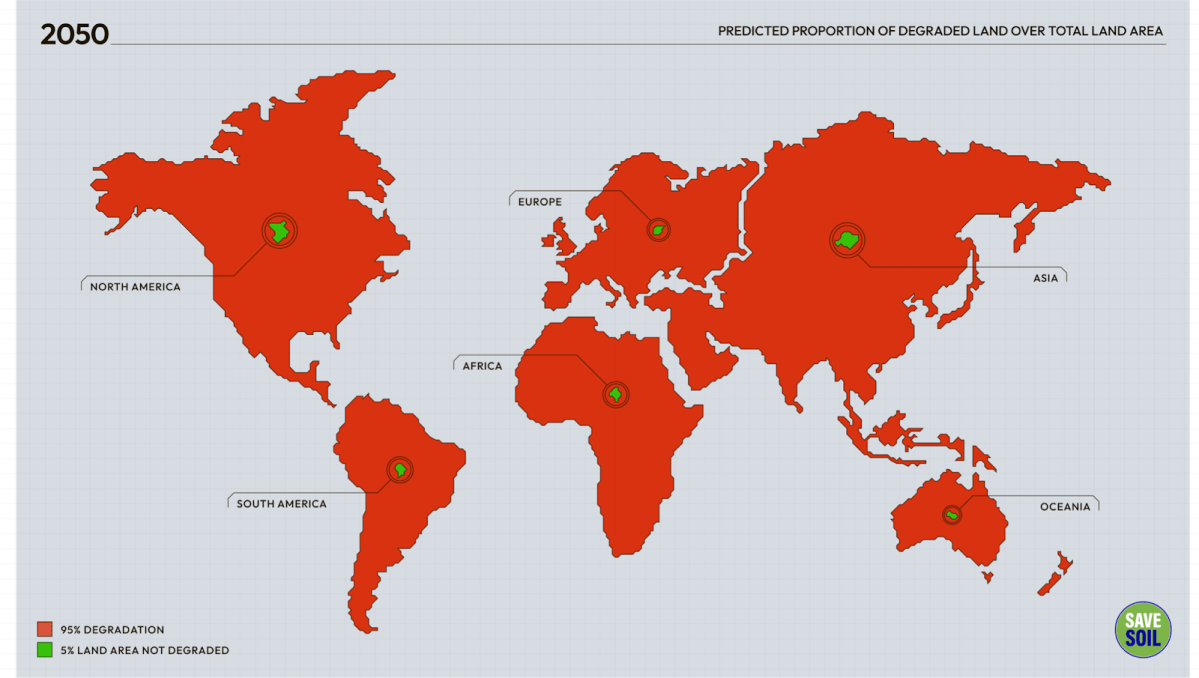
Map shows how much U.S. land may be degraded by 2050
Save Soil movement predicts massive damage to fields all over the glove over the next 30 years.www.newsweek.com
LOL!!!
It is "predicted" in the US where we are, because it isn't happening here, but it "is happening" all over the world except North America, because we don't see it and hence it is easy to lie about it.
ReinyDays
Platinum Member
... because it isn't happening here ...
Have you ever lived on a farm? ... a real one ... Iowa corn growers know to rotate soybeans because ... well ... it is happening here ... citysliclin' flatlanders don't know how food is made ...
EMH
Diamond Member
- Apr 5, 2021
- 32,119
- 18,991
- 2,788
Woodznutz
Diamond Member
- Dec 9, 2021
- 34,282
- 17,460
- 1,788
- Thread starter
- #33
The "Dust Bowl" was losing grasslands out of the front door. What is happening now is like losing them out of the back door.Now this is where I KNOW you are indeed ignorant since they did learn a lot from the dust bowl days since then as bad farming practices were discovered and addressed which is why there have been no recurrence in the 1950's when a similar drought pattern and bad weather came along.
Read and learn!
Us History Timeline
Agriculture and the Dust Bowl: Lessons from the Past
Excerpt:
The Dust Bowl, a period of severe dust storms during the 1930s, remains one of the most significant environmental disasters in American history. This catastrophic event, which devastated large portions of the Great Plains, was not only a result of natural phenomena but also a consequence of agricultural practices that disregarded the delicate balance of the ecosystem. As we reflect on this tumultuous time, it is essential to explore the intricate relationship between agriculture and environmental stewardship, and how the lessons learned can inform our practices today.
Understanding the Dust Bowl's historical context provides a foundation for recognizing the impact of human actions on the environment and the critical need for sustainable practices in agriculture. The era serves as a stark reminder of how neglecting soil health and proper land management can lead to dire consequences, both economically and ecologically. By examining the factors that contributed to this disaster, we can better appreciate the importance of cultivating a resilient agricultural framework that prioritizes sustainability and conservation.
LINK

Have you ever lived on a farm? ... a real one ... Iowa corn growers know to rotate soybeans because ... well ... it is happening here ... citysliclin' flatlanders don't know how food is made ...
They should also know to plant something besides soybeans these days now that the Donald has pissed off China.
If the neighbors can't see me doing my doodoo they won't doodoo as I do. I want to be a soil health influencerUse the back yard, and dig a hole first.

TBH, I have followed this issue most of my life and have concluded that this is a corporate agribusiness problem that will eventually upend the industry when they can no longer hide behind fertilizers to mask what is happening. Until then, nothing is going to slow them down. While some people think the Netherlands will be the role model, their grow houses are just as bad, just on fewer square feet. They consume massive amounts of energy and chemicals to offset less land than the US.
I do believe that nature will eventually be able to reclaim these farms and naturally restore them in hundreds of years after they are depleted, and family farmers are already increasingly aware of the need to manage soils so will be there to pick up some of the production slack. Beyond that, you might as well howl at the moon or scream at the river if you think Archer Daniels Midland gives a flip about the damage they are doing as long as there is an extra nickel per acre they can extract in profits.
Woodznutz
Diamond Member
- Dec 9, 2021
- 34,282
- 17,460
- 1,788
- Thread starter
- #37
True. Many businesses are engaged in 'managing debt' rather than building equity. Same with agriculture. They're borrowing the natural fertility of the soil and repaying the loan with chemicals.If the neighbors can't see me doing my doodoo they won't doodoo as I do. I want to be a soil health influencer
TBH, I have followed this issue most of my life and have concluded that this is a corporate agribusiness problem that will eventually upend the industry when they can no longer hide behind fertilizers to mask what is happening. Until then, nothing is going to slow them down. While some people think the Netherlands will be the role model, their grow houses are just as bad, just on fewer square feet. They consume massive amounts of energy and chemicals to offset less land than the US.
I do believe that nature will eventually be able to reclaim these farms and naturally restore them in hundreds of years after they are depleted, and family farmers are already increasingly aware of the need to manage soils so will be there to pick up some of the production slack. Beyond that, you might as well howl at the moon or scream at the river if you think Archer Daniels Midland gives a flip about the damage they are doing as long as there is an extra nickel per acre they can extract in profits.
ReinyDays
Platinum Member
They should also know to plant something besides soybeans these days now that the Donald has pissed off China.
Aww ... so you don't know how food is made ...
Farmers need a thing called a "combine" ... $1.4 million ... and then for each crop he grows, he'll need a "head" ... $400,000 each ... one for corn and one for soybeans ... which he feeds to his cows and pigs ... tractors, plows, furrowers, planters, sprayers ... much of this equipment is specialized and can't be used on other crops ...
That's only for hard crops ... soft crops still have to be harvested by hand ... and that means shipping in Mexicans ... why would a Mexican work for $2/hr in North Dakota? ...
Perhaps you don't know money is earned. Let me help you-- growing something that nobody will buy at your cost of growing it puts a big old "-" on your books. "-" means you lost more money than you spent, for which you earn nothing. Growing soy and selling it at a loss isn't going to pay a thing toward your precious combine. It will, however, make your combine worth less because you put another year's wear and tear on it. Do it again next year, and you will have a bigger loss and a less valuable combine.Aww ... so you don't know how food is made ...
Farmers need a thing called a "combine" ... $1.4 million ... and then for each crop he grows, he'll need a "head" ... $400,000 each ... one for corn and one for soybeans ... which he feeds to his cows and pigs ... tractors, plows, furrowers, planters, sprayers ... much of this equipment is specialized and can't be used on other crops ...
That's only for hard crops ... soft crops still have to be harvested by hand ... and that means shipping in Mexicans ... why would a Mexican work for $2/hr in North Dakota? ...
Tobacco farmers learned the hardway you can pout and pout but that doesn't pay a single bill. Change crops or go belly up.
You're welcome.

Clipper
Diamond Member
- Dec 22, 2018
- 22,164
- 14,416
- 1,290
The pig's ass is waiting for you, Cletus. Have your fun, weirdo.Thank you for demonstrating my point ... do you think food is magically created in shipping crate? ...
I know ... cityslicking flatlanders think mRNA is just for vaccines ...
Similar threads

- Replies
- 0
- Views
- 140

- Replies
- 2
- Views
- 130

- Replies
- 65
- Views
- 1K

- Poll
- Replies
- 132
- Views
- 3K

New Topics
-

-

-

-
Zone1 Exposing the "Star of David",..... It's Satanic!
- Started by TruthSeeker112125
- Replies: 1
-
CONVERSATIONS: Bill Kristol w A.B. Stoddard on Trump’s Psyche—and The Implications for 2028
- Started by Dante
- Replies: 3


