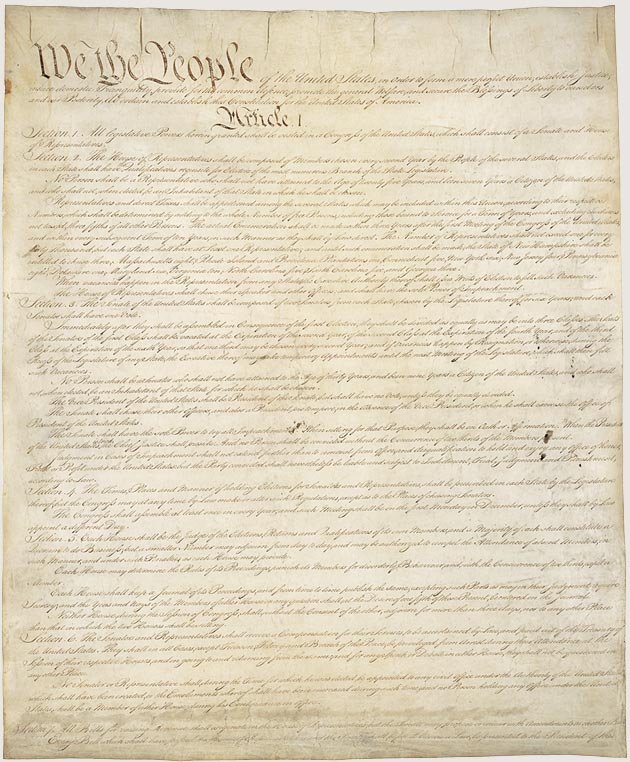
Further, if a big deal is to be made of the commas and their placement in the 2nd Amendment, consider this image of the original document preserved by the Library of Congress:
See that? One comma.
The Second Amendment Foundation maintains, "The Final (ratified) version had only one comma according to the Library of Congress and Government Printing Office."
This image, from the Library of Congress, also shows the ratified version with one comma.
http://memory.loc.gov/ll/llsl/001/0100/01450021.gif
And this page from the National Archives contains a three comma version.
Author David E. Young writes:
Thomas Jefferson as Secretary of State in the Washington Administration prepared an official printing of the amendments. This is the version that he authenticated as being the amendments proposed by Congress, ratified by the state legislatures, and made part of the Constitution under the ratification procedure set forth in Article V. Jefferson's official imprint of the Second Amendment has one middle comma with only the leading word, "A", of the sentence capitalized.(
On Second Opinion Blog: Commas and the "Original" Version of the Second Amendment)
This law journal article states:
The second amendment's capitalization and punctuation is not uniformly reported; another version has four commas, after "militia," "state," and "arms." Since documents were at that time copied by hand, variations in punctuation and capitalization are common, and the copy retained by the first Congress, the copies transmitted by it to the state legislatures, and the ratifications returned by them show wide variations in such details. Letter from Marlene McGuirl, Chief, British-American Law Division, Library of Congress (Oct. 29, 1976).(
The Second Amendment and the Historiography of the Bill of Rights)
So, it appears the states ratified insignificant differing versions of the Bill of Rights. These slight variations in puncuation and capitalization should not have any bearing on the document's interpretation.
And all this only magnifies the gross error and failure to educate as demonstrated in that textbook emphasized in the OP.
Not much of an analysis, but Foxy has at least grokked what the question was. Thank you.
But do tell, how does this "insignificant" punctuation "magnify the gross error"? And the original question-- what's the "error"?
Here's why commas matter. They can change meaning radically. The old example noted before:
"Let's eat, Grandma!" versus
"Let's eat Grandma!"
Two radically different meanings rendered by nothing more than the presence or absence of a comma.
I also noted back there that they could have, if they wanted to, written:
A well regulated Militia:
Being necessary to the security of a free State, the right of the people to keep and bear Arms shall not be infringed.
Exact same words, different punctuation. Had they written it this way there would be no murky meaning. In this version, it would be clearly "the right of the people (to keep and bear arms) that is noted as "necessary to the security of a free State".
But that's not the construction, is it?
The actual construction (the ratified version):
A well regulated militia being necessary to the security of a free state, the right of the people to keep and bear arms, shall not be infringed.
This means something different -- what is "necessary to the security of a free state" is now "a well regulated militia". And this is the way it was written, both before and after revision.
This is where RKMBrown sees the "well regulated militia" clause as "prefatory" -- a passage which sort of introduces the following "the right of the people" etc.
My point to him was that, unless a
connection was intended between the militia and the eventual thrust of the Amendment, there's no reason to qualify the right with the militia application, as distinct from other applications. If as Brown implies this opening clause is a justification for the Amendment, then it's odd that this is the
only Amendment that finds a need for any such justification, is it not?
I've been mostly posting over people's heads who would rather set up strawmen about gun rights than strain their brain on grammatical logic. Maybe you can follow the question.
Somebody else did it here--
>> The best way to make sense of the Second Amendment is to take away all the commas (which, I know, means that only outlaws will have commas). Without the distracting commas, one can focus on the grammar of the sentence. Professor Lund is correct that the clause about a well-regulated militia is “absolute,” but only in the sense that it is grammatically independent of the main clause, not that it is logically unrelated. To the contrary, absolute clauses typically provide a causal or temporal context for the main clause.
The founders — most of whom were classically educated — would have recognized this rhetorical device as the “ablative absolute” of Latin prose. To take an example from Horace likely to have been familiar to them: “Caesar, being in command of the earth, I fear neither civil war nor death by violence” (
ego nec tumultum nec mori per vim metuam, tenente Caesare terras). The main clause flows logically from the absolute clause: “Because Caesar commands the earth, I fear neither civil war nor death by violence.”
Likewise, when the justices finish diagramming the Second Amendment, they should end up with something that expresses a causal link, like: “Because a well regulated militia is necessary to the security of a free state, the right of the people to keep and bear Arms shall not be infringed.” In other words, the amendment is really about protecting militias, notwithstanding the originalist arguments to the contrary. << --
Clause and Effect
Then again there's an obvious difference (the same one) between:
“Caesar being in command of the earth, I fear neither civil war nor death by violence" (Because Caesar is in command of the earth I fear neither...) and
“Caesar, being in command of the earth I fear neither civil war nor death by violence" (Caesar is being personally addressed and told "Because I (the speaker) command the earth, I fear neither...")
All due to the location of a comma.
Why this grammatical tangent?
Because the entire OP (as well as several posts including yours) is predicated on the claim that this study guide book has somehow changed the meaning of the Second Amendment, and that requires some kind of reading analysis ability. That must be why I haven't got an answer yet as to
how the book has changed the meaning -- particularly from the same posters who can't understand the comma question.
But it's Monday, a new week.