Virginia should dump it’s Lee/Jackson holiday and just get on to honoring Adolph Hitler
And you move to hide that fact that even you cannot defend Superbrothers absurd claim that genocide and slavery are the same thing.
Liberals such as yourselfs, are motivated by racism and bigotry, in your refusal to allow Southern Whites the Right to celebrate their heritage and culture.
You know this, which is why you are so dishonest.
Has nothing to do with the topic of this thread
The topic is that Virginia wants to end a holiday honoring men who led Armies to ensure the continuation of slavery
EXACTLY.
Who in their right minds would want a holiday commemorating men who attacked the union, fought for the right own humans, and then lost the war. You don't commemorate losers. You don't commemorate traitors. And you don't commemorate slavers.
Just America, for the last 5 generations.
Obama sent a wreath to the Confederate Memorial at Arlington. He was right to do so.
Your confusion about why, is something wrong with you, not US.
No. It isn't me.
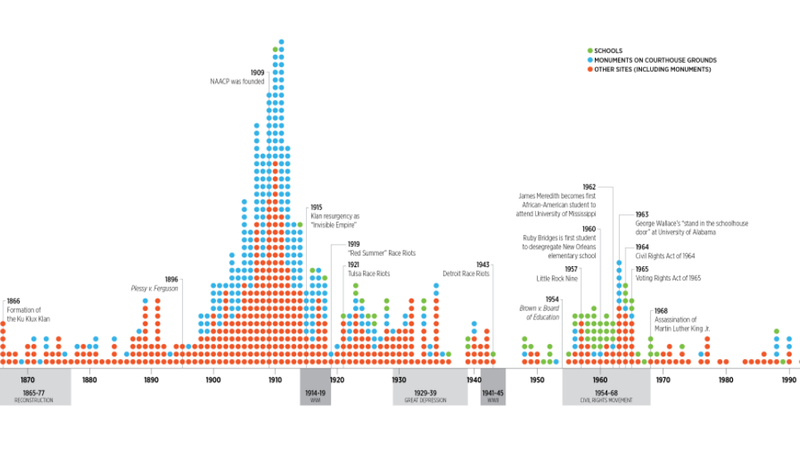
Here is a question: why did so many of these confederate monuments spring up during times of increased racial tensions like the 50's and 60's??
Confederate Statues Were Built To Further A 'White Supremacist Future'
The building blocks are really a few decades before that though, in the period of the late nineteenth-early twentieth century that was the absolute nadir of racial relations in this country, concurrent with the revisionism of the Lost Cause Cult and its army the UDC that erected hundreds of monuments.
The Context:
1866 - the year after the War ended -- Edward Pollard publishes
The Lost Cause: A New Southern History of the War of the Confederates.
[14]
>> Pollard promotes many of the aforementioned themes of the Lost Cause. In particular, he dismisses the role of slavery in starting the war and understates the cruelty of American slavery, even promoting it as a way of improving the lives of Africans:<< (Wiki) This is the origin of the term "Lost Cause"
1867-1874: More than two dozen vigilante groups such as the Knights of the White Camellia (Louisiana 1867-69) the White Brotherhood (North Carolina 1868-70) and the White League (Louisiana 1874) form for the purpose of preserving the antebellum way of life, often using violence against freed slaves, Northern Reconstruction interlopers and local sympathizers. These same elements also take over a street theater social club formed 1865 called the Ku Klux Klan and start committing violence under its banner.
1874: the aforementioned White League stages a municipal coup d'êtat in New Orleans overthrowing an elected biracial government in the "Battle of Liberty Place" -- a monument glorifying this white supremacist insurrection stood at the foot of Canal Street, the busiest spot in the city, for decades and was the first one to be permanently removed by the city in 2015
1877: with the end of federal Reconstruction the first local "Jim Crow" laws are passed, segregation becomes codified, separate public facilities were designated and striated segregation both official and unofficial began. especially but not exclusively in the South
1884: Moses "Fleetwood" Walker plays his last game in Major League Baseball, and would be the last black player in MLB until Jackie Robinson "broke the color line" in 1947 (meaning broke the "gentlemen's agreement" that kept blacks out of baseball for 63 years)
1890s to 1820s: The spate of racial lynchings, begun after the War's end, peaks with the
Equal Justice Institute having documented some 4075 such incidents in the years 1877-1950 but peaking in these three decades. These lynchings become social events for whites, sometimes
advertised in advance, in one case even a special train designated for spectators, who then take home souvenirs of postcards depicting the event and even body parts of the victims
1899: the UDC begins to ramp up its construction of propaganda-transmitter statues and monuments, placing them not in cemeteries, museums or battlefields but at courthouses, public squares, anywhere maximum traffic will be achieved, in its effort to whitewash the Confederate history
1905: Thomas Dixon's novel "The Clansman: A Historical Romance of the Ku Klux Klan" is published, the second in a trilogy of books glorifying the Ku Klux Klan which had died out in 1872. The book was adapted into a play and caused uproar in both the North and the South
1906: Race riots in Arkansas, Georgia and Mississippi begin a spate of racial terror riots that would peak thirteen years later
1910: the victory of black heavyweight fighter Jack Johnson over his white opponent spurs race riots by angry whites across the nation
1913-1914: new President Woodrow Wilson reneges on his campaign promises and segregates his administration, even
ejecting a black civil rights leader who was a supporter.
1915: The D.W. Griffith film "Birth of a Nation" based on the Dixon 1905 novel sweeps across the nation creating mass controversy. Like the novel, the film glorifies the memory of the old Ku Klux Klan, a group formed before Reconstruction in 1865 but taken over by the same vigilante elements that spurred the other vigilante groups (see 1867-1874). The film creates an even bigger uproar than the book for its rationalization of violence and for bringing up old national wounds.
1915: a failed Methodist minister named William Simmons rents a bus, takes followers up Stone Mountain Georgia outside Atlanta and founds the "Knights of the Ku Klux Klan", making the KKK of the notorious film into a real thing people could join, with membership fees of course going into his pocket
1916: the "Great Migration" of six million African-Americans begins, bringing blacks seeking work and fleeing unbearable conditions in the South, populating northern cities such as Chicago, Detroit, St. Louis, Pittsburgh, Baltimore, Philadelphia, New York and many others, where both factories busy with Great War (WWI) activity and segregation await them
1916: the UDC commissions Gutzon Borglum (who would later carve Mount Rushmore) to sculpt a bas-relief depiction on the side of Stone Mountain, site of the re-founding of the Klan
1917: The UDC affixes a plaque on a building at 205 W. Madison Street in Pulaski Tennessee honoring the six founders of the original Ku Klux Klan. This plaque stood until 1989 when the building's new owner turned it backward as a symbol of the town "turning its back on the Klan". Nobody protested except Klan stragglers who had come to pay homage.
1917: Race riots in East St. Louis, Chester and Philadelphia PA, Lexington Kentucky and Houston
1919: the "
Red Summer" of race riots in 36 US cities
1920: Three black circus workers are lynched in Duluth Minnesota, as usual on the basis of a rumor about a white woman. A young boy named Abraham Zimmerman, among the witnesses to the event, recounts it to his son years later, who integrates the story into his song "Desolation Row", writing under the name Bob Dylan
1921:
Tulsa Race Riot killed and displaced hundreds, burned out an entire section of the city called "Black Wall Street" for its affluence and destroyed 1250 homes in violence against the black community including
bombing from the air.
This is about the point where the UDC's funding gets depleted -- you can see where the activity tails off here:
As can be seen here, the propaganda transmitter movement peaks beginning in 1899 and extends twenty years before they started running short of funds. There is then another spike in the 1960s mirroring the Civil Rights Era, but the main foundation is laid about a century ago. During and before this time they were also rewriting school history books, literally: