President Beji Caid Essebsi warned that Tunisia could fall prey to Islamic State group militants in neighboring Libya profiting from the instability. The violent demonstrations over unemployment opened a new front of concern for Tunisia, already struggling from a foundering economy and the threat of terrorism after three major attacks last year. The week of increasingly violent demonstrations was triggered Sunday when a young man who was turned down for a government job climbed a transmission tower in protest and was electrocuted.
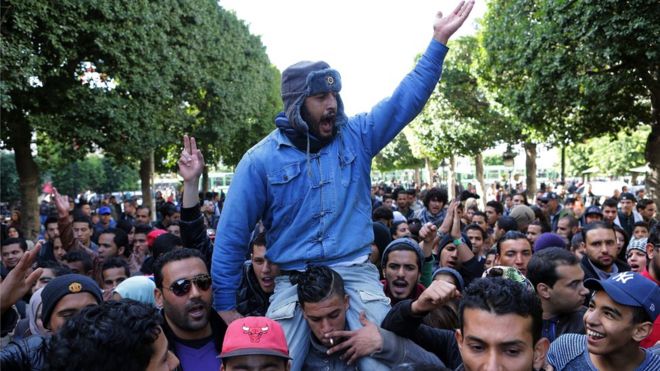
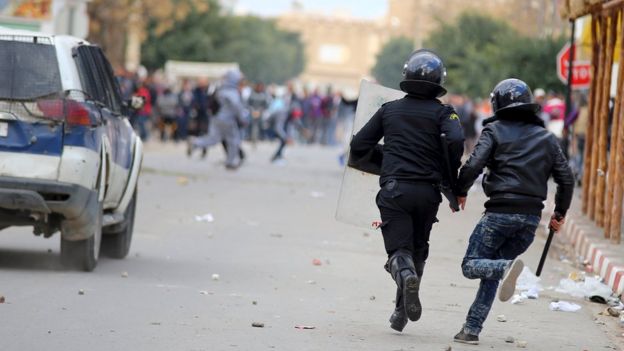
Unemployed protestors demonstrate in Tunis, Tunisia, on Friday. Tunisia has imposed a nationwide curfew in response to growing unrest over unemployment, as protests across the country have descended into violence in several cities.
His death had unsettling resonance: The suicide five years ago of another unemployed youth set off the popular uprising that overthrew Tunisia’s autocratic leader, Zine El Abidine Ben Ali, and gave rise to the “Arab Spring” uprisings. This North African country has been the only Arab Spring nation to avoid a chaotic aftermath and take the road to democracy. “We will get out of this ordeal,” the president said in his first address to the nation since the crisis erupted. He pressed the government to put in place a program to address unemployment. About one in three young people remains without work. “One cannot speak of dignity without a job,” he said. “You can’t tell people who are hungry … to be patient.”
Tunisia’s prime minister, Habib Essid, cut short a visit to France to preside over an extraordinary Cabinet meeting on Saturday. A curfew from 8 p.m. until 5 a.m. was declared because the attacks on public and private property “represent a danger to the country and its citizens,” the Interior Ministry said. Weekend sports events were canceled. A tense calm reigned. The unrest began Sunday in the town of Kasserine in central Tunisia where the young man electrocuted himself – not far from the town of Sidi Bouzid where a vegetable seller set himself afire in 2011, triggering Tunisia’s revolution.
Tunisia’s unemployment stands around 15 percent, but is 30 percent among youth and in the Tunisian heartland that has long felt ignored by the powers-that-be in the capital – despite government promises of change. On Friday, hundreds of unemployed graduates filed into Kasserine’s main administrative office demanding jobs. Others screamed from the top of the building before being escorted out by police, and still more held a sit-in inside the lobby.
MORE