Trump's Tariffs Seriously Reducing The National Debt

The U.S. federal government ran a monthly deficit of $272 billion in August 2025 and a fiscal year-to-date (October 2024-August 2025) deficit of $2 trillion, which was a 1% increase from the same period in fiscal year 2024.
 
The U.S. federal government ran a monthly deficit of $272 billion in August 2025 and a fiscal year-to-date (October 2024-August 2025) deficit of $2 trillion, which was a 1% increase from the same period in fiscal year 2024.
And?

Please don't hijack this thread.
 
Because they help the economy, especially US manufacturing.

Do you see any "crippling" of the US economy? Hint: no you don't.

So don't ask stupid questions.

I don’t see them helping the economy. We are in a manufacturing recession. The only thing propping the economy up is huge investment in AI infrastructure which has nothing to do with tariffs and would have happened regardless.
 
DOGE found issues in SSI that should help plus many of the things DOGE found haven't been initiated yet.

There's a cold hard fact about SSI and that's in the future the swell of boomers won't be drawing on it enmass any more. That's probably why raising the age hasn't been dealt with.
What about this ? If a person dies before he or she draws on their social security, otherwise in any kind of real meaningful way, then why not bury the person by paying for their funeral with some of the money that was way under paid to the taxpayer who has now passed away ???

Shouldn't that be a benefit to a citizen by including it within the social security income portfolio that the taxpayer is entitled too ??

How hard can it be to make sure that the nation highly respects and honors the contributions that a taxpaying hard working citizen (without waver), had given to his or her nation as a long suffering child of that nation for over 40 year's + in the workforces of America ????
 
A CR is typically only for a month or two until the Appropriations Bills get passed, not for a year.

1. There is no current CR. Democrats want to add $trillion and Republicans said "pound sand". That is why therer will be a government shutdown Wednesday 10/1.
2. Tariff revenue is about $400b a year, so by definition it reduces the budget deficit irrespective of the budget.

Don't spike the ball on the 5-yd line candy dear. I always win.
Quite the imagination you’ve got there.

So how many trillions will the debt be reduced by when the blob oozes out of office. Surely we must be running a surplus by then, right?
 
What about this ? If a person dies before he or she draws on their social security, otherwise in any kind of real meaningful way, then why not bury the person by paying for their funeral with some of the money that was way under paid to the taxpayer who has now passed away ???

Shouldn't that be a benefit to a citizen by including it within the social security income portfolio that the taxpayer is entitled too ??

How hard can it be to make sure that the nation highly respects and honors the contributions that a taxpaying hard working citizen (without waver), had given to his or her nation as a long suffering child of that nation for over 40 year's + in the workforces of America ????
Get it passed would be the clincher.
 
The U.S. federal government ran a monthly deficit of $272 billion in August 2025 and a fiscal year-to-date (October 2024-August 2025) deficit of $2 trillion, which was a 1% increase from the same period in fiscal year 2024.
Biden's last "budget" month is September, Trump's first budget month starts in October, unless a CR is used.
 
I don’t see tariffs helping the economy. We are in a manufacturing recession. The only thing propping the economy up is huge investment in AI infrastructure which has nothing to do with tariffs and would have happened regardless.
You just type lies with no links to prove what you claim.
1. There is no manufacturing recession.

2. Your lies are easily disproved. There is a boom in new manufacturing plants.
1759064638214.webp
 
Quite the imagination you’ve got there.
So how many trillions will the debt be reduced by when the blob oozes out of office. Surely we must be running a surplus by then, right?
The math says that there should be a surplus if congress keeps cutting spending, and tariffs are legal.

The problem is that both parties ALWAYS squander any surpluses. So your point is well taken.
 
You just type lies with no links to prove what you claim.
1. There is no manufacturing recession.

2. Your lies are easily disproved. There is a boom in new manufacturing plants.
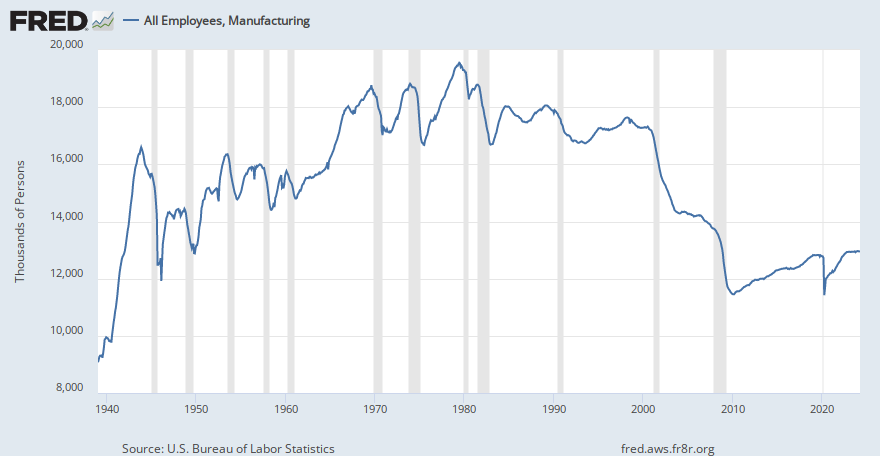
View attachment 1167198

1. Not sure what you think this graph proves. There are fewer manufacturing jobs now than a year ago.

2. There is a boom in promises. Not manufacturing plants.
 
Biden's last "budget" month is September, Trump's first budget month starts in October, unless a CR is used.
Read the thread title. Not my claim. I am disputing the bullshit title.
 
1. Not sure what you think this graph proves. There are fewer manufacturing jobs now than a year ago.
MFG jobs have been dropping since 1980. There are about 150,000 fewer manufacturing jobs than a year ago. The job losses started 1/23 under Biden. Commitments to build new manufacturing plants takes time. Trump is in office 8-months, it takes years to build new plants.
2. There is a boom in promises. Not manufacturing plants.
We'll see.
 
Read the thread title. Not my claim. I am disputing the bullshit title.
OK, so tariffs are reducing the DEFICIT, not necessarily the National Debt, unless congress seriously cuts spending too.

Trump’s tariffs bring in record revenues, could reduce deficit by $4T — but will American households pay the price?​

 
15th post
I don’t see them helping the economy. We are in a manufacturing recession. The only thing propping the economy up is huge investment in AI infrastructure which has nothing to do with tariffs and would have happened regardless.
Evidently they still don't know who is incurring the extra costs of these tariffs.

It has to be a freakin' miracle that they still don't know. That's how closed their world is.
 
The math says that there should be a surplus if congress keeps cutting spending, and tariffs are legal.

The problem is that both parties ALWAYS squander any surpluses. So your point is well taken.

The president has to sign off on all spending so you can’t get away from it being 100% Trump’s fault if we run a deficit.

So how many trillions will we be in debt on 1/20/2029?

More than we are now?
Less than we are now?

Don’t wuss out and try to blame someone else like you always do.
 
You just type lies with no links to prove what you claim.
1. There is no manufacturing recession.

2. Your lies are easily disproved. There is a boom in new manufacturing plants.
View attachment 1167198
manufacturing in the U.S. has seen a significant, decades-long decline in employment, which has been exacerbated by recent economic pressures, higher interest rates, weaker consumer demand, and shifts in geopolitical trade dynamics. While total manufacturing output grew slowly in recent decades, it hasn't kept pace with other nations, and productivity growth has stalled. This decline is a result of factors including outsourcing, increased global competition, and the rise of automation, leading to a reduction in the number of firms and manufacturing jobs.

Key indicators of the decline:
    • Job losses: Since January 2000, the U.S. has lost over 4.7 million manufacturing jobs.
    • Falling output: Manufacturing output has grown more slowly in the U.S. than in many other major manufacturing countries.
    • Decreased investment: Fixed capital investment in manufacturing declined in the 2000s.
    • Stagnant productivity: U.S. manufacturing productivity growth has lagged significantly since the late 2000s.
Causes of the decline:
    • Outsourcing and globalization:
      Increased global competition has led to the offshoring of many manufacturing jobs.
    • Technological advancements:
      Automation and advanced technology have increased output without a corresponding increase in jobs, especially in capital-intensive industries.
    • Recessions and economic shifts:
      The industry has been impacted by successive recessions, with employment never fully recovering to pre-recession levels after each downturn.
    • Shifting economic structures:
      The U.S. economy has shifted from manufacturing to service-providing industries.
Recent Trends:
    • Accelerating job losses:
      Manufacturing job losses have accelerated in 2025 due to pressures from higher interest rates, softer consumer demand, and geopolitical changes.
    • Inventory cycle effects:
      Recent increases in input buying and inventory building following April tariff announcements in 2025 have boosted production, but this is expected to fade, leading to lower production trends.
    • Sector-specific shifts:
      While some sectors like textiles and furniture have been hit hard, others like food, beverages, and tobacco have seen growth.

    • Who killed US manufacturing?.
 
OK, so tariffs are reducing the DEFICIT, not necessarily the National Debt, unless congress seriously cuts spending too.

Trump’s tariffs bring in record revenues, could reduce deficit by $4T — but will American households pay the price?​


From your link:

Of course, it's also important to note that a U.S. appeals court has ruled that most of Trump's tariffs were illegal. The administration has asked the Supreme Court to overturn the decision, but if it doesn't, the revenues will have to be refunded.

It will be interesting to see what happens to Trump's tariffs. Will most of them be declared illegal, as Appeals Court ruled? And if so, will some of those commitments to reshore manufacturing here be quietly changed or even deleted? Historically, higher tariffs have mostly been reduced eventually. There were reasons why domestic manufacturing left the US for other countries in the 1st place, so what will be different if Trump's tariffs go away?


Even Treasury Secretary Scott Bessent has admitted that Trump’s tariffs are being paid by American importers who can pass them off to consumers [3].

Some businesses have already announced their intentions to raise prices as a result of tariffs. A few notable examples include Walmart, Adidas, Home Depot, and Best Buy among others. Ultimately, these price hikes mean that American households will face higher costs for goods, putting pressure on already tight budgets.

“Trump administration policies are driving up consumers’ cost of living in four specific areas: new cars, health insurance, products for children, and cookout staples and other foods,” said the Center for American Progress [4]. The Yale Budget Lab has said the new tariffs will cost American households $2,400 on average in 2025 [5].


The CAP and Yale are left-leaning, so I take their estimates with a grain of salt. But that doesn't make them wrong, but perhaps overstated. But here's the real problem IMHO:

But it’s worth noting that the Big Beautiful Bill, recently signed into law, comes with a hefty price tag. It will cost an estimated $3.4 trillion over the next decade, says the CBO, which could offset much of the potential tariff revenue projections.

This is what happens when revenues go up: Congress spends more money and the anticipated deficit reduction never happens or at best isn't what it was supposed to be. So, we end up with what I think is the worst scenario: the debt and deficits continue to go up and the cost of living goes up more than it otherwise would and that is called inflation. Maybe not all that much due to the tariffs alone, but still that ain't good.


So, I see tariffs as a bad idea, but what can we do to support our manufacturing base? DamnifIknow. Maybe we need to restrict or limit the amount of foreign investments here in some areas, like land for instance. I don't want foreign interests owning one square inch of US soil.
 
Back
Top Bottom