The first thing is comparative advantage vs absolute advantage. Know these or there is no discussion.
It isn't GDP that we really care about anyways. What we care about is employment. We know that standard of living and efficiency increase with time. We know that employment fluctuates and when it goes to shits, it takes employment down with it. If it's low and GDP is high, then we are more interested in employment anyways and GDP is just masking the issue.
Now, all the theory in the world is meaningless with out real data to put it into context. Physics is easier because we can do it in the lab. You can do basic "forces of the universe" experiments at home by flipping coins (statistics and normal distribution) and making a pendulum (gravity). For economics, thank the Congress and industry for the internet and data. Our tax dollars at work.
Things have to be done per capita. Population grows and GDP goes up with it. If absolute GDP isn't keeping up with population growth, it's going up but it isn't good. As well, if you just look at absolute GDP, everything just gets swamped out by the population increase.
Things have to be looked at in real dollars.
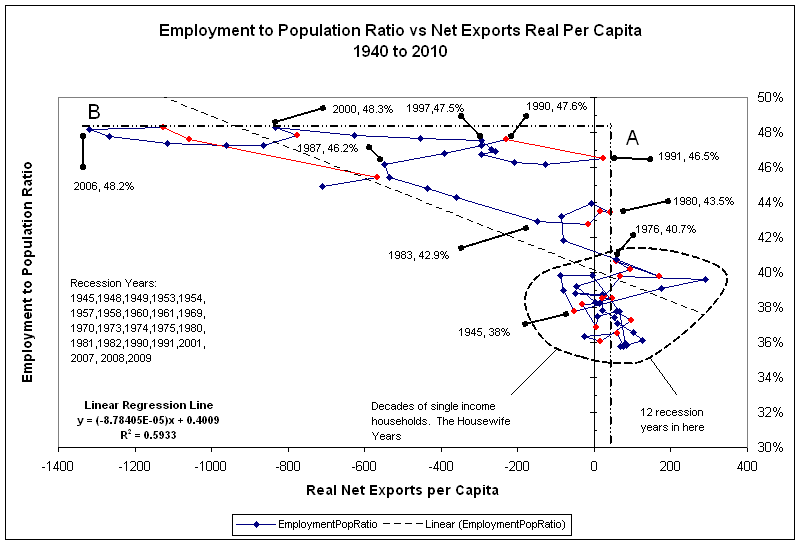
So here is the employment ratio vs net exports (real dollar per capita).
The data points are connected by year.
There is some connection between net exports and employment. When employment railed, imports per capita continued to increase along the top because people were consuming more then we could produce domestically.
In the early years, when every house hold was a single income earner household, there were little imports because household income wasn't up there. This had nothing to do with imports and exports. It was a social thing. Women didn't work.
In between the two, imports increased as employment increased. Here is the story of employment and net exports. Here is the story of the national and global economy. Find the comparative and absolute advantage in here. Does comparative advantage remain constant with time? While the standard of living and technology increases in other countries?
That's the story of employment and imports. There is the story of recessions. Just follow that line, as it moves on up and loops around. Isn't it just beautiful.
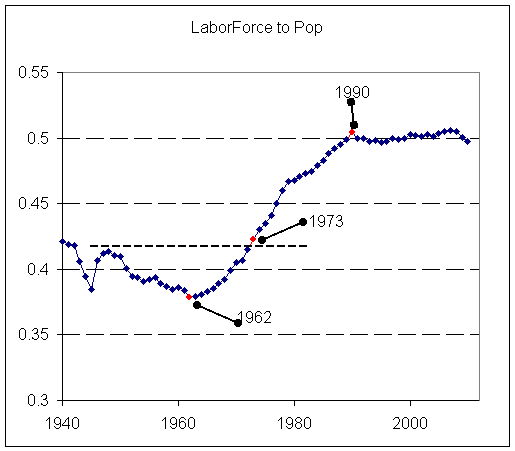
As an aid to understanding it, here is the labor force to population ratio.
Note where it began to increase above the level of 1973 and where it leveled in 1990. Compare those dates to the graph above.
What did the EPR vs Net Exports do after 1990, when the labor force to population ratio maxed out?
What did it do before then, from 1972 up to 1990?
Don't ask me what's up with the with 1948 through 1962. I haven't figured out yet. But 1962 through 1972 and beyond should be clear as to why the workforce kept going up.
What is interesting is that it was at no appreciable imports with a recession that it began to really climb.
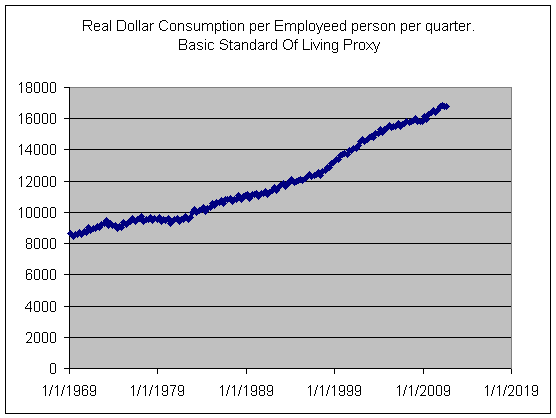
Now, check out the consumption per employed person. This is C from the NIPA account divided by population.
Well, damned if the standard of living just never really fell back much over all those recessions, not for employed people anyways. This is what I figured. Recessions don't drop the standard of living for those employed as much, it just kills the standard of living for those that drop out of employment.
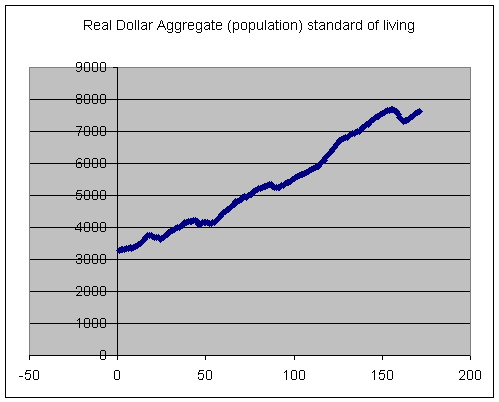
See what I mean when consumption is per capita?
It falls back more clearly.
Going back to that EPR vs NE. Notice how the increases and recession from, 1983 and on, tend to follow the same slope of EPR/NE ratio. Notice how, before the recessions, there was a decrease in NE while EPR still went up. Notice how the 2006 to 2007 fall back on NE followed the max employment rail before the recession hit. Notice the consistent under-ward loop after the recessions of 1980, 1990, 2001. Notice that 2001 was railed, it couldn't loop up and back around under. We can almost predict what the economy is gonna do on this last recession. (quarterly and monthly data would be better. It's amazing how things get more complicated when resolution increases. Patterns can disappear into the noise. )
It is a global economy. It has been since forever, before WWI and WWII. Those were the result of global recessions. Where does absolute advantage and comparative advantage fit into this?
It's not the same system as it has been. It hasn't been since 1997, abouts.


 "to make it consistent with individual preferences".


