I've been studying the OP so that I am sure I am understanding it properly. Sometimes, it's a matter of the right amount of sleep. Another post helped clarify a possible meaning. With this help, I start by restating the OPs post such that he can verify I am understanding and representing it properly .
This helped as, in the end, it seems that the difficulty lies in being able to connect the concept to the available measures in a way that eliminated conflagrating factors. Unfortunately, it can't. When defined by the available measures, and in practice, if the effect exists it is aligned in a manner that makes it appear as if it is none existent. It is also not easily extracted from the available data. For all intents and purposes, it is as if it isn't there.
I went after a scatter plot which turns out to be in line with one comment. Scanning over them, I think I caught another that rearranged the GDP=C+G+I+(X-M) in a way that clarified it.
I think I've just managed to validated other posts.
The following is an attempt to put it in some other words and to formalize the meaning.
Hypothesis:
Trade deficits are ALWAYS detrimental to their nations’ GDPs.
At best, I can say that this is not strictly true. It may be that trade deficits sometimes are detrimental to their nations' GDPs. This will be clarified.
Formally, this is that, for GDP=C+G+I+(X-M), a negative X-M reduces the effective national output compared to a positive X-M in that there is a multiplier effect of exports. An increase in exports increases GDP by more than just the directly measurable output of the exports. As such, GDP with the existence of imports is relatively less by comparison. There is some sense in this.
For clarity, E = C+G+I and TD = (X-M) {This is actually the beginning of an error. See DSGE post earlier re E containing international products. It will suffice for lack of any other way to differentiate things. )
For negative TD=X-M, GDP is reduced. That is, given that GDP1 = E1+TD1 | TD1 > 0 and GDP2 = E2+TD2 | TD2 < 0 , the hypothesis is that GDP1(E1,TD1 | TD1 > 0) > GDP2(E2,TD2,| TD2 < 0) Even more so, E1(TD1 > 0) > E2(TD2 < 0).
(Yes, put that into a sentence, it's the only way. The formal definition forces certain rules to it. It all assures all relationships are perfectly clear. Few can just read it like a story. I can't.)
It says that the domestic output for internal consumption is greater for a net export then it is for a net import. By extension, employment for domestic production due to support services is lessened. (per DSGE, E isn't just domestic production though. So we are already in error here).
Employment, unfortunately, isn't included in this formal definition. This is the conflagrating factor that fuzzies this thing out. Figuring out how to isolate employment is the difficulty and the whole point. It's a shame, because in the end, I'm stuck.
Still, if you follow me on this, there is still something to be said.
Nations’ entire production of goods and service products contribute to their GDPs but prices of individual products do not always reflect the entire goods and services that supported the production of those products.
GDP only counts final goods.
Also individual product prices certainly do not reflect their productions’ inducement of additional goods or services productions.
The final product doesn't include "externalities".
For lack of another word, I am using "externality" to refer to services and products that are utilized in the production of a product but not directly purchased. These are, basically, "positive externalities".
For instance, education accumulated by an employee contributes to the value of the product. It is not a bill of material cost though it is part of the employees salary. The cost of repairing the transportation network adds value to the product in supporting delivery to the final destination. This cost is not included in the bill of material costs though it is paid for by taxes, requires employment of road workers and does increase final goods for materials like asphalt.
Having said this, it hints of a more formal expression. It also begins to stick some of those "externalities" into the proper place. Consider a technical product that is produced for export only. To product it requires educated workers and those workers purchase education. The cost of that education is returned to them in their increased salary. The cost of that education is recorded in GDP as a final good. The cost of that education is also included in M.
All production contributes to producing nations’ gross domestic product, (GDP). The production is not statistically lost;
Costs, including labor, and materials of intermediate goods are included in the final good price and material
but to the extent that production costs of globally traded goods are understated, nations’ global trade imbalances’ affects upon their GDPs are not fully attributed to global trade.
////////////////////////////////// Further Explanations ///////////////////////
For example governments often induce producers to establish their factories within their jurisdictions by granting them favorable tax considerations or providing infrastructure that’s particularly favorable to targeted enterprises. Governments and other non–profits often co-operate by favoring enterprises with research, loans of equipment, or access to their expertise. These production supports are of lesser or no cost to the favored enterprises and thus those enterprises products are lesser priced.
"Externalities" add value to the final product without adding cost
All of a nation’s production, (including production support that’s not reflected within produced products prices), are included within the producing nations’ GDPs. But domestic production support not included within the supported export products are not to that extent attributed as exports’ contributions to the producing nation’s GDP.
"Externalitie"s are included in the GDP but that portion of the "externality" that contributes to X are not included in X
Production of products can support or induce the production of other unrelated products.
For example increasing the production rate of export goods can increase the factory’s payroll and induce increasing revenues for local beauty parlor service products. This is an additional example of exports additionally increasing the nation’s GDP but the addition is not attributed to the nation’s global trade.
The income earned by workers producing products increases demand for other products.
[We cannot spend the same money twice. That’s why the GDP calculation formulas are reduced by the amount of the nation’s imports. When U.S. purchasers perceiving their own individual benefits chose to purchase imported products their transaction reduces their nations’ GDPs. Trade surpluses increase their nations’ GDPs.]
GDP is reduced by -M because GDP is a measure of production, not money spent. As well, imports may be intermediate goods and is not to be counted as part of the final product. This is similar to the concept of counting only final products as the value and cost of intermediate products is included in the final product.
Trade surpluses ALWAYS contribute and trade deficits are ALWAYS detrimental to their nations’ GDPs.
This is baked into the formula defining and calculating GDP; it is not matters of opinion.
In conclusion, (X - M) has a multiplier effect in stimulating "externalities"
So there is the hypothesis.
We have the complementary processes of deduction and empirical evidence.
The OP's discussion is a deductive presentation. Is is supported empirically?
A difficulty in demonstrating this empirically is that population and efficiency continue to increase. Employment-Population ratio also varies. GDP can be normalized by dividing by population or employment which will provide some sense of the increase. The idea of dividing by employment is that it is a proxy for efficiency. Unfortunately, dividing by employment takes out the trade contribution in that the trade is hypothesized to increase employment. There is no alternate measure of efficiency with which to factor out efficiency contribution so that only the trade contribution becomes visible.
Let's consider then doing a linear regression on net exports and GDP in real dollar per capita. GDP in real dollar per capita is a bit of a proxy for standard of living.
We could do RGDP/(pop*emp). This produces a measure that is normalized for both though it suffers from a) the lack of uniqueness b) not being very intuitive.
Finding a good combination of variables that have only the "externality effect" may not be possible.
One should be careful with causality. Does the increase in GDP, and therefore consumption due to increased employment, drive the demand for imports? Or is it that the purchase of imports drives the GDP by holding it down due to reduced employment, per the hypothesis?
(On a side note, I think it is unbiased to state the causalities this way. I am a bit biased in not saying that an increase in imports drives GDP or national production. That's a bit easier then causal relationships between taxes and government spending.)
Even more so, is it both such that they work in opposite directions?
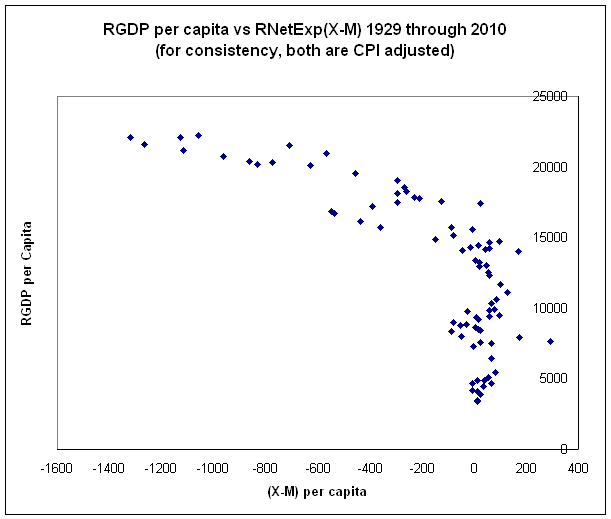
Having considered doing a linear regression, the first order of business is a scatter plot of the data.
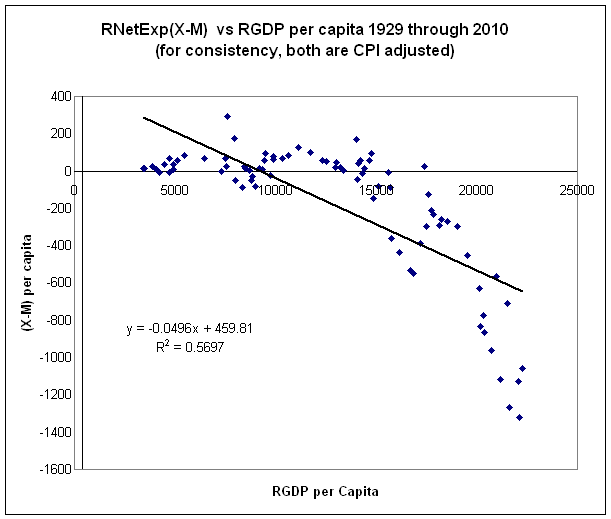
Here is the scatter plot of GDP vs Net Exports. It is RGDP per capita vs Net Exports per capita. This is all years from 1929 to 2010. What does it show?
It shows GDP increasing as imports increase and imports increasing with GDP. Notice that it is not clearly straight, but a bit curved.
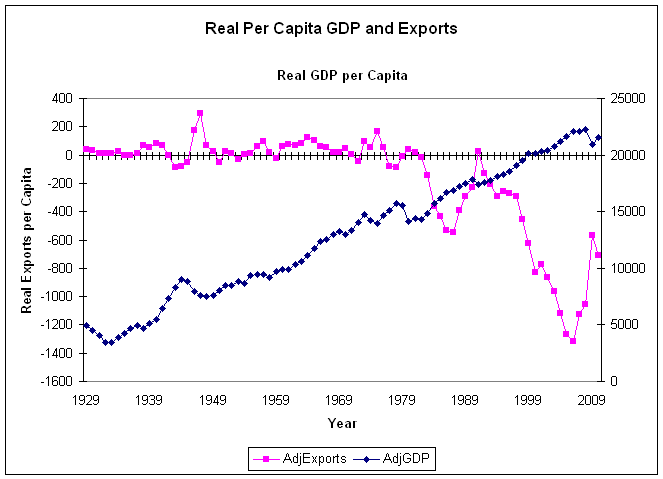
For context, here is the GDP and Exports per year, from 1929 through 2010. The scatter plot is easier to see the relationship.
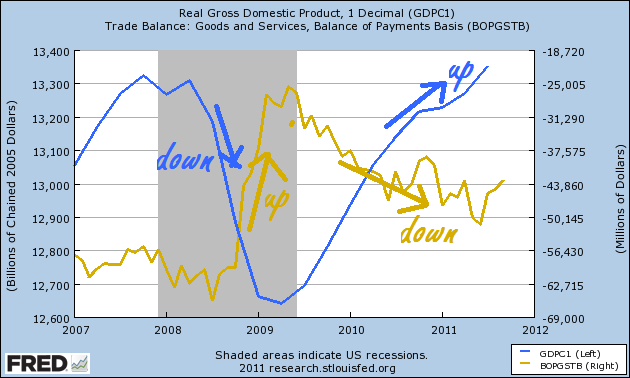
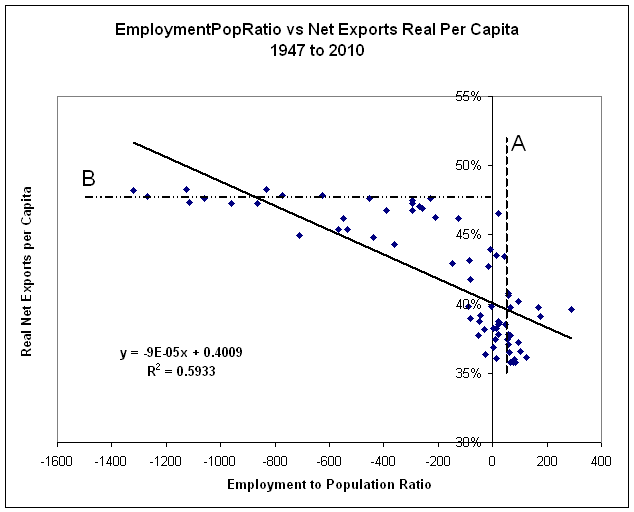
For the sake of connecting it to a reference, compare it to this from a previous post
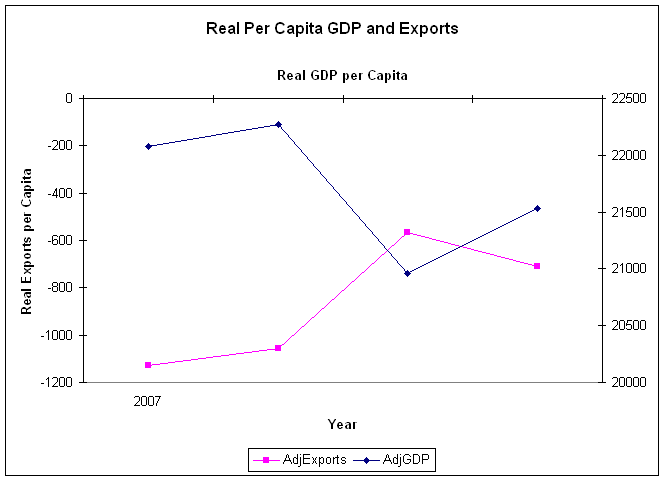
Which is a zoom on the full year plot above and detailed with quarterly data.
Do they support each other? Yes
Still, there is some sense of the logic of the hypothesis. It is deductively appropriate, that net exports cause supporting services in a sort of multiplier. That is the whole concept behind the government multiplier and stimulus spending. The multiplier effect isn't unique to the government. There is no argument that if Apple builds a factory in a town, the towns output increases by more then just the factory output.
I find a few issues to be considered.
A minor point, is that the externality of education is included in the salary of the worker and therefore is included in the price of the export and domestic production. This is a bit minor though in that, in the final end, the idea that the production of an export decreases potential employment.
More importantly are a series of three parts of the process of deduction.
A first is that of ensuring the absolute physicality of the concepts and connectivity in the deduction.
A second one, an extension of the first, is making sure that measures capture the physical properties.
A third is to ensure that the available measures of the elements, that are being related, properly isolate the physical property of interest without conflagrating extraneous factors.
Even when all this is done, the fifth is that of scale. There are cause and effect relationships that, while entirely true, are not of a magnitude that is large enough to bear out in practice. Other relationships simply overpower it. This is as true in physics as in economics.
{Back to that error for the sake of having something to work with}
With these considerations, expanding on the formal attempt of an export multiplier effect, that GDP1(E1,TD1 | TD1 > 0) > GDP2(E2,TD2,| TD2 < 0), a couple of considerations come to mind.
One is that the formal relationship presented really need to be E1(TD1 | TD1 > 0) > E2(TD2| TD2 < 0). In essence, E1=GDP1-TD1, E2=GDP2-TD2 and we are saying that
E(GDP-TD|TD>0) > E(GDP-TD|TD<0)
If I've done this correctly, the relationship cannot hold. For the same GDP, E must be smaller for a larger TD.
Why is this a different result then Supposn, given that we both start with the same equation? Because, I am holding GDP constant and considering the trade balance as TD = X-M. This is a more operational definition in terms of the multiplier factor and it's detractor due to a trade deficit. This is where I ended up in trying to formalize it. As I got further in the thread, I see he defines it as E' = GDP +M.
But, we are in no better position as CGI still contains international products. And this becomes the issue, being able to practically differentiate purely domestic production. Without it, it's not possible to define the multiplier effect that we are trying to isolate as being "crowded out" by a lack of domestic production.
Now it may be that this idea of a multiplier affect remains valid, just that we are back to the deduction process above, defining the proper elements and connectivity to get employment into it, specifically, in such a manner that it differentiates out the difference between the increase in domestic output for domestic consumption due to just the net exports and employment.
There is a difference between full employment and high unemployment.
During recessions, imports fall off. So a lack of a multiplier effect due to imports is lessened during increased unemployment periods.
During full output, any multiplier effect is supporting domestically consumed products which is at full consumption. Imports are then no detracting from the multiplier effect but are just adding on top of the consumption.
If the formal relationship can be modified to highlight the multiplier is not entirely clear. If it could be, then the significance of it during periods of unemployment could be highlighted.
It still may be that there is a detracting factor but that we need to be able to somehow account for the employment factor. Supposing the multiplier exists, as unemployment rises, GDP decreases and imports decrease proportionally. So, proportionally, the detractor of imports becomes lessened. If it exists, this multiplier effect cannot be extracted from GDP, unemployment, and imports. And still, if it exists, though to a lesser extent, the idea suggests that GDP would be proportionally higher without it. Still, without a formal definition I am getting the impression that it doesn't seem so.
At full employment, there is no detractor because imports are simply increasing standard of living. At minimum employment, there are no imports so there is no detractor. This means that between minimum employment (as measured by no imports), this detractor must rise then fall again to zero. This makes the multiplier itself not constant or offset by some other factor..
This is possible, that there is some sweet spot where it is the most detracting. If so, then at that point, moving imports to domestic production would bump GDP up. But to ferret this out truly requires a formal definition which requires somehow distinguishing between the proportion of the domestic product that is the result of the multiplier.
In practice, it just goes away at both ends. The scatter plot is not a straight line. This suggests that, in fact, there is something more going on then simply imports being directly proportional to GDP and vis a vis. It may be that the curved shape is a result of the OPs suggested effect. Imports start out at out at zero and do not begin to increase until a certain GDP per capita has been reached. Then, as GDP increases further, imports begin to increase with GDP and almost have a curve to them. Unfortunately, the variance is a bit to big to really tell for sure.
Still, without proof, I say that this multiplier is true but offset by the simpler increase in imports due to an increase in income.
At this point, it's just getting too complicated in that, in practice, it just seems to go away at both ends anyways. In practice it would require dynamic tariffs to extract out some additional percentage of employment and GDP. There is a concept in econometrics called statistical significance.
What the concept of statistical significance misses in practical importance. Something can be statistically significant but not practically important. And, in many real world settings, if you have to do the detailed calculation of p-value to find the statistical significance, it isn't of practical importance.