Companies don't spend billions of dollars in this sort of thing, unless they have to. Most companies would rather avoid automation, if at all possible. But it's generally not possible.
I worked for a company that prior to, hand built all their CPU boards. They had it automated, so the work of 25 people, could be done by 1.
But the alternative was, go out of business. So in effect the capital investment to replace labor, was actually money spent preserving dozens of jobs. If they had not done this, the company would of closed, and EVERYONE would be unemployed.
So even that spending, is spending that benefits the entire country, and the people who worked there.
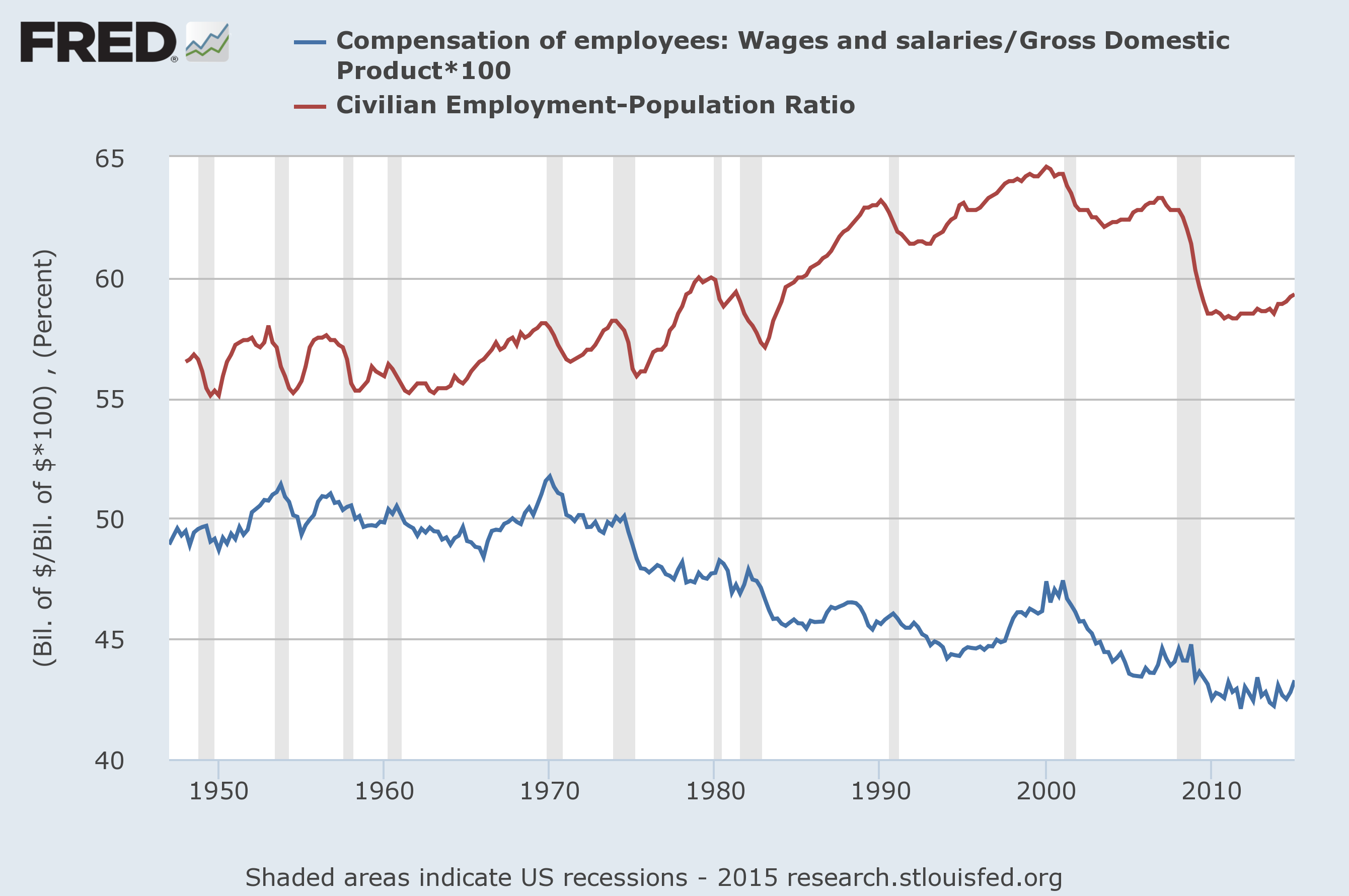
Yes, this is correct. But looking at the employment charts this happens more frequently every time, and it is not just blue collar jobs, but other jobs also.
In economy this is called creative destruction.
It happens all the time, but what matters most is if the rate of creative destruction can be offset by the economic growth.
Again , this doesnt seem to be happening
All true. And?
Let's assume no inflation:
Year one : GDP = 100
Income = 50 ( an arbitrary number)
Year two : GDP = 105
Income still 50
Production increased.
Scenario 1 : Positive trade balance --> No problem
Scenario 2 : Negative trade balance --> We have a problem
a) There is an over production. You can reduce prices, but at the expense of reducing gains. Which in turn will reduce employment ( additional to creative destruction).
b) Households increased their debt , keeping up with the consumption level. No problem at short term , but a problem if debt grows too much.
In the days of mercantilism, having a trade deficit meant that the other country was selling stuff to you, for currency which they converted into gold. As they sold more stuff, collected more dollars, converted into more gold, the other countries would slowly lose their gold reserves causing major economic problems.
Fiat Currency, eliminated this issue. When a Chinaman sells a TV for $200, what can he do with this money? Nothing. He can't spend it, because no business in China takes US dollars. He can't pay his workers, because they won't except US dollars. He can't pay his suppliers, or invest, or purchase anything with it. Not in his home country.
Primary place that excepts US dollars is.... the US. There are a few alternatives, but none worth noting. You can buy oil with US dollars, perhaps some blood diamonds from Africa, but beyond that, there isn't anything you can do with US dollars, but buy US goods, or invest in the US.
Even if they buy oil.... what can those oil people do with US dollars? Nothing, but buy US goods.
So ultimately speaking, all dollars sent out of the US, at some point must return back to the US. The so-called 'trade deficit' is completely irrelevant.
But if all money must return back to the US, and it must..... then why is there a trade deficit? Because there is one thing not counted in the trade deficit numbers. Purchase of US bond and T-bills.
And this is where the implication of your post, contradicts all your prior posts. If you want to eliminate most of the trade deficit, there is a simple way to do it. Stop borrowing. If you simply refuse to borrow money, what are companies around the world going to do? They'll be forced into investing and buying. There is no other choice for them.
But you claim deficit spending is good. Well you can't have both. If you want deficit spending, then people who sell us stuff from abroad are going to buy debt, which is going to create a trade deficit.
Beyond that, like Friedman was famous for saying, the trade deficit isn't a big deal. If anything a trade deficit is an indication of a successful growing economy.
Without getting into the gritty details, just using fundamental logic, the entire reason that you are importing more goods... is because you can afford to. If the economy sucks, and you have no money, you can't afford to buy imported goods.
And that exactly mirrors what we see in trade history. In the 1980s, as the economy improved, the trade deficit grew.
When the recession hit around 1990, the trade deficit fell.
As the economy grow in the mid to late 1990s, the trade deficit grew.
When the recession hit 2002, the trade deficit fell.
In the mid 2000s as the economy grew, the trade deficit grew.
When the massive recession hit, the trade deficit fell like a rock.
Over and over throughout the trade deficit history, the deficit runs parallel to economic growth, rising wages and prosperity. Trade deficit declines, run parallel to economic recession, decline and falling wages.
The trade deficit is merely a sign that we are affluent.
Lastly, the idea that somehow people will be better off without a trade deficit, isn't even logical. Name one employer, anywhere on the face of the Earth, that has given out a pay raise because of a change in the balance of trade? It never happens. Ever. No employer has ever said "oh look the balance of trade is getting better.... pay hike for everyone!".
Now aside from the absurdity, the point is, people are paid what the labor is worth. That value doesn't change with trade deficits.
Moreover, I would argue that any attempt to "fix" trade deficits would necessarily make everyone worse off. If you were to ban the import of cars for example... what would happen? Supply is reduced, and demand remains the same. Result prices go up.
Now would wages go up? No. Not at all. My company that I work for is not going to pay me a higher wage, because the cost of automobiles goes up. I promise you.
So wages stay the same, but prices go up. Am I better off, or worse off? Worse off. By trying to eliminate the the trade deficit, you are going to make everyone worse off.
Worse, what if all those countries, place similar bans on exports from the US? What if all the customers around the world, that buy the products my company sells, stop buying because of retaliation trade barriers? Now I'm out of a job. So prices go up, and I'm unemployed.
Welcome to what led into the great depression. The key economic policy that was passed going into the great depression, was protectionism.