Time to drop a brick of epistemology on a table full of vibes. - Climate change

The policy is directed solely at Western civilization. The fake "Science" has convinced stupid leaders that it's a "real problem" and they need to destroy their economy to get a thumbs from from Greta & the Stupids.

CO2 doesn't drive a thing on planet Earth and certainly not the climate
Trump has taken us away from net zero renewable energy madness. Europe is destroying its economy and driving factories over here
 
No, there is NO science.

Moving the goalposts....That particular question was on the efficacy of any reputed "remedy" to alleged man made climate coolerwarmeringchange, not any alleged physics measurements

Moving the goalposts again....The question was one if independence, not validation...A cartel of governments is the farthest thing from independence as you're going to get.

Thousands of scientists also signed the Oregon petition, but they don't count, huh?

Indeed...They undercut the silly notion that there's ANY valid science at all.

The "science" is inarguable and settled as the premise for the whole thread...There's no greater affront to anything resembling applied epistemology than that.

There are no "mistakes"...The entire mess is the greatest sham ever perpetrated on the people of the world.

This thread is a gigantic fail.
You're labeling everything I say with debate terminology without actually engaging with the substance underneath. That's not a rebuttal. That's avoidance with formatting.

My analogy wasn't equating policy with physics. It was illustrating that implementation failures don't invalidate underlying data. If you understood that and still called it a false equivalence, you're being dishonest. If you didn't understand that, the analogy stands.

On independence: you're conflating political coordination with scientific methodology. Governments can coordinate policy. They cannot coordinate thousands of independent researchers across competing nations to produce identical fake measurements for decades with zero defections. Those are structurally different claims and treating them as the same is the actual false equivalence in this conversation.

The Oregon Petition included dentists, engineers, and anyone with a science-adjacent bachelor's degree. Comparing that to active climate researchers publishing peer-reviewed work is like comparing everyone who's held a steering wheel to NASCAR drivers.

East Anglia produced embarrassing emails. Multiple independent investigations cleared the researchers of data manipulation. The science was reproduced by other teams. If your position is that embarrassing emails invalidate all of climate science, then every institution that's ever had an internal scandal, which is all of them, produces no valid work. That standard destroys all human knowledge, not just climate science.

And "there is NO science" isn't an argument. It's a conclusion framed as a starting point. Declaring the entire enterprise a sham while refusing to engage with any specific piece of it is exactly the circular pattern I have mentioned already.
 
Well the EU is committing economic suicide by refusing cheap and readily available Russian gas.
We have our own cheaper gas and have to help Russia invade other countries. F Russia sanction them until they collapse
 
We have our own cheaper gas and have to help Russia invade other countries. F Russia sanction them until they collapse

Having to liquify and ship our "cheap" gas overseas to the Stupids in the EU = not so cheap.
 
You're labeling everything I say with debate terminology without actually engaging with the substance underneath. That's not a rebuttal. That's avoidance with formatting.
The debate terminology applies...Your entire argument is one run-on logical fallacy after another....The logical fallacies give lie to the alleged "science" behind them.

If you had the science on your side you wouldn't just declare it as beyond reproach, and use that begged question and its appeal to authority as the basis for all the fallacies which follow.

You're even poorer at science than you are at debate.
 
The policy is directed solely at Western civilization. The fake "Science" has convinced stupid leaders that it's a "real problem" and they need to destroy their economy to get a thumbs from from Greta & the Stupids.

CO2 doesn't drive a thing on planet Earth and certainly not the climate
You’re still collapsing three different layers into one and assuming that makes a scientific argument.

Policy ≠ science
Net zero is a policy goal. That part is just descriptively true. Governments choose targets, timelines, taxes, bans, subsidies. None of that is a measurement of atmospheric physics. You can argue (reasonably) that net zero is economically destructive, selectively applied to the West, or politically motivated, but none of that is evidence that refutes what climate scientists are saying.

When you say “the policy is directed at Western civilization, therefore the science is fake” you are treating political incentives as if they invalidate physical observations. That’s not skepticism, that’s a non sequitur. Even if every climate policy were evil, corrupt, and stupid (plausible), it still wouldn’t logically imply that the underlying measurements are fabricated.

You’re just asserting a conclusion. You're circling back to politics, Greta, Western decline, and corruption. None of that touches the physics.

The loop is

Institutions are political

Therefore science is fake

Therefore policy is evil

Therefore institutions are political

That’s a closed ideological circuit. No possible data could ever enter that loop, because everything gets reclassified as “part of the sham” by definition.

The real issue isn’t religious worship of science. It’s the opposite: you’ve replaced empirical claims with a fully immunized belief system. Every error proves fraud, every correction proves conspiracy, every measurement proves manipulation.
That’s not skepticism.
 
The debate terminology applies...Your entire argument is one run-on logical fallacy after another....The logical fallacies give lie to the alleged "science" behind them.

If you had the science on your side you wouldn't just declare it as beyond reproach, and use that begged question and its appeal to authority as the basis for all the fallacies which follow.

You're even poorer at science than you are at debate.
Labeling something a “fallacy” isn’t a refutation by itself. It’s just a description you attached so you can justify not actually engaging, as evidenced by the fact you keep choosing to respond to small parts of my post without addressing the rest.

Also, nobody here has said climate science is “beyond reproach.” The existence of retractions, disputes, and corrections is literally evidence that it is questioned, by scientists. Constantly.
 
Labeling something a “fallacy” isn’t a refutation by itself. It’s just a description you attached so you can justify not actually engaging, as evidenced by the fact you keep choosing to respond to small parts of my post without addressing the rest.

Also, nobody here has said climate science is “beyond reproach.” The existence of retractions, disputes, and corrections is literally evidence that it is questioned, by scientists. Constantly.
Since all the climate change science proved we would have more hurricanes and they would be more powerful how we didnt have one? Not one
 
Since all the climate change science proved we would have more hurricanes and they would be more powerful how we didnt have one? Not one
Your argument just slid into folk meteorology. That’s usually the last stage before an argument collapses into pure vibes.

We started with claims about institutions, models, funding, and methodology. Now the argument has become “I didn’t see a hurricane this year.”

That’s not a scientific rebuttal, it’s anecdotal reasoning.

No climate model has ever claimed that every single year must have more or stronger hurricanes. The actual claim is statistical and long-term: that the probability distribution shifts, meaning stronger storms become more likely over decades, rainfall per storm increases, and variability increases. That’s a trend claim, not a prophecy about any one season.

Using one quiet year to “disprove” climate science is like saying smoking doesn’t increase cancer risk because one smoker lived to 95. You’re confusing trend vs instance, which is a basic category error.
More importantly, this is a clear retreat from epistemic arguments into personal observation.

Earlier you were attacking institutions, funding, consensus, and methodology. Now the argument is literally “look out your window.”

You’ve gone from criticizing science to abandoning it and replacing it with a sample size of one.

At that point, we’re not debating climate anymore. We’re debating whether complex global systems should be evaluated by decades of data or by individual perception. And that’s not a scientific position.
 
Labeling something a “fallacy” isn’t a refutation by itself. It’s just a description you attached so you can justify not actually engaging, as evidenced by the fact you keep choosing to respond to small parts of my post without addressing the rest.
There's no evidence that you'd accept, hence the premise that you won't argue the fake "science".

As I said, the fallacious logic reveals the fallacious "science" for what it is.
Also, nobody here has said climate science is “beyond reproach.” The existence of retractions, disputes, and corrections is literally evidence that it is questioned, by scientists. Constantly.
All those "corrections", yet the underlying premise remains the same....That's a pseudo-scientific cult, not actual provable, quantifiable science.
 
Your argument just slid into folk meteorology. That’s usually the last stage before an argument collapses into pure vibes.

We started with claims about institutions, models, funding, and methodology. Now the argument has become “I didn’t see a hurricane this year.”

That’s not a scientific rebuttal, it’s anecdotal reasoning.

No climate model has ever claimed that every single year must have more or stronger hurricanes. The actual claim is statistical and long-term: that the probability distribution shifts, meaning stronger storms become more likely over decades, rainfall per storm increases, and variability increases. That’s a trend claim, not a prophecy about any one season.

Using one quiet year to “disprove” climate science is like saying smoking doesn’t increase cancer risk because one smoker lived to 95. You’re confusing trend vs instance, which is a basic category error.
More importantly, this is a clear retreat from epistemic arguments into personal observation.

Earlier you were attacking institutions, funding, consensus, and methodology. Now the argument is literally “look out your window.” That’s not a stronger form of evidence; it’s a weaker one.

You’ve gone from criticizing science to abandoning it and replacing it with a sample size of one.

At that point, we’re not debating climate anymore. We’re debating whether complex global systems should be evaluated by decades of data or by individual perception. And that’s not a scientific position.
But where were all the predicted hurricanes? We had zero not less nada zip nothing. How could your releigion be so wrong


Tomorrow is Earth Day 2022 and marks the 52nd anniversary of Earth Day, so it’s time for my annual CD post on the spectacularly wrong predictions that were made around the time of the first Earth Day in 1970…..

“The prophets of doom were not simply wrong, but spectacularly wrong,” according to Bailey. Here are 18 examples of the spectacularly wrong predictions made around 1970 when the “green holy day” (aka Earth Day) started:

1. Harvard biologist George Wald estimated that “civilization will end within 15 or 30 years [by 1985 or 2000] unless immediate action is taken against problems facing mankind.”

2. “We are in an environmental crisis that threatens the survival of this nation, and of the world as a suitable place of human habitation,” wrote Washington University biologist Barry Commoner in the Earth Day issue of the scholarly journal Environment.

3. The day after the first Earth Day, the New York Times editorial page warned, “Man must stop pollution and conserve his resources, not merely to enhance existence but to save the race from intolerable deterioration and possible extinction.”

4. “Population will inevitably and completely outstrip whatever small increases in food supplies we make,” Paul Ehrlich confidently declared in the April 1970 issue of Mademoiselle. “The death rate will increase until at least 100-200 million people per year will be starving to death during the next ten years [by 1980].”

5. “Most of the people who are going to die in the greatest cataclysm in the history of man have already been born,” wrote Paul Ehrlich in a 1969 essay titled “Eco-Catastrophe! “By…[1975] some experts feel that food shortages will have escalated the present level of world hunger and starvation into famines of unbelievable proportions. Other experts, more optimistic, think the ultimate food-population collision will not occur until the decade of the 1980s.”

6. Ehrlich sketched out his most alarmist scenario for the 1970 Earth Day issue of The Progressive, assuring readers that between 1980 and 1989, some 4 billion people, including 65 million Americans, would perish in the “Great Die-Off.”

7. “It is already too late to avoid mass starvation,” declared Denis Hayes, the chief organizer for Earth Day, in the Spring 1970 issue of The Living Wilderness.

8. Peter Gunter, a North Texas State University professor, wrote in 1970, “Demographers agree almost unanimously on the following grim timetable: by 1975 widespread famines will begin in India; these will spread by 1990 to include all of India, Pakistan, China, and the Near East, Africa. By the year 2000, or conceivably sooner, South and Central America will exist under famine conditions….By the year 2000, thirty years from now, the entire world, with the exception of Western Europe, North America, and Australia, will be in famine.”

Note: The prediction of famine in South America is partly true, but only in Venezuela and only because of socialism, not for environmental reasons.

9. In January 1970, Life reported, “Scientists have solid experimental and theoretical evidence to support…the following predictions: In a decade, urban dwellers will have to wear gas masks to survive air pollution…by 1985 air pollution will have reduced the amount of sunlight reaching earth by one half….”

10. Ecologist Kenneth Watt told Time that, “At the present rate of nitrogen buildup, it’s only a matter of time before light will be filtered out of the atmosphere and none of our land will be usable.”

11. Barry Commoner predicted that decaying organic pollutants would use up all of the oxygen in America’s rivers, causing freshwater fish to suffocate.

12. Paul Ehrlich chimed in, predicting in 1970 that “air pollution…is certainly going to take hundreds of thousands of lives in the next few years alone.” Ehrlich sketched a scenario in which 200,000 Americans would die in 1973 during “smog disasters” in New York and Los Angeles.

13. Paul Ehrlich warned in the May 1970 issue of Audubon that DDT and other chlorinated hydrocarbons “may have substantially reduced the life expectancy of people born since 1945.” Ehrlich warned that Americans born since 1946…now had a life expectancy of only 49 years, and he predicted that if current patterns continued this expectancy would reach 42 years by 1980 when it might level out. (Note: According to the most recent CDC report, life expectancy in the US is 78.6 years).

14. Ecologist Kenneth Watt declared, “By the year 2000 if present trends continue, we will be using up crude oil at such a rate…that there won’t be any more crude oil. You’ll drive up to the pump and say, `Fill ‘er up, buddy,’ and he’ll say,`I am very sorry, there isn’t any.’”

Note: Global oil production last year at about 95M barrels per day (bpd) was double the global oil output of 48M bpd around the time of the first Earth Day in 1970.

15. Harrison Brown, a scientist at the National Academy of Sciences, published a chart in Scientific American that looked at metal reserves and estimated that humanity would totally run out of copper shortly after 2000. Lead, zinc, tin, gold, and silver would be gone before 1990.

16. Sen. Gaylord Nelson wrote in Look, “Dr. S. Dillon Ripley, secretary of the Smithsonian Institute, believes that in 25 years, somewhere between 75 and 80 percent of all the species of living animals will be extinct.”

17. In 1975, Paul Ehrlich predicted that “since more than nine-tenths of the original tropical rainforests will be removed in most areas within the next 30 years or so [by 2005], it is expected that half of the organisms in these areas will vanish with it.”

18. Kenneth Watt warned about a pending Ice Age in a speech. “The world has been chilling sharply for about twenty years,” he declared. “If present trends continue, the world will be about four degrees colder for the global mean temperature in 1990, but eleven degrees colder in the year 2000. This is about twice what it would take to put us into an Ice Age.”

MP: Let’s keep those spectacularly wrong predictions from the first Earth Day 1970 in mind when we’re bombarded again this year with dire predictions of “gloom and doom” and “existential threats” due to climate change. And let’s think about the question posed by Ronald Bailey in 2000: What will Earth look like when Earth Day 60 rolls around in 2030? Bailey predicts a much cleaner, and much richer future world, with less hunger and malnutrition, less poverty, longer life expectancy, and lower mineral and metal prices. But he makes one final prediction about Earth Day 2030: “There will be a disproportionately influential group of doomsters predicting that the future – and the present – never looked so bleak.” In other words, the hype, hysteria, and spectacularly wrong apocalyptic predictions will continue, promoted by virtue-signaling “environmental grievance hustlers” like AOC, who said several years ago that we have “only 12 years left to stop the worst impacts of climate change.”

 
" Green Reduces Carbon Dioxide While Desertification Swelters *

* Us Governance Incompetence At The Level Of Water Management *

The debate terminology applies...Your entire argument is one run-on logical fallacy after another....The logical fallacies give lie to the alleged "science" behind them.
If you had the science on your side you wouldn't just declare it as beyond reproach, and use that begged question and its appeal to authority as the basis for all the fallacies which follow.
You're even poorer at science than you are at debate.
Whether sea levels would rise due to melting ice sounds like actuarial speculation for insurance companies .

Those earning a living from petitions and grants through government for studies and data collection , on topics of safety and security in economic and environmental factors , would in general not be enthusiastic to short lived or paltry compensation .

If the numb skulls were actually competent in their roles and concerns for investigation , discovery and recommendation , why has it not been suggested to divert some of fresh water from nothern regions , such as great lakes , to western regions of etas unis to prevent them from burning and allow them to consume carbon dioxide ?
 
Last edited:
There's no evidence that you'd accept, hence the premise that you won't argue the fake "science".

As I said, the fallacious logic reveals the fallacious "science" for what it is.

All those "corrections", yet the underlying premise remains the same....That's a pseudo-scientific cult, not actual provable, quantifiable science.
Labeling something “fallacious” doesn’t magically refute the underlying evidence. At best it critiques the argument, not the data. You keep talking about logical errors in how people talk about climate as if it's proof that the measurements themselves are invalid.

That’s a category mistake. Bad reasoning about a topic doesn’t invalidate research.

And calling science a “cult” because core conclusions persist through corrections is backwards. That’s literally how cumulative science works: individual papers get revised, models get tuned, error bars shrink, but the signal remains because it’s supported by independent lines of evidence. A cult protects beliefs from revision; climate science constantly revises methods while the empirical pattern stays consistent.

Models also converge on gravity being real.

Why?

Because...

Convergence is a normal feature of mature science.
 
But where were all the predicted hurricanes? We had zero not less nada zip nothing. How could your releigion be so wrong


Tomorrow is Earth Day 2022 and marks the 52nd anniversary of Earth Day, so it’s time for my annual CD post on the spectacularly wrong predictions that were made around the time of the first Earth Day in 1970…..

“The prophets of doom were not simply wrong, but spectacularly wrong,” according to Bailey. Here are 18 examples of the spectacularly wrong predictions made around 1970 when the “green holy day” (aka Earth Day) started:

1. Harvard biologist George Wald estimated that “civilization will end within 15 or 30 years [by 1985 or 2000] unless immediate action is taken against problems facing mankind.”

2. “We are in an environmental crisis that threatens the survival of this nation, and of the world as a suitable place of human habitation,” wrote Washington University biologist Barry Commoner in the Earth Day issue of the scholarly journal Environment.

3. The day after the first Earth Day, the New York Times editorial page warned, “Man must stop pollution and conserve his resources, not merely to enhance existence but to save the race from intolerable deterioration and possible extinction.”

4. “Population will inevitably and completely outstrip whatever small increases in food supplies we make,” Paul Ehrlich confidently declared in the April 1970 issue of Mademoiselle. “The death rate will increase until at least 100-200 million people per year will be starving to death during the next ten years [by 1980].”

5. “Most of the people who are going to die in the greatest cataclysm in the history of man have already been born,” wrote Paul Ehrlich in a 1969 essay titled “Eco-Catastrophe! “By…[1975] some experts feel that food shortages will have escalated the present level of world hunger and starvation into famines of unbelievable proportions. Other experts, more optimistic, think the ultimate food-population collision will not occur until the decade of the 1980s.”

6. Ehrlich sketched out his most alarmist scenario for the 1970 Earth Day issue of The Progressive, assuring readers that between 1980 and 1989, some 4 billion people, including 65 million Americans, would perish in the “Great Die-Off.”

7. “It is already too late to avoid mass starvation,” declared Denis Hayes, the chief organizer for Earth Day, in the Spring 1970 issue of The Living Wilderness.

8. Peter Gunter, a North Texas State University professor, wrote in 1970, “Demographers agree almost unanimously on the following grim timetable: by 1975 widespread famines will begin in India; these will spread by 1990 to include all of India, Pakistan, China, and the Near East, Africa. By the year 2000, or conceivably sooner, South and Central America will exist under famine conditions….By the year 2000, thirty years from now, the entire world, with the exception of Western Europe, North America, and Australia, will be in famine.”

Note: The prediction of famine in South America is partly true, but only in Venezuela and only because of socialism, not for environmental reasons.

9. In January 1970, Life reported, “Scientists have solid experimental and theoretical evidence to support…the following predictions: In a decade, urban dwellers will have to wear gas masks to survive air pollution…by 1985 air pollution will have reduced the amount of sunlight reaching earth by one half….”

10. Ecologist Kenneth Watt told Time that, “At the present rate of nitrogen buildup, it’s only a matter of time before light will be filtered out of the atmosphere and none of our land will be usable.”

11. Barry Commoner predicted that decaying organic pollutants would use up all of the oxygen in America’s rivers, causing freshwater fish to suffocate.

12. Paul Ehrlich chimed in, predicting in 1970 that “air pollution…is certainly going to take hundreds of thousands of lives in the next few years alone.” Ehrlich sketched a scenario in which 200,000 Americans would die in 1973 during “smog disasters” in New York and Los Angeles.

13. Paul Ehrlich warned in the May 1970 issue of Audubon that DDT and other chlorinated hydrocarbons “may have substantially reduced the life expectancy of people born since 1945.” Ehrlich warned that Americans born since 1946…now had a life expectancy of only 49 years, and he predicted that if current patterns continued this expectancy would reach 42 years by 1980 when it might level out. (Note: According to the most recent CDC report, life expectancy in the US is 78.6 years).

14. Ecologist Kenneth Watt declared, “By the year 2000 if present trends continue, we will be using up crude oil at such a rate…that there won’t be any more crude oil. You’ll drive up to the pump and say, `Fill ‘er up, buddy,’ and he’ll say,`I am very sorry, there isn’t any.’”

Note: Global oil production last year at about 95M barrels per day (bpd) was double the global oil output of 48M bpd around the time of the first Earth Day in 1970.

15. Harrison Brown, a scientist at the National Academy of Sciences, published a chart in Scientific American that looked at metal reserves and estimated that humanity would totally run out of copper shortly after 2000. Lead, zinc, tin, gold, and silver would be gone before 1990.

16. Sen. Gaylord Nelson wrote in Look, “Dr. S. Dillon Ripley, secretary of the Smithsonian Institute, believes that in 25 years, somewhere between 75 and 80 percent of all the species of living animals will be extinct.”

17. In 1975, Paul Ehrlich predicted that “since more than nine-tenths of the original tropical rainforests will be removed in most areas within the next 30 years or so [by 2005], it is expected that half of the organisms in these areas will vanish with it.”

18. Kenneth Watt warned about a pending Ice Age in a speech. “The world has been chilling sharply for about twenty years,” he declared. “If present trends continue, the world will be about four degrees colder for the global mean temperature in 1990, but eleven degrees colder in the year 2000. This is about twice what it would take to put us into an Ice Age.”

MP: Let’s keep those spectacularly wrong predictions from the first Earth Day 1970 in mind when we’re bombarded again this year with dire predictions of “gloom and doom” and “existential threats” due to climate change. And let’s think about the question posed by Ronald Bailey in 2000: What will Earth look like when Earth Day 60 rolls around in 2030? Bailey predicts a much cleaner, and much richer future world, with less hunger and malnutrition, less poverty, longer life expectancy, and lower mineral and metal prices. But he makes one final prediction about Earth Day 2030: “There will be a disproportionately influential group of doomsters predicting that the future – and the present – never looked so bleak.” In other words, the hype, hysteria, and spectacularly wrong apocalyptic predictions will continue, promoted by virtue-signaling “environmental grievance hustlers” like AOC, who said several years ago that we have “only 12 years left to stop the worst impacts of climate change.”

Did you even read my post?
 
I don't debate the science. I don't need to. Here's why.

Every scientific institution on Earth says climate change is real and human caused. Every national academy of sciences. Every major university. Researchers across every continent, including countries that agree on almost nothing else. Thousands of independent teams, different methodologies, different funding sources, arriving at the same conclusion for decades.

To believe this is a hoax, you have to believe all of them are lying and coordinating across borders, languages, political systems, and career incentives. With no meaningful leaks or defections in fifty years.

Or you can believe that the most profitable industry in human history is paying people to create doubt, which isn't even in question by the way. Exxon's own internal research confirmed climate change in the 1970s while they spent forty years funding external denial. That's not speculation. That's court evidence.

Now think about incentives. The average climate scientist makes professor wages if they're lucky. Shares an office with two grad students. Drives a ten year old car. Begs for grant funding. That's your conspirator? That's who's maintaining the greatest scientific fraud in history?

Meanwhile, every scientist on Earth would love to be the one who proves climate change isn't happening. They'd be famous overnight. They'd be in history books. Entire scientific careers are built on proving other scientists wrong. That's literally what peer review is. The incentive structure points in the opposite direction of a conspiracy.

So what's more likely?

A.) Every scientific institution on Earth, thousands of underpaid researchers across every country, all coordinating a lie for no personal benefit with zero defections.

B.) The trillion-dollar fossil fuel industry, which was already caught doing exactly this, spends a fraction of its profits on blogs and talking points to delay regulation.

That's the real Occam's Razor test. One side requires a thousand assumptions. The other requires one. And the one has receipts.

And here's the part almost nobody talks about. The scientific community doesn't even agree on everything within climate science. They argue constantly about timelines, feedback mechanisms, tipping points, regional impacts, model sensitivity. There's fierce internal debate about the details. That's what a healthy scientific ecosystem looks like. What they don't disagree on is whether it's happening and whether humans are driving it. If this were a coordinated lie, they'd all agree on everything. The fact that they fight about the details while agreeing on the fundamentals is what genuine consensus actually looks like. Manufactured consensus is uniform. Real consensus is messy everywhere except at the foundation.

Small conspiracies happen all the time. Five people can fake data. A company can hide a defect. A government can lie about a war for a while, or a murder...

But global, multi-decade, multi-discipline conspiracies are structurally impossible because they require:

perfect information control

perfect incentive alignment

zero whistleblowers

zero rival factions exploiting it

zero prestige seekers breaking ranks for fame.

That combination has literally never existed in human history.

Not for religions, not for empires, not for intelligence agencies, not for the Catholic Church, not for the USSR, not for the NSA. The bigger and longer the system, the more it fractures. Always.
Science is one of the most adversarial human systems ever built. It is explicitly designed to fail conspiracies. Peer review, replication, data sharing, international competition, ideological diversity. It's basically a distributed lie detection engine run by people whose main hobby is proving each other wrong.

If climate change were fake, it wouldn’t require a conspiracy of scientists. It would require the first perfectly functioning global human institution in history.
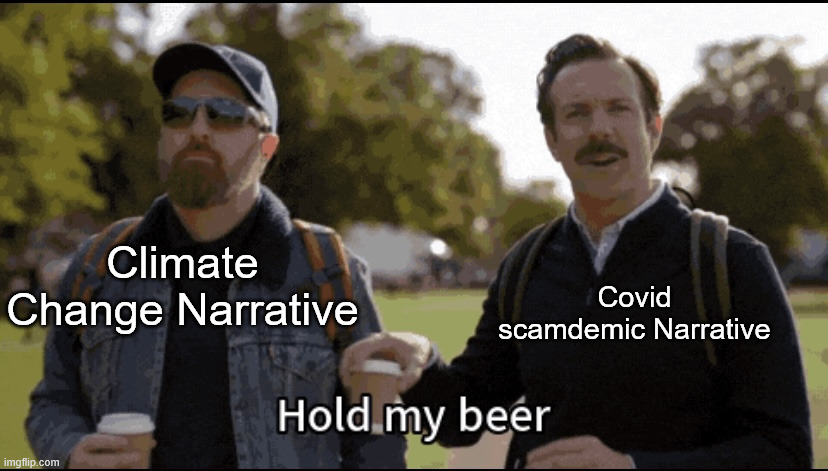
You do know that all of these places that all pushed this AGW narrative all were full bore on the Scamdemic narrative, right?

All of this is about money, power and control. This is not about an existential crises for global civilization.

ajlgsc.jpg


15th post
Labeling something “fallacious” doesn’t magically refute the underlying evidence. At best it critiques the argument, not the data. You keep talking about logical errors in how people talk about climate as if it's proof that the measurements themselves are invalid.

That’s a category mistake. Bad reasoning about a topic doesn’t invalidate research.

And calling science a “cult” because core conclusions persist through corrections is backwards. That’s literally how cumulative science works: individual papers get revised, models get tuned, error bars shrink, but the signal remains because it’s supported by independent lines of evidence. A cult protects beliefs from revision; climate science constantly revises methods while the empirical pattern stays consistent.

Models also converge on gravity being real.

Why?

Because...

Convergence is a normal feature of mature science.

Why do you argue so savagely about something you said you know nothing about ... read the first sentence in your OP again ... are you trying to convince yourself you're one of the cool peoples or something ...

All I asked was where climate has changed ... where do all the scientists in the whole wide say man-kind and changed the climate ... latitude and longitude please ...
 
Why do you argue so savagely about something you said you know nothing about ... read the first sentence in your OP again ... are you trying to convince yourself you're one of the cool peoples or something ...

All I asked was where climate has changed ... where do all the scientists in the whole wide say man-kind and changed the climate ... latitude and longitude please ...
I never said I know nothing. I said I’m not a climate scientist. That distinction matters if you actually want a productive discussion instead of tossing strawmen around.

As for your latitude and longitude request...

Climate change isn’t a single point on a map. It’s a statistical shift across the globe, ocean temperatures, atmospheric composition, ice mass, and weather patterns. Every major dataset literally comes from millions of geo-tagged measurements. Asking for a single GPS coordinate is a misunderstanding of the field.

If your goal is to challenge the science, the question isn’t “where exactly did it change?” It’s “can you show reproducible data that humans aren’t affecting these global systems?” No one has done that.
 
This collapses instantly under incentive analysis.

If you could credibly disprove human caused climate change, you would become one of the most famous scientists in history. You’d get:

instant tenure

massive media attention

book deals

think tank funding

fossil fuel money

political backing from half the plane

Overturning a dominant scientific paradigm is the single most rewarded act in science. That’s how careers are made. Also, the idea that there’s no funding on the skeptic side is just factually false. Oil companies, energy lobbies, conservative foundations, and entire governments have poured billions into climate skepticism for decades. The reason there’s no successful disproof isn’t lack of money; it’s lack of evidence.

You can fund research all you want. You can’t fund different laws of physics. So the real situation is the opposite of what you think. If climate change weren’t real, it would be the most overfunded, politically supported, career-making disproof project in modern scientific history.

And it still hasn’t happened.
All real scientific theories are falsifiable. Tell me what type of experiments can be run to prove or disprove AGW.

For years, these same quacks have been telling us the Arctic Ice will be gone, or the Ocean's will rise X amount over a certain period, all predictions turn out wrong.
 

New Topics

Back
Top Bottom