This is not what measured, mature leadership looks like.

2. 2nd claim: Russians hacked democrat emails. That claim is also not proven
Now you're just lying. It was the GRU who gave the hacked material to Wikileaks. Then Roger Stone coordinated the document dump with Assange right after the Access Hollywood tape went public.

Read pages 36-62, Vol. I of the Mueller Report.

III. RUSSIAN HACKING AND DUMPING OPERATIONS

Beginning in March 2016, units of the Russian Federation’s Main Intelligence Directorate of the General Staff (GRU) hacked the computers and email accounts of organizations, employees, and volunteers supporting the Clinton Campaign, including the email account of campaign chairman John Podesta. Starting in April 2016, the GRU hacked into the computer networks of the Democratic Congressional Campaign Committee (DCCC) and the Democratic National Committee (DNC). The GRU targeted hundreds of email accounts used by Clinton Campaign employees, advisors, and volunteers. In total, the GRU stole hundreds of thousands of documents from the compromised email accounts and networks.109 The GRU later released stolen Clinton Campaign and DNC documents through online personas, “DCLeaks” and “Guccifer 2.0,” and later through the organization WikiLeaks. The release of the documents was designed and timed to interfere with the 2016 U.S. presidential election and undermine the Clinton Campaign.
 
Last edited:
3. This claim also lacks specifics and details, but what has been more than amply proven is that democrats attempted to frame Trump associates with alleged Russian collusion
Nothing remotely like that happened. But you're welcome to provide your false evidence if you are prepared to be embarrassed.
 
Putting aside the fact that the Russians did a whole lot more than buy some adds, something you'd know if you has read Vol. I, how do you account for the trump campaign never once informing the FBI it had been contacted by operatives of a foreign adversary? Never once publicly stated it abhorred the idea a foreign adversary was helping trump get elected?

Let's see if we can clear this us. Trump had nothing to do with the Russian spy that crooked FBI officials helped arrange to meet with Trump. Trump never met with the woman and Trump Jr. threw her out of the building soon after she showed up claiming to have dirt that Trump would like to see. Trump Jr. saw she was a poser and saw no reason to report her attempts to the FBI because she was a poser who Trump Jr. was sure the FBI would have dismissed anyway.
The second enduring truth of the Mueller Report is that Russian military intelligence, in addition to the active measures, also conducted a campaign of hacking emails associated with the Democratic campaign and dumping them into the public domain. As the report puts it, “The release of the documents was designed and timed to interfere with the 2016 U.S. presidential election and undermine the Clinton Campaign.” The Trump campaign showed a keen interest in the release of these documents and, at times, engaged directly with the entities through which the Russians were distributing them.
There was a Romanian hacker, Guccifer 1, who was jailed for hacking into secret national accounts and he was caught and jailed in 2016. Guccifer 2 was never caught because he never existed except in democrat disinformation reports. Democrats suggested Guccifer 2 was the hacker who gave Wikileaks the DNC emails in spite of irrefutable testimony from CrowdStrike that the DNC emails were stolen in house and not hacked. Nobody ever heard of Guccifer 2 until the day after Wikileaks posted damaging democrat emails at which time Guccifer 2 was invented by democrats to deflect the truth about how the emails got into Assange's hands.
This is an uncomfortable truth for those who associate MAGA with patriotism and America First: Trump got help from the Russians. Whether that help ultimately mattered we will never know. But he knew he was getting help. His people knew he was getting help. They had every opportunity to behave like patriots and eschew help from foreign malign actors. And they passed every one of them up.
Democrats falsely claim the Russians helped Trump in 2016 in spite of all the evidence to the contrary. Putin clearly wanted Hillary to win in spite of democrat lies to the contrary.
This simple truth—which Trump has not meaningfully contested to this day—hangs over every incident in which Trump tilts towards Russia in its current war with Ukraine. In the wake of the Mueller Report, Trump—with an able assist from then-Attorney General Bill Barr—crowed that the big message of the report was that there had been “no collusion.” And for criminal purposes, that was right, in a sense. Mueller and his team had been unable to find people associated with the Trump campaign who actively conspired with Russian espionage or influence operations.
The reason Mueller never found out how the DNC emails got into Assange's hands is because Mueller never asked anyone anything about Seth Rich's very likely involvement in the matter.
 
Now you're just lying. It was the GRU who gave the hacked material to Wikileaks. Then Roger Stone coordinated the document dump with Assange right after the Access Hollywood tape went public.

Read pages 36-62, Vol. I of the Mueller Report.

III. RUSSIAN HACKING AND DUMPING OPERATIONS

Beginning in March 2016, units of the Russian Federation’s Main Intelligence Directorate of the General Staff (GRU) hacked the computers and email accounts of organizations, employees, and volunteers supporting the Clinton Campaign, including the email account of campaign chairman John Podesta. Starting in April 2016, the GRU hacked into the computer networks of the Democratic Congressional Campaign Committee (DCCC) and the Democratic National Committee (DNC). The GRU targeted hundreds of email accounts used by Clinton Campaign employees, advisors, and volunteers. In total, the GRU stole hundreds of thousands of documents from the compromised email accounts and networks.109 The GRU later released stolen Clinton Campaign and DNC documents through online personas, “DCLeaks” and “Guccifer 2.0,” and later through the organization WikiLeaks. The release of the documents was designed and timed to interfere with the 2016 U.S. presidential election and undermine the Clinton Campaign.
This is from the Mueller Report:

The Russian government interfered in the 2016 presidential election in sweeping and systematic fashion. Evidence of Russian government operations began to surface in mid-2016. In June, the Democratic National Committee and its cyber response team publicly announced that Russian hackers had compromised its computer network. Releases of hacked materials—hacks that public reporting soon attributed to the Russian government—began that same month. Additional releases followed in July through the organization WikiLeaks, with further releases in October and November.

This is from the irrefutable testimony that contradicts the unsupported self-serving lying claim that someone hacked the DNC computers and gave the emails to Assange:

Austin-based cybersecurity firm responsible for global IT outage lied about Russian hack and then later admitted there was no evidence to support this assertion.​

John Leake
Jul 20, 2024


The second I saw the news yesterday that computers all over the world had been taken down—causing widespread disruptions to travel, medical care and an array of businesses—I couldn’t help wondering if it was an implicit reminder of how dependent we are on global computer systems, and therefore how vulnerable we are.

Then I saw the outage was purportedly traced to CrowdStrike—the same Austin-based cybersecurity hired by the DNC in 2016 to investigate the alleged “hack” of its server. The security breach resulted in the leak of incredibly embarrassing e-mails revealing John Podesta, Hillary Clinton, and DNC leadership performing all manner of Machiavellian machinations.

Back then, when I read the Wikileaks e-mails, I immediately wondered, “How are these villains going to change the subject from the content of their e-mails to something else? What misdirection trick are they going to pull?”

Enter CrowdStrike, which the DNC hired to do a forensic cybersecurity analysis of the DNC server. Shortly thereafter, CrowdStrike claimed that Russian agents had hacked it.


It didn’t matter that there was no evidence of this, as CrowdStrike President Shawn Henry admitted under oath in a declassified December 2017 interview before the House Intelligence Committee. The lying mainstream media still ran with the story that became the Russian Collusion HOAX—the biggest fraud of the decade.

Even though former NSA Technical Director, William Binney, tried to tell anyone who would listen that the leak must have resulted from a DNC insider who downloaded the e-mails onto a storage device, no major mainstream media outlet would listen to him.
 
This is from the irrefutable testimony
Not irrefutable. Horseshit.

A Collusion Reading Diary: What Did the Senate Intelligence Committee Find?​

The section entitled “Hack and Leak” contains perhaps the frankest statements describing efforts by the Trump campaign institutionally—and Trump personally—to take advantage of Russia’s efforts, through WikiLeaks, to damage Hillary Clinton’s candidacy:


While the GRU and WikiLeaks were releasing hacked documents, the Trump Campaign sought to maximize the impact of those materials to aid Trump's electoral prospects. To do so, the Trump Campaign took actions to obtain advance notice about WikiLeaks releases of Clinton emails; took steps to obtain inside information about the content of releases once WikiLeaks began to publish stolen information; created messaging strategies to promote and share the materials in anticipation of and following their release; and encouraged further theft of information and continued leaks.

The report summarizes the key role of Roger Stone in these efforts:


Trump and senior Campaign officials sought to obtain advance information about WikiLeaks through Roger Stone. In spring 2016, prior to Assange's public announcements, Stone advised the Campaign that WikiLeaks would be releasing materials harmful to Clinton. Following the July 22 DNC release, Trump and the Campaign believed that Roger Stone had known of the release and had inside access to WikiLeaks, and repeatedly communicated with Stone about WikiLeaks throughout the summer and fall of 2016. Trump and other senior Campaign officials specifically directed Stone to obtain information about upcoming document releases relating to Clinton and report back. At their direction, Stone took action to gain inside knowledge for the Campaign and shared his purported knowledge directly with Trump and senior Campaign officials on multiple occasions. Trump and the Campaign believed that Stone had inside information and expressed satisfaction that Stone's information suggested more releases would be forthcoming.

These summaries are supported by detailed factual accounts that specify the roles different members of the campaign and other Trump associates played in the efforts. The report shows, in detail, that Roger Stone did not act in a vacuum or without the knowledge of the campaign or Donald Trump himself. In August 2016, following a tasking from the campaign, Stone obtained information indicating that John Podesta would be a target of an upcoming release, prior to WikiLeaks releasing Podesta's emails. Stone communicated this information to Trump and other senior campaign officials and affiliates, including Paul Manafort and Rick Gates.


Indeed, the report specifies that “[w]hile it was seeking advance information about potential WikiLeaks releases, the Campaign created a messaging strategy to promote the stolen materials.”


And crucially, the report makes clear that both Trump and the campaign continued these efforts even after it was well understood that Russia was behind them:


Trump and the Campaign continued to promote and disseminate the hacked WikiLeaks documents, even after the Office of the Director of National Intelligence [ODNI] and the Department of Homeland Security [DHS] released a joint statement officially attributing the hack-and-leak campaign to Russia as part of its interference in the U.S. presidential election. The Trump Campaign publicly undermined the attribution of the hack-and-leak campaign to Russia, and was indifferent to whether it and WikiLeaks were furthering a Russian election interference effort.
 
Nothing remotely like that happened. But you're welcome to provide your false evidence if you are prepared to be embarrassed.
The Russian spy was working for democrats and met with democrats before and after the scam meeting with Trump Jr. that democrats had hoped to use to support their false claims that Trump cnspired with Russia during the 2016 election.

Firm behind Trump dossier met with Russian lawyer involved in Trump Jr. meeting | New York PostTop of Form

Firm behind Trump dossier met with Russian lawyer involved in Trump Jr. meeting

By

Mark Moore

Published Nov. 7, 2017

Updated Oct. 14, 2019, 1:49 p.m. ET

1775168405878.webp
Natalia Veselnitskaya and Donald Trump Jr.Getty Images

One of the founders of the research firm behind the controversial Russian dossier met with a Kremlin-linked lawyer before and after she sat down with President Trump’s son and other campaign officials at the Trump Tower during the 2016 election, Fox News reported on Tuesday.


Russian lawyer reportedly met with Kremlin official before Trump Jr. sitdown


Glenn Simpson, a former Wall Street Journal reporter and co-founder of Fusion GPS, was with Russian lawyer Natalia Veselnitskaya at a Manhattan federal courtroom just hours before the Trump Tower meeting on June 9, 2016, Fox News reported, citing a source. He met with her again after the meeting, the report said.

Veselnitskaya, promising “dirt” on Hillary Clinton, met with Donald Trump Jr. and other campaign operatives – including Jared Kushner and former campaign manager Paul Manafort. Trump Jr. later said the discussion was about Russian adoptions.

But the meeting took place at a critical time when Fusion GPS was being paid by a Russian oligarch and by the Clinton campaign and the Democratic National Committee while it enlisted former British spy Christopher Steele to dig up damaging information about Trump through his contacts in Moscow, Fox News said.

The report said Simpson’s meeting Veselnitskaya and Fusion GPS’ being bankrolled by the DNC, the Clinton campaign and Russian interests raises new questions about what role the firm played in the presidential election.
 
The Russian spy was working for democrats
I congratulate you for it taking you a few posts before descending hopelessly down the rabbit hole of crazed conspiracy theories. Most trumples do it much faster.
 
Trump represents a tiny sliver of America today. Everyone knows that including our allies and enemies. Our Allies have decided to ignore him as he will be out of power soon. Now that tariffs are illegal they arent even taking his calls.
Bergies idea of 'Measured, mature leadership:


**** them. Bunch of ingrates all of em…

Lessee: NATO is using the argument that the mission of NATO was to protect Europe from Soviet incursions! But there is no Soviet Union, and why does USA need to be in an org that is ostensibly for EUROPE? Meantime, they came running when we went after al-Quada, then it was their war, but it is not their war now that Iran has cut off THEIR oil supply? They have left Trump out twisting in the wind, stuck with cleaning up the mess while we pay for it all so they can waltz in for free and start taking oil again, safely.

NATO leaders are now "shocked and concerned" about Trump's comment on leaving NATO.

Funny how it always works one way where everything Trump says and does pisses them yet they can say and do anything, crap like this, and Trump is not to be offended?

It would not surprise me now if Trump doesn't leave Europe over a barrel and really screw them. I think Trump has lost all respect for most of the EU leaders.
 
15th post
Not irrefutable. Horseshit.

A Collusion Reading Diary: What Did the Senate Intelligence Committee Find?​

The section entitled “Hack and Leak” contains perhaps the frankest statements describing efforts by the Trump campaign institutionally—and Trump personally—to take advantage of Russia’s efforts, through WikiLeaks, to damage Hillary Clinton’s candidacy:


The report summarizes the key role of Roger Stone in these efforts:


These summaries are supported by detailed factual accounts that specify the roles different members of the campaign and other Trump associates played in the efforts. The report shows, in detail, that Roger Stone did not act in a vacuum or without the knowledge of the campaign or Donald Trump himself. In August 2016, following a tasking from the campaign, Stone obtained information indicating that John Podesta would be a target of an upcoming release, prior to WikiLeaks releasing Podesta's emails. Stone communicated this information to Trump and other senior campaign officials and affiliates, including Paul Manafort and Rick Gates.


Indeed, the report specifies that “[w]hile it was seeking advance information about potential WikiLeaks releases, the Campaign created a messaging strategy to promote the stolen materials.”


And crucially, the report makes clear that both Trump and the campaign continued these efforts even after it was well understood that Russia was behind them:


False or weakly supported allegations are not irrefutable facts. Democrats can claim their reports are true and reports like this are lying but they cannot prove this report is lying because it is not lying.

Hidden Over 2 Years: Dem Cyber-Firm's Sworn Testimony It Had No Proof of Russian Hack of DNC | RealClearInvestigations

Hidden Over 2 Years: Dem Cyber-Firm's Sworn Testimony It Had No Proof of Russian Hack of DNC
5-13-20

CrowdStrike, the private cyber-security firm that first accused Russia of hacking Democratic Party emails and served as a critical source for U.S. intelligence officials in the years-long Trump-Russia probe, acknowledged to Congress more than two years ago that it had no concrete evidence that Russian hackers stole emails from the Democratic National Committee’s server.

Crowdstrike President Shawn Henry: "We just don’t have the evidence ..."

Crowdstrike.com

CrowdStrike President Shawn Henry's admission under oath, in a recently declassified December 2017 interview before the House Intelligence Committee, raises new questions about whether Special Counsel Robert Mueller, intelligence officials and Democrats misled the public. The allegation that Russia stole Democratic Party emails from Hillary Clinton, John Podesta and others and then passed them to WikiLeaks helped trigger the FBI's probe into now debunked claims of a conspiracy between the Trump campaign and Russia to steal the 2016 election. The CrowdStrike admissions were released just two months after the Justice Department retreated from its its other central claim that Russia meddled in the 2016 election when it dropped charges against Russian troll farms it said had been trying to get Trump elected.

Henry personally led the remediation and forensics analysis of the DNC server after being warned of a breach in late April 2016; his work was paid for by the DNC, which refused to turn over its server to the FBI. Asked for the date when alleged Russian hackers stole data from the DNC server, Henry testified that CrowdStrike did not in fact know if such a theft occurred at all: "We did not have concrete evidence that the data was exfiltrated [moved electronically] from the DNC, but we have indicators that it was exfiltrated," Henry said.

Henry reiterated his claim on multiple occasions:

  • "There are times when we can see data exfiltrated, and we can say conclusively. But in this case it appears it was set up to be exfiltrated, but we just don’t have the evidence that says it actually left."
  • "There’s not evidence that they were actually exfiltrated. There's circumstantial evidence but no evidence that they were actually exfiltrated."
  • "There is circumstantial evidence that that data was exfiltrated off the network. … We didn't have a sensor in place that saw data leave. We said that the data left based on the circumstantial evidence. That was the conclusion that we made."
  • "Sir, I was just trying to be factually accurate, that we didn't see the data leave, but we believe it left, based on what we saw."
  • Asked directly if he could "unequivocally say" whether "it was or was not exfiltrated out of DNC," Henry told the committee: "I can't say based on that."


Rep. Adam Schiff: Democrat held up interview transcripts, but finally relented after acting intel director Richard Grenell suggested he would release them himself.

(Senate Television via AP)

In a later exchange with Republican Rep. Chris Stewart of Utah, Henry offered an explanation of how Russian agents could have obtained the emails without any digital trace of them leaving the server. The CrowdStrike president speculated that Russian agents might have taken "screenshots" in real time. "[If] somebody was monitoring an email server, they could read all the email," Henry said. "And there might not be evidence of it being exfiltrated, but they would have knowledge of what was in the email. … There would be ways to copy it. You could take screenshots."

Henry’s 2017 testimony that there was no “concrete evidence” that the emails were stolen electronically suggests that Mueller may have been misleading in his 2019 final report. The report stated that Russian intelligence "appears to have compressed and exfiltrated over 70 gigabytes of data" and agents "appear to have stolen thousands of emails and attachments" from Democratic Congressional Campaign Committee and DNC servers, respectively. It also suggests that the DNC emails were transferred to a server in Illinois controlled by the Russian intelligence service GRU. But in addition to including the qualifier "appear," Mueller's source for the Illinois server claim is redacted. That leaves CrowdStrike, to date, as U.S. intelligence officials’ primary, publicly known source for its confident claims about Russian hacking.

The stolen emails, which were published by Wikileaks – whose founder, Julian Assange has long denied they came from Russia – were embarrassing to the party because, among other things, they showed the DNC had favored Clinton during her 2016 primary battles against Sen. Bernie Sanders for the presidential nomination. The DNC eventually issued an apology to Sanders and his supporters "for the inexcusable remarks made over email." The DNC hack was separate from the FBI’s investigation of Clinton’s use of a private server while serving as President Obama’s Secretary of State.

The disclosure that CrowdStrike found no evidence that alleged Russian hackers exfiltrated any data from the DNC server raises a critical question: On what basis, then, did it accuse them of stealing the emails? Further, on what basis did Obama administration officials make far more forceful claims about Russian hacking?


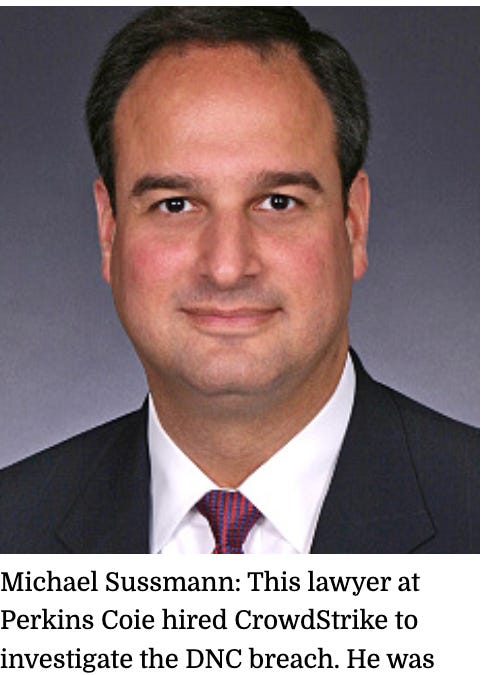
Michael Sussmann: This lawyer at Perkins Coie hired CrowdStrike to investigate the DNC breach. He was also involved with Fusion GPS and Christopher Steele in producing the discredited Steele dossier.

perkinscoie.com

The January 2017 Intelligence Community Assessment (ICA), which formally accused Russia of a sweeping influence campaign involving the theft of Democratic emails, claimed the Russian intelligence service "exfiltrated large volumes of data from the DNC." A July 2018 indictment claimed that GRU officers "stole thousands of emails from the work accounts of DNC employees."

According to everyone concerned, the cyber-firm played a critical role in the FBI's investigation of the DNC data theft. Henry told the panel that CrowdStrike "shared intelligence with the FBI" on a regular basis, making "contact with them over a hundred times in the course of many months." In congressional testimony that same year, former FBI Director James Comey acknowledged that the FBI "never got direct access to the machines themselves," and instead relied on CrowdStrike, which "shared with us their forensics from their review of the system." According to Comey, the FBI would have preferred direct access to the server, and made "multiple requests at different levels," to obtain it. But after being rebuffed, "ultimately it was agreed to… [CrowdStrike] would share with us what they saw."

Henry’s testimony seems at variance with Comey’s suggestion of complete information sharing. He told Congress that CrowdStrike provided "a couple of actual digital images" of DNC hard drives, out of a total number of "in excess of 10, I think." In other cases, Henry said, CrowdStrike provided its own assessment of them. The firm, he said, provided "the results of our analysis based on what our technology went out and collected." This disclosure follows revelations from the case of Trump operative Roger Stone that CrowdStrike provided three reports to the FBI in redacted and draft form. According to federal prosecutors, the government never obtained CrowdStrike's unredacted reports.


CrowdStrike's newy disclosed admissions raise new questions about whether Special Counsel Robert Mueller (above), intelligence officials and Democrats misled the public.

AP Photo/Susan Walsh

There are no indications that the Mueller team accessed any additional information beyond what CrowdStrike provided. According to the Mueller report, "the FBI later received images of DNC servers and copies of relevant traffic logs." But if the FBI obtained only "copies" of data traffic – and not any new evidence -- those copies would have shown the same absence of "concrete evidence" that Henry admitted to.

Adding to the tenuous evidence is CrowdStrike's own lack of certainty that the hackers it identified inside the DNC server were indeed Russian government actors. Henry's explanation for his firm's attribution of the DNC hack to Russia is replete with inferences and assumptions that lead to "beliefs," not unequivocal conclusions. "There are other nation-states that collect this type of intelligence for sure," Henry said, "but what we would call the tactics and techniques were consistent with what we'd seen associated with the Russian state." In its investigation, Henry said, CrowdStrike "saw activity that we believed was consistent with activity we'd seen previously and had associated with the Russian Government. … We said that we had a high degree of confidence it was the Russian Government."

But CrowdStrike was forced to retract a similar accusation months after it accused Russia in December 2016 of hacking the Ukrainian military, with the same software that the firm had claimed to identify inside the DNC server.

The firm's work with the DNC and FBI is also colored by partisan affiliations. Before joining CrowdStrike, Henry served as executive assistant director at the FBI under Mueller. Co-founder Dmitri Alperovitch is a vocal critic of Vladimir Putin and a senior fellow at the Atlantic Council, the pro-NATO think tank that has consistently promoted an aggressive policy toward Russia. And the newly released testimony confirms that CrowdStrike was hired to investigate the DNC breach by Michael Sussmann of Perkins Coie – the same Democratic-tied law firm that hired Fusion GPS to produce the discredited Steele dossier, which was also treated as central evidence in the investigation. Sussmann played a critical role in generating the Trump-Russia collusion allegation. Ex-British spy and dossier compiler Christopher Steele has testified in British court that Sussmann shared with him the now-debunked Alfa Bank server theory, alleging a clandestine communication channel between the bank and the Trump Organization.

Henry’s recently released testimony does not mean that Russia did not hack the DNC. What it does make clear is that Obama administration officials, the DNC and others have misled the public by presenting as fact information that they knew was uncertain. The fact that the Democratic Party employed the two private firms that generated the core allegations at the heart of Russiagate -- Russian email hacking and Trump-Russia collusion – suggests that the federal investigation was compromised from the start.

The 2017 Henry transcript was one of dozens just released after a lengthy dispute. In September 2018, the Republican-controlled House Intelligence Committee unanimously voted to release witness interview transcripts and sent them to the U.S. intelligence community for declassification review. In March 2019, months after Democrats won House control, Rep. Adam Schiff ordered the Office of the Director of National Intelligence (ODNI) to withhold the transcripts from White House lawyers seeking to review them for executive privilege. Schiff also refused to release vetted transcripts, but finally relented after acting ODNI Director Richard Grenell suggested this month that he would release them himself.

Several transcripts, including the interviews of former CIA Director John Brennan and Comey, remain unreleased. And in light of the newly disclosed Crowdstrike testimony, another secret document from the House proceedings takes on urgency for public viewing. According to Henry, Crowdstrike also provided the House Intelligence Committee with a copy of its report on the DNC email theft.
 
I congratulate you for it taking you a few posts before descending hopelessly down the rabbit hole of crazed conspiracy theories. Most trumples do it much faster.
Claiming a report is false is a long way from proving it to be false.
 
False or weakly supported allegations are not irrefutable facts. Democrats can claim their reports are true and reports like this are lying but they cannot prove this report is lying because it is not lying.

Hidden Over 2 Years: Dem Cyber-Firm's Sworn Testimony It Had No Proof of Russian Hack of DNC | RealClearInvestigations

Hidden Over 2 Years: Dem Cyber-Firm's Sworn Testimony It Had No Proof of Russian Hack of DNC
5-13-20

CrowdStrike, the private cyber-security firm that first accused Russia of hacking Democratic Party emails and served as a critical source for U.S. intelligence officials in the years-long Trump-Russia probe, acknowledged to Congress more than two years ago that it had no concrete evidence that Russian hackers stole emails from the Democratic National Committee’s server.

Crowdstrike President Shawn Henry: "We just don’t have the evidence ..."

Crowdstrike.com

CrowdStrike President Shawn Henry's admission under oath, in a recently declassified December 2017 interview before the House Intelligence Committee, raises new questions about whether Special Counsel Robert Mueller, intelligence officials and Democrats misled the public. The allegation that Russia stole Democratic Party emails from Hillary Clinton, John Podesta and others and then passed them to WikiLeaks helped trigger the FBI's probe into now debunked claims of a conspiracy between the Trump campaign and Russia to steal the 2016 election. The CrowdStrike admissions were released just two months after the Justice Department retreated from its its other central claim that Russia meddled in the 2016 election when it dropped charges against Russian troll farms it said had been trying to get Trump elected.

Henry personally led the remediation and forensics analysis of the DNC server after being warned of a breach in late April 2016; his work was paid for by the DNC, which refused to turn over its server to the FBI. Asked for the date when alleged Russian hackers stole data from the DNC server, Henry testified that CrowdStrike did not in fact know if such a theft occurred at all: "We did not have concrete evidence that the data was exfiltrated [moved electronically] from the DNC, but we have indicators that it was exfiltrated," Henry said.

Henry reiterated his claim on multiple occasions:


  • "There are times when we can see data exfiltrated, and we can say conclusively. But in this case it appears it was set up to be exfiltrated, but we just don’t have the evidence that says it actually left."
  • "There’s not evidence that they were actually exfiltrated. There's circumstantial evidence but no evidence that they were actually exfiltrated."
  • "There is circumstantial evidence that that data was exfiltrated off the network. … We didn't have a sensor in place that saw data leave. We said that the data left based on the circumstantial evidence. That was the conclusion that we made."
  • "Sir, I was just trying to be factually accurate, that we didn't see the data leave, but we believe it left, based on what we saw."
  • Asked directly if he could "unequivocally say" whether "it was or was not exfiltrated out of DNC," Henry told the committee: "I can't say based on that."


Rep. Adam Schiff: Democrat held up interview transcripts, but finally relented after acting intel director Richard Grenell suggested he would release them himself.

(Senate Television via AP)

In a later exchange with Republican Rep. Chris Stewart of Utah, Henry offered an explanation of how Russian agents could have obtained the emails without any digital trace of them leaving the server. The CrowdStrike president speculated that Russian agents might have taken "screenshots" in real time. "[If] somebody was monitoring an email server, they could read all the email," Henry said. "And there might not be evidence of it being exfiltrated, but they would have knowledge of what was in the email. … There would be ways to copy it. You could take screenshots."

Henry’s 2017 testimony that there was no “concrete evidence” that the emails were stolen electronically suggests that Mueller may have been misleading in his 2019 final report. The report stated that Russian intelligence "appears to have compressed and exfiltrated over 70 gigabytes of data" and agents "appear to have stolen thousands of emails and attachments" from Democratic Congressional Campaign Committee and DNC servers, respectively. It also suggests that the DNC emails were transferred to a server in Illinois controlled by the Russian intelligence service GRU. But in addition to including the qualifier "appear," Mueller's source for the Illinois server claim is redacted. That leaves CrowdStrike, to date, as U.S. intelligence officials’ primary, publicly known source for its confident claims about Russian hacking.

The stolen emails, which were published by Wikileaks – whose founder, Julian Assange has long denied they came from Russia – were embarrassing to the party because, among other things, they showed the DNC had favored Clinton during her 2016 primary battles against Sen. Bernie Sanders for the presidential nomination. The DNC eventually issued an apology to Sanders and his supporters "for the inexcusable remarks made over email." The DNC hack was separate from the FBI’s investigation of Clinton’s use of a private server while serving as President Obama’s Secretary of State.

The disclosure that CrowdStrike found no evidence that alleged Russian hackers exfiltrated any data from the DNC server raises a critical question: On what basis, then, did it accuse them of stealing the emails? Further, on what basis did Obama administration officials make far more forceful claims about Russian hacking?


Michael Sussmann: This lawyer at Perkins Coie hired CrowdStrike to investigate the DNC breach. He was also involved with Fusion GPS and Christopher Steele in producing the discredited Steele dossier.

perkinscoie.com

The January 2017 Intelligence Community Assessment (ICA), which formally accused Russia of a sweeping influence campaign involving the theft of Democratic emails, claimed the Russian intelligence service "exfiltrated large volumes of data from the DNC." A July 2018 indictment claimed that GRU officers "stole thousands of emails from the work accounts of DNC employees."

According to everyone concerned, the cyber-firm played a critical role in the FBI's investigation of the DNC data theft. Henry told the panel that CrowdStrike "shared intelligence with the FBI" on a regular basis, making "contact with them over a hundred times in the course of many months." In congressional testimony that same year, former FBI Director James Comey acknowledged that the FBI "never got direct access to the machines themselves," and instead relied on CrowdStrike, which "shared with us their forensics from their review of the system." According to Comey, the FBI would have preferred direct access to the server, and made "multiple requests at different levels," to obtain it. But after being rebuffed, "ultimately it was agreed to… [CrowdStrike] would share with us what they saw."

Henry’s testimony seems at variance with Comey’s suggestion of complete information sharing. He told Congress that CrowdStrike provided "a couple of actual digital images" of DNC hard drives, out of a total number of "in excess of 10, I think." In other cases, Henry said, CrowdStrike provided its own assessment of them. The firm, he said, provided "the results of our analysis based on what our technology went out and collected." This disclosure follows revelations from the case of Trump operative Roger Stone that CrowdStrike provided three reports to the FBI in redacted and draft form. According to federal prosecutors, the government never obtained CrowdStrike's unredacted reports.


CrowdStrike's newy disclosed admissions raise new questions about whether Special Counsel Robert Mueller (above), intelligence officials and Democrats misled the public.

AP Photo/Susan Walsh

There are no indications that the Mueller team accessed any additional information beyond what CrowdStrike provided. According to the Mueller report, "the FBI later received images of DNC servers and copies of relevant traffic logs." But if the FBI obtained only "copies" of data traffic – and not any new evidence -- those copies would have shown the same absence of "concrete evidence" that Henry admitted to.

Adding to the tenuous evidence is CrowdStrike's own lack of certainty that the hackers it identified inside the DNC server were indeed Russian government actors. Henry's explanation for his firm's attribution of the DNC hack to Russia is replete with inferences and assumptions that lead to "beliefs," not unequivocal conclusions. "There are other nation-states that collect this type of intelligence for sure," Henry said, "but what we would call the tactics and techniques were consistent with what we'd seen associated with the Russian state." In its investigation, Henry said, CrowdStrike "saw activity that we believed was consistent with activity we'd seen previously and had associated with the Russian Government. … We said that we had a high degree of confidence it was the Russian Government."

But CrowdStrike was forced to retract a similar accusation months after it accused Russia in December 2016 of hacking the Ukrainian military, with the same software that the firm had claimed to identify inside the DNC server.

The firm's work with the DNC and FBI is also colored by partisan affiliations. Before joining CrowdStrike, Henry served as executive assistant director at the FBI under Mueller. Co-founder Dmitri Alperovitch is a vocal critic of Vladimir Putin and a senior fellow at the Atlantic Council, the pro-NATO think tank that has consistently promoted an aggressive policy toward Russia. And the newly released testimony confirms that CrowdStrike was hired to investigate the DNC breach by Michael Sussmann of Perkins Coie – the same Democratic-tied law firm that hired Fusion GPS to produce the discredited Steele dossier, which was also treated as central evidence in the investigation. Sussmann played a critical role in generating the Trump-Russia collusion allegation. Ex-British spy and dossier compiler Christopher Steele has testified in British court that Sussmann shared with him the now-debunked Alfa Bank server theory, alleging a clandestine communication channel between the bank and the Trump Organization.

Henry’s recently released testimony does not mean that Russia did not hack the DNC. What it does make clear is that Obama administration officials, the DNC and others have misled the public by presenting as fact information that they knew was uncertain. The fact that the Democratic Party employed the two private firms that generated the core allegations at the heart of Russiagate -- Russian email hacking and Trump-Russia collusion – suggests that the federal investigation was compromised from the start.

The 2017 Henry transcript was one of dozens just released after a lengthy dispute. In September 2018, the Republican-controlled House Intelligence Committee unanimously voted to release witness interview transcripts and sent them to the U.S. intelligence community for declassification review. In March 2019, months after Democrats won House control, Rep. Adam Schiff ordered the Office of the Director of National Intelligence (ODNI) to withhold the transcripts from White House lawyers seeking to review them for executive privilege. Schiff also refused to release vetted transcripts, but finally relented after acting ODNI Director Richard Grenell suggested this month that he would release them himself.

Several transcripts, including the interviews of former CIA Director John Brennan and Comey, remain unreleased. And in light of the newly disclosed Crowdstrike testimony, another secret document from the House proceedings takes on urgency for public viewing. According to Henry, Crowdstrike also provided the House Intelligence Committee with a copy of its report on the DNC email theft.
You may not have noticed the chairman of the Senate Intelligence Committee when its bipartisan report was published was none other than Marco Rubio.

FBI reviewed cybersecurity firm’s evidence in 2016 DNC election hack​


CLAIM: The FBI only relied on the word of a cybersecurity firm, CrowdStrike, to determine that Russia hacked the emails of the Democratic National Committee.

AP’S ASSESSMENT: False. CrowdStrike provided forensic evidence and analysis for the FBI to review during its investigation into a 2016 hack of DNC emails.

THE FACTS: Social media posts are wrongly claiming that the FBI failed to review evidence in the hack of the DNC’s computer network before concluding that Russia was responsible for the breach.


The websites you're using are nutty fringe sites with no credibility.
 
Last edited:
Back
Top Bottom