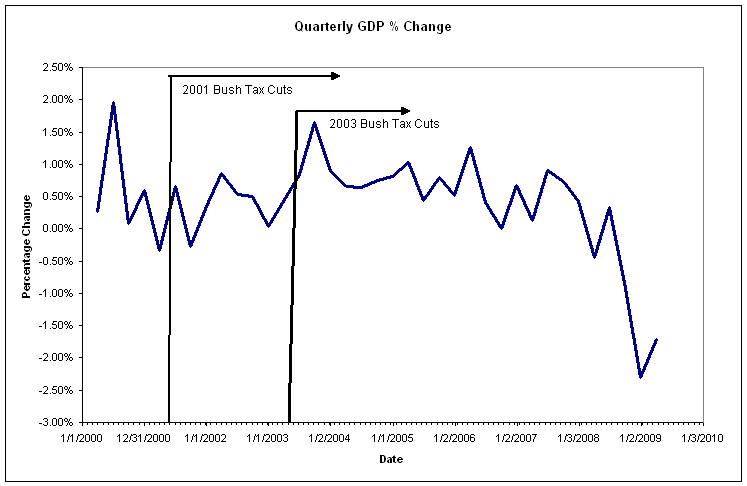
Is that just an autonomic response?
I already provided it. Did you bother to look?
You provided a link to the Heritage Foundation claiming the Bush tax cuts would eliminate the national debt by 2010?
I must have missed it.
Could you provide the link again?
Well, okay, it is referenced on
Economic Growth and Tax Relief Reconciliation Act of 2001 - Wikipedia, the free encyclopedia
"
The Heritage Foundation predicted the cuts would result in the complete elimination of the U.S. national debt by fiscal year 2010.[2]"
[2] ^ Wilson, D.; William Beach (2001-04-27). "The Economic Impact of President Bush's Tax Relief Plan". The Heritage Foundation. The Economic Impact of President Bush's Tax Relief Plan. Retrieved 2011-04-05. "Under President Bush's plan, an average family of four's inflation-adjusted disposable income would increase by $4,544 in fiscal year (FY) 2011, and the national debt would effectively be paid off by FY 2010."
This links to:
The Economic Impact of President Bush's Tax Relief Plan
The full report appears to be
http://thf_media.s3.amazonaws.com/2001/pdf/cda01-01.pdf
The web page reads
"Under President Bush's plan, an average family of four's inflation-adjusted disposable income would increase by $4,544 in fiscal year (FY) 2011, and the national debt would effectively be paid off by FY 2010." 4
4 Both the Congressional Budget Office (CBO) and the Office of Management and Budget estimate that, regardless of the size of the surpluses over the next 10 years, some debt will remain outstanding and incur interest costs. In fiscal year 2011, the CBO estimates, $818 billion in publicly held federal debt cannot be paid because it consists of long-term bonds and savings bonds that will not be available for redemption.
This qualifies the word "effectively". And that is fine. The debt was about $5.808 trillion, so paying off all but $818 billion would be pretty good.
The reference to the CBO does not include the source document or a link to the source document. It does not say that they estimate the "debt would effectively be paid off by FY 2010". It only says that they say that "
$818 billion in publicly held federal debt cannot be paid". It also does not quote the CBO, it paraphrases them. So, the reference qualifies the word "effectively" in paraphrasing an un-cited CBO statement.
Whatever the CBO says would have to be ferreted out by reading all the CBO reports on CBO Economic Growth and Reconciliation Act of 2001. It would take a bit of research to find any CBO analysis that might be the statement that is paraphrased.
----------------------
99:1 odds that the CBO reports on the Economic Growth and Reconciliation Act of 2001 invalidates what the the Heritage Foundation report claims.
I do not believe un-cited references. They are intentionally not cited. It is not accidental. It is learned. They are not stupid. It is done to avoid calling attention to other statements that negate the claim. If the cited reference supported their claims, then they would quote it and cite it. They are well aware that it takes considerable research to read every possible source of the un-cited reference. They depend on the reader not researching it. I have always given people the benefit of the doubt. I have learned better. There is as much to be understood from what is missing as there is from what is included. At this point, I could have predicted that the link chains would stop at the Heritage Foundation. Notice that they did do a link in " 9. The White House, "The President's Agenda for Tax Relief," at
Briefing Room | The White House (February 9, 2001). "
Reading the Heritage Foundation page, I see that they have all sorts of hypothesis set forth as economic law. For example,
"The analysis in this CDA Report is often called a dynamic or behavioral analysis. Dynamic tax analysis attempts to capture the many ways that taxpayer behavior changes following a significant tax policy change. For example, dramatic decreases in the taxes on labor or capital will cause more labor or capital to be employed in productive activities. A business owner who knows that his or her own labor will be taxed less may work more; a non-employed spouse may seek work outside the home once the taxes on labor fall. Overall, additional labor or capital can spur the economy to higher levels of output, which causes a growth in tax revenues as a result of the expansion of the tax base."
This is nice because peer reviewed published scientific papers that disprove or fail to prove something don't get published. Given the amount of reading, it's not fruitful to read "I proved this doesn't have an effect." Now, we have this nice "proof" of a failed hypothesis, that "A business owner who knows that his or her own labor will be taxed less may work more." In fact, there is as much reason to conclude that a business owner that knows he will have more money to take home may work less.
And, they might have meant "something else". Or it might be "more complicated than that". Or, they did say "may". All that is beside the point. They made this "dynamic" analysis based on their axioms or postulates. Their analysis proved incorrect. This negates all of it. It is incumbent on them to be right or re-publish and prove exactly how they were wrong.
Einstein, in his 1905 paper, "On the Electrodynamics of Moving Bodies", now known as the Theory of Special Relativity, made extra ordinary and outlandish claims that an object moving at near light speed is shorter than at rest. He made the outlandish claim that a clock moving at near light speed, or even a clock affected by a different gravitational pull, will run slower. He made the extra ordinary claim that gravity warps the fabric of space-time and that time and distance itself literally changes. It is the most counter-intuitive thought in the history of scientific thought. With a single experiment, his entire
Law of Space-Time could be proven wrong. And yet, it has been proven, beyond a shadow of a doubt, over and over and over again. It will never be proven wrong.
As counter-intuitive as it is, it is absolutely correct. If you are speeding your stretch limo, at near light speed, into your garage which is too short to fit it, it will fit completely in the garage. The back end will pass the door before the front ever touches the back. And, assuming you have really good brakes, as you stop it dead nuts in the garage, it will literally grow in length.
On the other hand, the Heritage Foundation presents some things not so seemingly outlandish. They makes some sort of "intuitive" sense. And they are demonstratively wrong. A monkey would do better. A monkey would get it right half the time. I can go down that Heritage Foundation paper and would do better stating the opposite of every postulate.
One might say, "A business owner will work more if taxes are higher because he want the money." "A women, who's husband is making more money because of a tax cut, will stop working." "Raise taxes, and the business owner works more" "Lower taxes, and he doesn't have to work as hard." "Lower taxes and he makes more profit. " I can go on and on and on. They are better hypothesis.
I don't use em, because I have higher standards of proof then the Heritage Foundation. I don't generally consider "taking the opposite of the Heritage Foundation" as "proof".
But as Albert Einstein Is His Name, it sure does work.
But it makes as much intuitive sense to say that, "given lower taxes, the company president will take the extra profits and pay for a membership at the country club while you work."
Duh!!!