Part 4
The "Armenian" Quarter
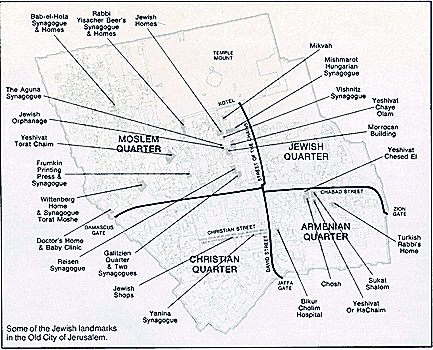
In the Armenian Quarter only one sector is actually occupied by the Armenian compound. The Armenian compound has a wall around it enclosing the big cathedral and its adjoining buildings. The rest of the quarter had to have a name. It wasn't Jewish, it wasn't Moslem, it wasn't Christian. So they applied to this section the name of its neighbor Armenian - simply a convenient fiction. Recently, an American Christian scholar made a study of the divisions of Jerusalem, and rightly calls this sector Hart el Yahud which means "The Jewish Section (of the Armenian Quarter)." Thus, here is an admission, from a non-Jew, that the 'Armenian Quarter' had a very heavy concentration of Jews.
The Armenian Quarter, on the west, and the Jewish Quarter, on the east, are divided by Chabad Street (Suq El Hussor Road). In other words, one half of Chabad Street is Jewish, the other half Armenian. Now, on one side of the Armenian Quarter there is, right opposite the Chabad Synagogue, a very famous yeshiva of Kabbalists called Yeshiva Hesed El, which was built in 1860 by a Jew from Baghdad. He endowed the yeshiva with a famous library of Kabbalistic works. Right next to Yeshiva Hesed El was the center of the Ashkenazi settlement in the Jewish quarter: the Hurva (Desolation) Synagogue, although the Hurva was far from desolate. It had a yeshiva and two big synagogues (the older one is still standing) and was a very busy center. Before theHurva Synagogue was built, a century ago, the center of the Ashkenazi Jews was also in the Armenian Quarter, in a compound called chatzer, i.e. a square around which homes are built. It was called the Chatzer of Rebbe Shayeh - Reb Shayeh Bardakee - also known by the name of its synagogue, Sukat Shalom. Besides tens of dwellings, and a mikva (ritual immersion pool) and this beautiful synagogue, it was the seat of the Bet Din (Court) of Reb Yosef Chaim Sonnenfeld. Built with money provided by the Jews of Amsterdam in 1836, it was the center of the Ashkenazi Jewish settlement until replaced by the Hurva.
Another very interesting building in the Armenian Quarter, is adjacent to the St. George Church. It was purchased by a Turkish rabbi who, in 1604, wrote a will in which he describes this building which he was leaving to his children so you can see how long ago he bought it. He delineated the boundaries, and mentions the church as one of them. The building is still standing; it is being renovated now. Strange thing: in his will, the Rabbi warns his descendants not to let the building out of the family's possession. "I bought this building," he writes, "so that when Mashiach comes, and we have revival of the dead, I will have a home in Jerusalem. And so, I want the building to remain in our possession." It has not gone out of the possession of this family, even until now. Two hundred years ago there was family litigation about this particular property and one of the rabbis, in his official response, quotes this will as a proof of the family's ownership from that early date.
There is, also, in the Armenian Quarter a whole section belonging to Jews called the chosh (in Arabic: a pen, an enclosure for animals). It was bought by a Hungarian Jew, named Zadok Kraus. The old-timers still call it Reb Zadok's Chosh. The story goes that he bought it for a sack of rice. (Some say it was a sack of potatoes, but they didn't have potatoes in those days -- it was a luxury unknown to this part of the world so it must have been rice which he offered the Arab owner.) Land didn't have the great value it does now in Jerusalem, and a sack of rice was a fair price then. In the chosh there are about thirty Jewish homes and two synagogues still standing today.