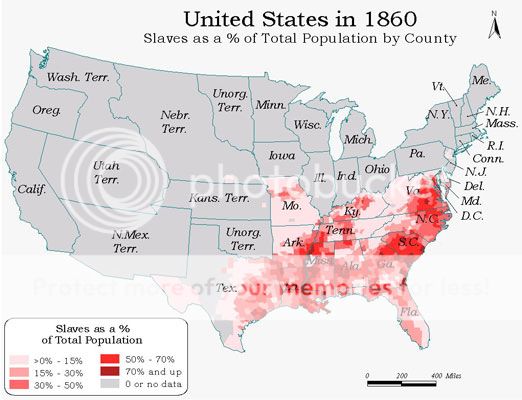
The Slave Power had been wielding the federal government like a club for nearly eighty years. .
yes and then the Republicans took over, the South did not want to submit, much like our founders did not want to submit, and the war started. Do you understand?
There wasn't anything to submit
to. Lincoln's government hadn't even done anything, up to and including taken office!
Anyway, while I'm on the subject of Washington and his views on citizenship, I might as well go into it further. He had quite a bit to say about the nature of the Union, after all.
First, this
letter to Reverend William Gordon.
It now rests with the Confederated Powers, by the line of conduct they mean to adopt, to make this Country great, happy, and respectable; or to sink it into littleness; worse perhaps, into Anarchy and Confusion; for certain I am, that unless adequate Powers are given to Congress for the general purposes of the Federal Union that we shall soon moulder into dust and become contemptable in the Eyes of Europe, if we are not made the sport of their Politicks; to suppose that the general concern of this Country can be directed by thirteen heads, or one head without competent powers, is a solecism, the bad effects of which every Man who has had the practical knowledge to judge from, that I have, is fully convinced of; tho' none perhaps has felt them in so forcible, and distressing a degree. The People at large, and at a distance from the theatre of Action, who only know that the Machine was kept in motion, and that they are at last arrived at the first object of their Wishes are satisfied with the event, without investigating the causes of the slow progress to it, or of the Expences which have accrued and which they now seem unwilling to pay; great part of which has arisen from that want of energy in the Federal Constitution which I am complaining of, and which I wish to see given to it by a Convention of the People, instead of hearing it remarked that as we have worked through an arduous Contest with the Powers Congress already have (but which, by the by, have been gradually diminishing) why should they be invested with more?
To say nothing of the invisible workings of Providence, which has conducted us through difficulties where no human foresight could point the way; it will appear evident to a close Examiner, that there has been a concatenation of causes to produce this Event; which in all probability at no time, or under any Circumstances, will combine again. We deceive ourselves therefore by this mode of reasoning, and what would be much worse, we may bring ruin upon ourselves by attempting to carry it into practice.
We are known by no other character among Nations than as the United States; Massachusetts or Virginia is no better defined, nor any more thought of by Foreign Powers than the County of Worcester in Massachusetts is by Virginia, or Glouster County in Virginia is by Massachusetts (respectable as they are); and yet these Counties, with as much propriety might oppose themselves to the Laws of the State in wch. they are, as an Individual State can oppose itself to the Federal Government, by which it is, or ought to be bound. Each of these Counties has, no doubt, its local polity and Interests. these should be attended to, and brought before their respective legislatures with all the force their importance merits; but when they come in contact with the general Interest of the State; when superior considerations preponderate in favor of the whole, their Voices should be heard no more; so should it be with individual States when compared to the Union. Otherwise I think it may properly be asked for what purpose do we farcically pretend to be United? Why do Congress spend Months together in deliberating upon, debating, and digesting plans, which are made as palatable, and as wholesome to the Constitution of this Country as the nature of things will admit of, when some States will pay no attention to them, and others regard them but partially; by which means all those evils which proceed from delay, are felt by the whole; while the compliant States are not only suffering by these neglects, but in many instances are injured most capitally by their own exertions; which are wasted for want of the United effort. A hundd. thousand men coming one after another cannot move a Ton weight; but the united strength of 50 would transport it with ease. so has it been with great part of the expence which has been incurred this War. In a Word, I think the blood and treasure which has been spent in it has been lavished to little purpose, unless we can be better Cemented; and that is not to be effected while so little attention is paid to the recommendations of the Sovereign Power.
To me it would seem not more absurd, to hear a traveller, who was setting out on a long journey, declare he would take no Money in his pocket to defray the Expences of it but rather depend upon chance and charity lest he should misapply it, than are the expressions of so much fear of the powers and means of Congress. For Heavens sake who are Congress? are they not the Creatures of the People, amenable to them for their Conduct, and dependant from day to day on their breath? Where then can be the danger of giving them such Powers as are adequate to the great ends of Government, and to all the general purposes of the Confederation (I repeat the word genl, because I am no advocate for their having to do with the particular policy of any State, further than it concerns the Union at large). What may be the consequences if they have not these Powers I am at no loss to guess; and deprecate the worst; for sure I am, we shall, in a little time, become as contemptable in the great Scale of Politicks as we now have it in our power to be respectable; and that, when the band of Union gets once broken, every thing ruinous to our future prospects is to be apprehended; the best that can come of it, in my humble opinion is, that we shall sink into obscurity, unless our Civil broils should keep us in remembrance and fill the page of history with the direful consequences of them.
I omit quote tags because at this point I suspect that certain people in the thread aren't actually opening them to read the contents. At any rate, he could hardly be more clear; the states have no more right to nullify or contravene the acts of the federal government than counties do to override their states (and in point of fact, state preemption of local laws on certain subjects has become very popular of late), and the federal government is, quote, "the Sovereign Power."
Or how about
this 1787 letter to David Stuart, accompanying copies of the Federalist Papers and urging their distribution:
I have seen no publication yet that ought, in my judgment, to shake the proposed Constitution in the mind of an impartial and candid public. In fine, I have hardly seen one that is not addressed to the passions of the people, and obviously calculated to alarm their fears. Every attempt to amend the Constitution at this time is in my opinion idle and vain. If there are characters, who prefer disunion, or separate confederacies, to the general government, which is offered to them, their opposition may, for aught I know, proceed from principle; but as nothing, according to my conception of the matter, is more to be deprecated than a disunion of these distinct confederacies, as far as my voice can go it shall be offered in favor of the latter. That there are some writers, and others perhaps who may not have written, that wish to see this Union divided into several confederacies, is pretty evident. As an antidote to these opinions, and in order to investigate the ground of objections to the Constitution which is submitted, the Federalist, under the signature of PUBLIUS, is written. The numbers which have been published, I send you. If there is a printer in Richmond who is really well disposed to support the new Constitution, he would do well to give them a place in his paper. They are, I think I may venture to say, written by able men; and before they are finished will, or I am mistaken, place matters in a true point of light. Although I am acquainted with the writers, who have a hand in this work, I am not at liberty to mention names, nor would I have it known that they are sent by me to you for promulgation.
Again, pretty clear: The United States are exactly that.
Or how about
this letter to John Jay in 1786:
Your sentiments, that our affairs are drawing rapidly to a crisis, accord with my own. What the event will be, is also beyond the reach of my foresight. We have errors to correct; we have probably had too good an opinion of human nature in forming our confederation. Experience has taught us, that men will not adopt and carry into execution measures the best calculated for their own good, without the intervention of a coercive power. I do not conceive we can exist long as a nation without having lodged some where a power, which will pervade the whole Union in as energetic a manner, as the authority of the State Governments extends over the several States.
To be fearful of investing Congress, constituted as that body is, with ample authorities for national purposes, appears to me the very climax of popular absurdity and madness. Could Congress exert them for the detriment of the public, without injuring themselves in an equal or greater proportion? Are not their interests inseparably connected with those of their constituents? By the rotation of appointment, must they not mingle frequently with the mass of Citizens? Is it not rather to be apprehended, if they were possessed of the powers before described, that the individual members would be induced to use them, on many occasions, very timidly and inefficaciously for fear of losing their popularity and future election? We must take human nature as we find it: perfection falls not to the share of mortals. Many are of opinion that Congress have too frequently made use of the suppliant humble tone of requisition, in applications to the States, when they had a right to assert their imperial dignity and command obedience. Be that as it may, requisitions are a perfect nihility where thirteen sovereign independent disunited States are in the habit of discussing and refusing compliance with them at their option. Requisitions are actually little better than a jest and a bye word throughout the land. If you tell the Legislatures they have violated the Treaty of Peace, and invaded the prerogatives of the confederacy, they will laugh in your face. What then is to be done? Things cannot go on in the same train forever. It is much to be feared, as you observe, that the better kind of people, being disgusted with the circumstances, will have their minds prepared for any revolution whatever. We are apt to run from one extreme into another. To anticipate and prevent disastrous contingencies, would be the part of wisdom and patriotism.
What astonishing changes a few years are capable of producing. I am told that even respectable characters speak of a monarchical form of Government without horror. From thinking proceeds speaking, thence to acting is often but a single step. But how irrevocable and tremendous! what a triumph for our enemies to verify their predictions! what a triumph for the advocates of despotism to find that we are incapable of governing ourselves, and that systems founded on the basis of equal liberty are merely ideal and fallacious! Would to God that wise measures may be taken in time to avert the consequences we have but too much reason to apprehend.
The "Treaty of Peace" he referred to is the 1783 Treaty of Paris which ended the Revolutionary War; though the terms of the treaty forbid retaliation against British loyalists and demand honoring of debts on both sides, several states, notably Virginia, confiscated property from them as a matter of course and passed laws forbidding the payment of British debts. The inability of the Articles Congress to enforce the terms of the treaty was grounds for a lot of foreign tension in the years immediately after the war.