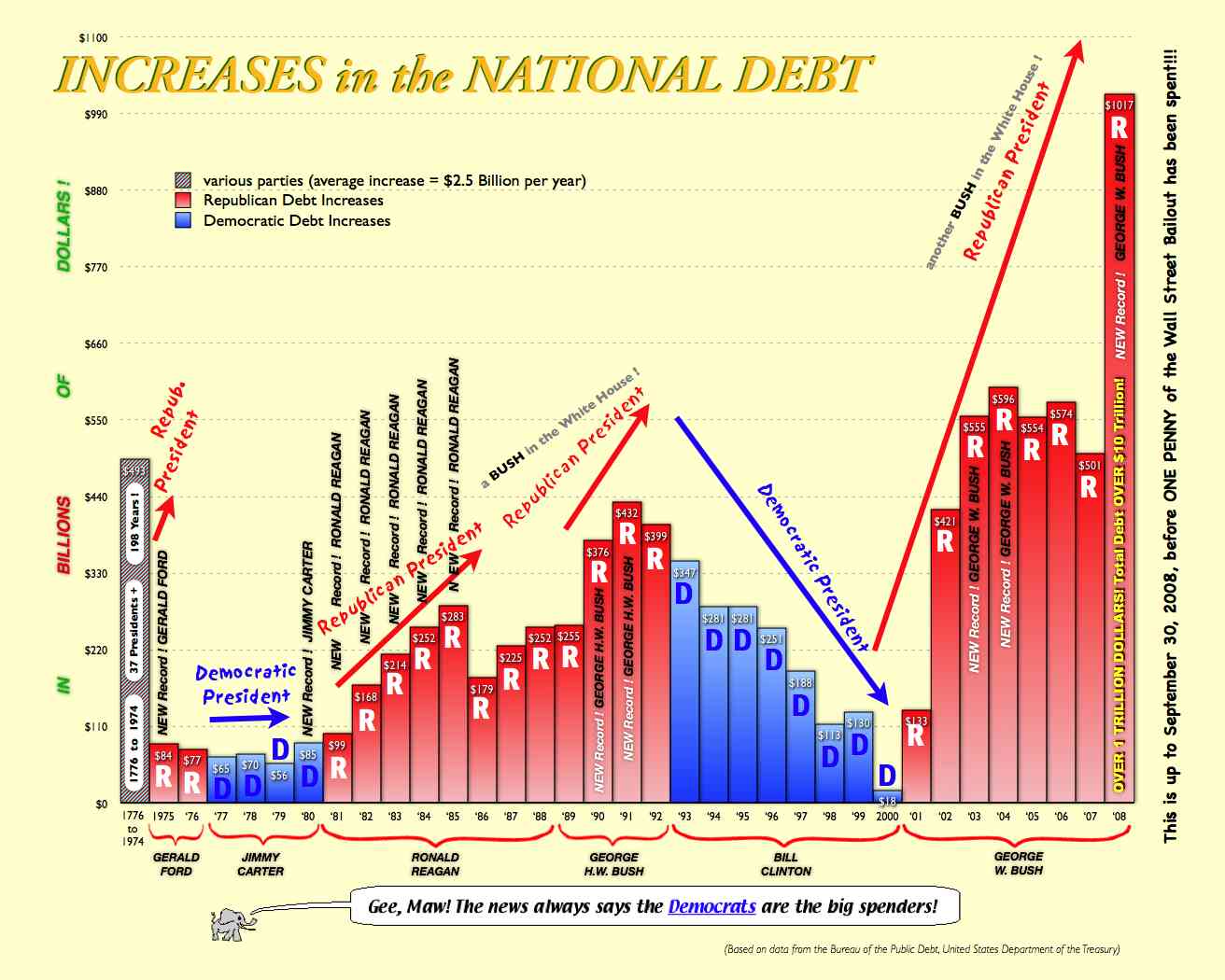
The Clinton years showed the effects of a large tax increase that Clinton pushed through in his first year, and that Republicans incorrectly claim is the "largest tax increase in history." It fell almost exclusively on upper-income taxpayers. Clinton’s fiscal 1994 budget also contained some spending restraints. An equally if not more powerful influence was the booming economy and huge gains in the stock markets, the so-called dot-com bubble, which brought in hundreds of millions in unanticipated tax revenue from taxes on capital gains and rising salaries.
Clinton’s large budget surpluses also owe much to the Social Security tax on payrolls. Social Security taxes now bring in more than the cost of current benefits, and the "Social Security surplus" makes the total deficit or surplus figures look better than they would if Social Security wasn’t counted. But even if we remove Social Security from the equation, there was a surplus of $1.9 billion in fiscal 1999 and $86.4 billion in fiscal 2000.
So any way you count it, the federal budget was balanced and the deficit was erased, if only for a while.FactCheck.org : The Budget and Deficit Under Clinton
Thank God
he had a Republican congress to keep his liberal tendencies
in check
Besides
The economic defense of the Clinton tax hikes does not hold up against the historical facts; economic growth during the 1990s, but rapid growth did not occur soon after the tax hike—it came later in the decade, when Congress cut taxes.
After the 1993 tax hike, the economy actually slowed to a point below what one would expect
Tax hikes slow growth
sorry but that is the truth
no matter how much you choose to ignore it