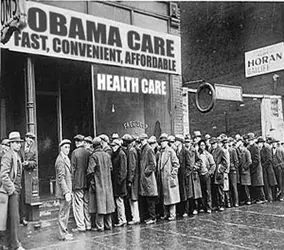
Interestingly, this is an essay written by Robert Moffit from the Heritage Foundation back in 1994. It was part of the conservative effort to come up with their alternative to Hillary-care.
Robert Moffit was deputy director of domestic policy studies at The Heritage Foundation at the time.
In late January 1994 The Robert Wood Johnson Foundation and Princeton University sponsored a conference entitled “Universal Coverage: How Best to Achieve It?” At that conference several prominent economists and policymakers presented papers on the pros and cons of employer and individual mandates. In response, a number of others offered comments on various aspects of the mandate question. Here Health Affairs presents the views of two respondents.
Personal Freedom, Responsibility, And Mandates
by Robert E. Moffit
Perspectives: Personal Freedom, Responsibility, and Mandates
A Snare And A Delusion
Employer-based health insurance in this country is the product of wartime economic and tax policy of the 1940s. There is no reason why health reform in the 1990s should be governed by those unique circumstances and outdated tax policies.
Uwe Reinhardt and Alan Krueger tell us that the tax treatment of employment-based health insurance now is sharply regressive. And, Mark Pauly confirms, it contributes to market distortions, high costs, and lack of portability in health insurance. Americans today get tax relief for health insurance on only one condition: that they get it from their employer. This has tied health insurance to the workplace in a way that no other insurance is treated. It means that if we lose or change a job, we lose our health coverage.
Pauly also tells us that employer-based insurance hides the true costs of health care. Thus, there is no normal collision between the forces of supply and demand on even the most basic level. Most workers do not purchase health insurance; it is purchased by somebody else, usually the company. For most workers, it is a “free good,” an extra, that automatically comes with the job. At least, we live with that comfortable illusion.
But, in fact, it is not free at all, and the employer gives us nothing. Because too many people think that the employer’s contribution is the employer’s money and not theirs, the consumer’s perception is distorted (as is the provider’s), and health spending is not subject to market discipline. Likewise, because too many people still do not understand this reality, “hidden taxes” through the employer mandate are politically attractive. Such a mandate thus serves as a psychological snare and an economic delusion.
Karen Davis and Cathy Schoen suggest a payroll tax to finance reform, whereby the employer pays 8 percent and the employee pays 2 percent. If one of our tasks is to make the true costs transparent, this suggestion does not help very much.
In his otherwise enlightening paper, Reinhardt calls attention to the virtues of a “mandated purchase” of health insurance. And he warns that calling an employer’s “mandated purchase” a “tax” comes close to debasing the English language. But, in a similar context, Reinhardt uses the word contribution to describe suspiciously similar functions. Suffice it to say, the campaign for linguistic precision is hardly advanced by using the word contibution to describe the state’s forcible extraction of citizens’ money.
In another context, Reinhardt proposes perhaps the best single reform idea to date. He suggests
a simple financial disclosure on the part of the nation’s employers, requiring every employer to put periodically on the pay stub of every worker in America something like the following: “We have paid you X thousand dollars in health benefits. This has reduced your wages by X thousand dollars.” We would add: “Have a nice day!„
http://content.healthaffairs.org/content/13/2/101.full.pdf