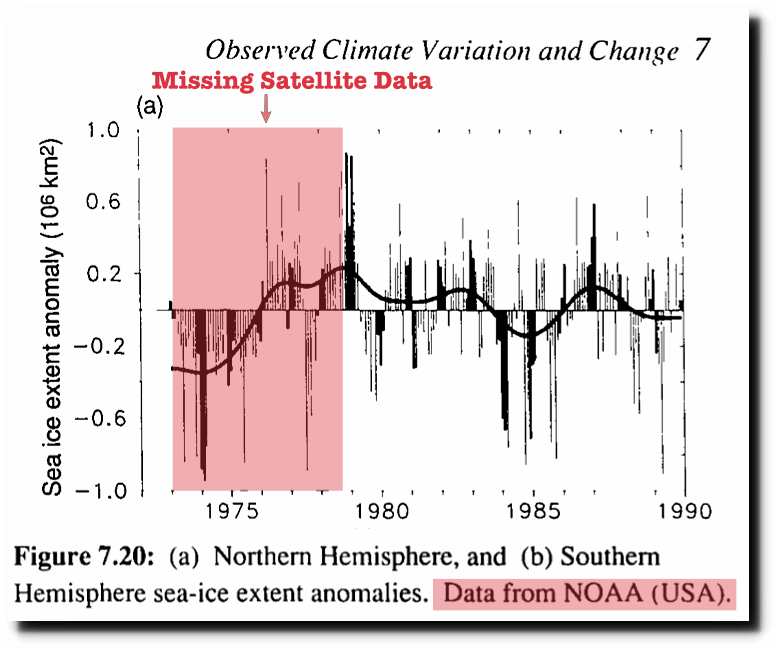
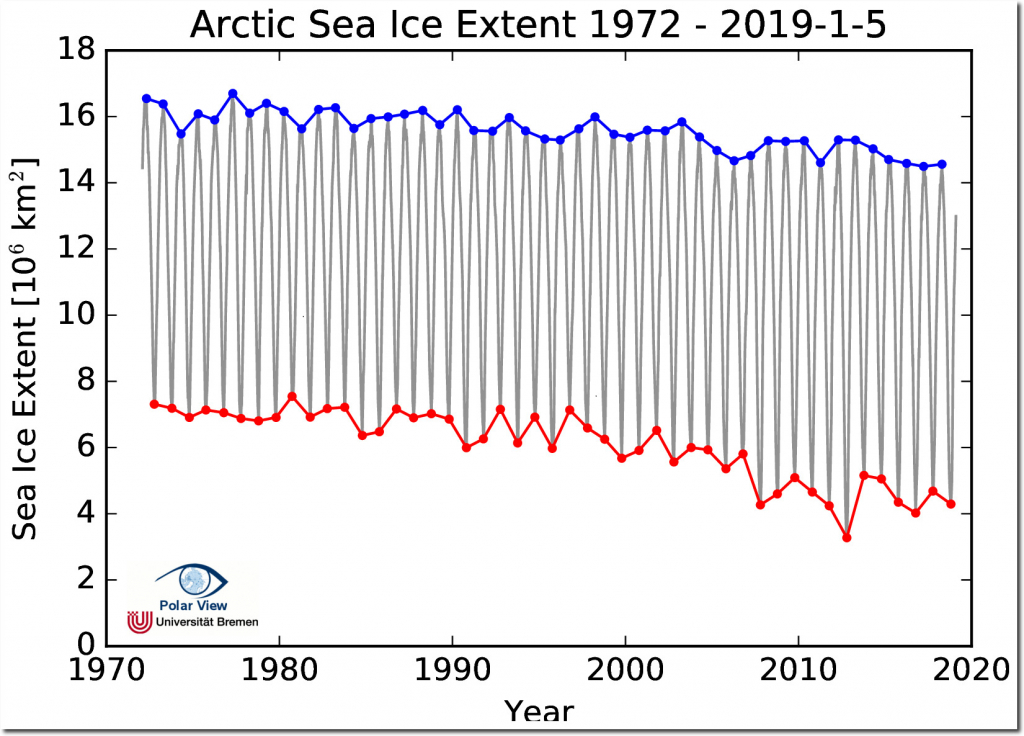
Walrus, polar bears, harp, hooded and ring seals aren't the only species negatively impacted by the shrinking Arctic ice.
Seabird colonies are struggling as winter sea ice levels hover near record lows
Once again your link and YOUR approach to the perceived problem are misleading and dishonest, since YOU have been shown a number of published papers showing strong evidence of little (far less than now) to NO Summer ice and it lasted for long periods of time!
Yet all the animals you listed are still here, the world didn't crash and humans who at that time only had Flinstone cars in use for travel and LOW CO2 levels didn't cause that low sea ice to happen. Here are a few papers I have stored at another forum board:
Taylor & Francis online
Birds and Climatic Change
Kenneth Williamson (1975) Birds and Climatic Change, Bird Study, 22:3,143-164, DOI: 10.1080/00063657509476459
Published online: 24 Jun 2009
“HISTORICAL REVIEW
Between 1000 and 1300 average summer temperatures were about 1°C higher than today, with the mean annual temperature higher by perhaps 4°C in a largely ice-free Arctic. Eric the Red, a renowned world citizen of that time, has been much maligned as the first progressive publicity man for giving Greenland a false image in order to attract settlers; but in truth, the southwest of that vast country was warmer and greener by far than at any time until the Fieldfares Turdus pilaris arrived there in the mid-1930s. The sea-temperature of the Atlantic was higher than it has been since, and there appears to have been none or very little ice to hinder the Vikings’ communications between Iceland, Greenland,Newfoundland and Labrador (Mowat 1965). Indeed Brooks (1926) considers thatthe polar ice-cap may have disappeared entirely during the summer months, tobuild anew each winter.”
and,
Quaternary Science Reviews
New insights on Arctic Quaternary climate variability from palaeo-records and numerical modelling
December 2010
Martin Jackobsson, et al
Abstract
Terrestrial and marine geological archives in the Arctic contain information on environmental change through Quaternary interglacial–glacial cycles. The Arctic Palaeoclimate and its Extremes (APEX) scientific network aims to better understand the magnitude and frequency of past Arctic climate variability, with focus on the “extreme” versus the “normal” conditions of the climate system. One important motivation for studying the amplitude of past natural environmental changes in the Arctic is to better understand the role of this region in a global perspective and provide base-line conditions against which to explore potential future changes in Arctic climate under scenarios of global warming. In this review we identify several areas that are distinct to the present programme and highlight some recent advances presented in this special issue concerning Arctic palaeo-records and natural variability, including spatial and temporal variability of the Greenland Ice Sheet, Arctic Ocean sediment stratigraphy, past ice shelves and marginal marine ice sheets, and the Cenozoic history of Arctic Ocean sea ice in general and Holocene oscillations in sea ice concentrations in particular. The combined sea ice data suggest that the seasonal Arctic sea ice cover was strongly reduced during most of the early Holocene and there appear to have been periods of ice free summers in the central Arctic Ocean. This has important consequences for our understanding of the recent trend of declining sea ice, and calls for further research on causal links between Arctic climate and sea ice.
and this comment by Dr. Meier,
Watts Up With That?
NSIDC’s Dr. Walt Meier – part 2
“Can the Arctic really become sea ice-free during summer?
It has been suggested that the Arctic really can’t lose all its sea ice during summer because there isn’t enough energy to melt all of the ice in the short summer. There are a couple of reasons why this thinking is faulty.
First, we know the Arctic can potentially lose all its sea ice during summer because it has done so in the past. Examination of several proxy records (e.g., sediment cores) of sea ice indicate ice-free or near ice-free summer conditions for at least some time during the period of 15,000 to 5,000 years ago (Polyak et al., 2010) when Arctic temperatures were not much warmer than today.”