Seriously? Given that I already explained the scenario, and that you've already been apprised of the risk, you now know there is one in a hundred M&M's that could be poisonous. But you're going to sit there and tell me you'd rather take the risk? How foolish.
And "rightwing memes?" Is that it? Is that all you're going to say to dismiss my argument?
I think you might want to re-read what I posted, because you seem to be responding to something else entirely.
And yeah - it's a right wing internet meme.
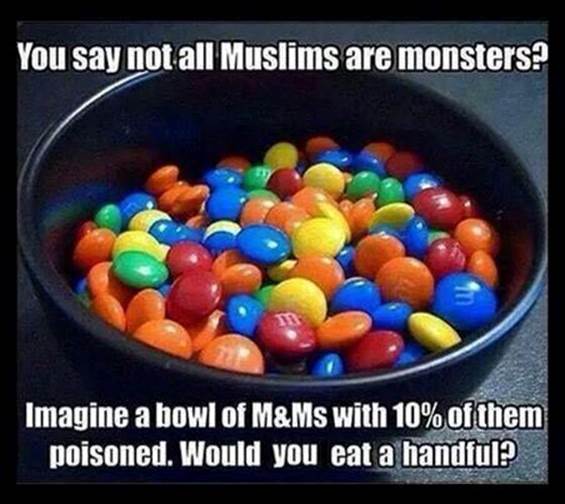
You're being asinine. Like I said, in these analogies, all it takes is one package of beef or one piece of candy to kill someone. That's all it takes.
These are people, Doc, who posses varying ideologies and opinions of the US, some of them negative. You can't sit there and say for certain all of them have a positive view of the US. They aren't M&M's, nor packages of beef. And it can be reasonable to assume there are some among them that have an ulterior motive, and a desire to go out and kill Americans. As we can see with ISIS, they can even use women and children as weapons.
You can't assure me that there aren't terrorists hiding in their midst. You won't even admit to the distinct possibility of such a thing being true.
You have no way of knowing that you are or aren't the unlucky guy who bought a poisonous package of beef at the deli. But when presented with the risk, and the ability to choose which circumstance you'll follow, you can take precaution instead of taking the risk.
As I've already gone over repeatedly, this argument is asinine.
Everything has risks, and sometimes risks are worth the rewards.
Stepping out your front door is a risk - you could get shot by a drug dealer, hit by a car, struck by lightening, or even fed a poisoned M&M. Would you choose to take the "precaution" of never leaving your house and becoming a shut-in?
26 terror plots in US tied to immigrants, Sen. Jeff Sessions says: 'Screening is very poor'
Here are 26 reasons they should go somewhere else. It's not a question of if the m&m's are poisoned, it's how many!
Sent from my SM-G920V using Tapatalk
More than half of those people on your list were American citizens. None of them were refugees.
Try reading a little more carefully Doc.

The Boston Bombers were refugees....among others on the list.
The Boston Bombers, who killed three and injured more than 250, were invited in as refugees. The younger brother applied for citizenship and was naturalized on September 11th, 2012. The older brother had a pending application for citizenship.
The Boston Bombers were not refugees.
Their father entered the US on a tourist visa, and then applied for assylum - the process is completely different than the refugee. The two brothers were small children at the time.
What's the difference between U.S. immigrant refugees and asylees?
UPDATE: Following the Boston Marathon bombing, the Washington Post and others reported that the bombers were refugees. Other reports, however, have indicated that the Tsarnaev brothers were not refugees — they arrived in the United States as young children of an asylee. As a State Department official told Bloomberg, their father came to the United States on a tourist visa and applied for asylum.
Most people aren’t familiar with the distinct, separate definitions of refugees and asylees (or asylum-seekers), but both groups in the U.S. tend to get a disproportionate amount of attention in the news for a variety of reasons. For example, the infamous 2013 Boston Marathon bombers were both immigrant
refugees from Chechnya, which prompted some U.S. politicians to try to pass laws to lower the number of refugees allowed in the country. (See update above.) In September 2013, 25 DREAMers tried to re-enter the U.S. border from Mexico in order
to ask for asylum in an attempt to bring attention to immigration issues as well as to obtain a legitimate legal status...
Characteristics of refugees
The U.S. government has much tighter restrictions on who can be labeled a refugee, but there are many more refugees than asylees granted legal status per year. Each year, the President determines how many refugees will be allowed to enter the U.S. In fiscal year 2013,
69,930 refugees were authorized to enter the U.S., just 70 people shy of the 70,000 maximum. Iraq, Burma, and Bhutan sent the largest groups of refugees to the U.S. (Update: In fiscal year 2014,
69,986 refugees entered the United States. Numbers for 2015 are not yet available.)
In order to be a refugee under U.S. immigration law,
- You must fit the requirements regarding persecution (listed above)
- You must secure refugee status while you are still outside the United States. You cannot seek refugee status once you are inside.
- Your case is of special humanitarian concern to the United States.
- You can be labeled admissible for legal entry into the United States.
Characteristics of asylees
For the last decade, the United States has been accepting between 20,000 and 30,000 asylum applicants per year. Popular countries of U.S. asylum seekers include China, Venezuela, and Ethiopia, Egypt, and Haiti.
To seek asylum in the U.S. under current laws,
- You fit the requirements of living under threat of persecution as a refugee (listed above).
- You are already present in the United States or are seeking admission at a port of entry.
One important difference is that asylees do not have to have legal immigration status to apply for protection. This is one of the reasons why it has become a popular method with DREAMers and undocumented immigrants who don’t have any other alternatives to seek legal status.
There are two ways to apply for asylum in the U.S.: affirmatively (voluntarily or preemptively) or defensively. Defensive applicants are those who ask for asylum in response for being detained or apprehended by immigration enforcement. In 2013, slightly more than half of
asylees gained refuge through affirmative applications.
It's funny how The Right castigates The Left for being all about "fweewings" when utterly shameful crap like this is going on. Fear is a "feeling" too and like many feelings not always rational.
Republicans' anti-refugee rhetoric is shameful and despicable — and probably good politics
As I write this, 26 Republican governors (and one Democrat) have said publicly that they oppose bringing Syrian refugees to their states, with most saying they'd refuse to accept them; by the time you read this, the other five Republican governors may have made similar statements. Meanwhile, every major GOP presidential candidate has come out against bringing Syrian refugees here, and Ted Cruz has introduced a bill to bar any Syrian refugees from settling in the United States.
This hurricane of xenophobia and cynical opportunism makes for a truly odious display. But sadly, it's also good politics for Republicans, at least in the short term.
Yes...politics is certainly playing a big part. Let's analyze the reality.

Before we go any farther, we should acknowledge a simple fact: If you're concerned about stopping ISIS from committing an act of terrorism in the United States, the 10,000 Syrian refugees who will be admitted after a rigorous vetting process is one of the last things you should be worried about. It's possible (though far from necessary) for a member of ISIS to get to Europe by posing as a refugee, since large numbers of Syrians are somewhat chaotically making their way to places like Greece, and once they're on European soil they can move freely between countries. But the process of getting to the United States as a refugee is completely different.
Rightwing Histrionic#1 -- we don't know who they are!!!! they could be anyone!!! they aren't vetted well!!!!!
The vetting process is far more extensive for a refugee coming in than it is for, say, someone with a tourist visa. It can take upwards of 2 years before they are admitted.
4 Things To Know About The Vetting Process For Syrian Refugees
Refugees are screened by several different agencies
Their first point of a refugee's contact is with the U.N. High Commission for Refugees. The UNHCR refers people to countries based on whether they have any family members there and where resettlement makes the most sense, say U.S. officials. If that's the U.S., then refugees are vetted by the National Counterterrorism Center, the FBI's Terrorist Screening Center, and the Departments of State, Defense and Homeland Security. Fingerprints are taken, biographical information is collected. They are then each individually interviewed by U.S. officials trained to verify that they're bona fide refugees.
Refugees from Syria are then subject to additional screening that looks at where they came from and what caused them to flee their home, stories that are checked out. All of this occurs before a refugee is allowed to set foot in the country.
It's a lengthy process
As you might imagine, all of the vetting, from interviews to fingerprinting, takes a while. On average, officials say it's 18 to 24 months before a refugee is approved for admission to the U.S...
Histrionic #2: why should we be paying for them when we got xyz homeless people and people in poverty? (this one was a shocker to hear because it's the first time I've heard any concern from the Republicans for the welfare of homeless people and their actions in cutting programs demonizing the poor as parasites indicate quite the opposite).

Physical resettlement
There are nine different nonprofit groups, six of them faith-based, that help refugees settle in the U.S. Volunteers with the groups help refugees find homes, furniture, school supplies and jobs.
Oops...looks like you don't have to pay for it unless you want to, people volunteer because they feel it's the right thing to do - another faux objection.
Histrionic #3: omg omg a refugee disappeared in Louisiana...no one knows where he is!!!!!!! We've got to stop taking Syrian refugees!!!!!
Reality check: umh...no...
he was never missing.
Catholic Charities: One Syrian immigrant briefly settled in Baton Rouge before moving; he never went missing
Baton Rouge received one Syrian refugee over the summer, a man Catholic Charities helped for a few days before he left to meet family in another state.
Catholic Charities said Tuesday the man is the only Syrian refugee they have helped recently, and Louisiana State Police confirmed he had left Baton Rouge for Washington, D.C.
But the news of that one man set off a flood of phone calls Tuesday to the organization, especially from misinformation that made some people believe the man had gone missing, Catholic Charities Executive Director David Aguillard said.
One caller even made several threats while on the phone with Catholic Charities, especially against Syrian refugees. State Police said they are investigating the threats and take them seriously.
Now IS there a need for concern? Some, but far less than the hysteria demands.
Objections of governors and members of Congress
Some officials, including FBI Director James Comey, worry there are what Comey has called "gaps" in the vetting process. Experts say U.S. intelligence in Syria isn't very good, because the U.S. lacks much of a presence on the ground. So there's no way to compile a thorough watch list of possible terrorists from Syria against which refugees can be checked. Administration officials are briefing governors and members of Congress about the process, but lawmakers may try to pass legislation calling on the administration to suspend its refugee resettlement efforts.
The groups most responsible for helping refugees - whether they are Burmese, Somali, or Syrian are often our religious institutions and other non-profit charities. Kudos to them, for they are struggling to keep our nation's moral compass pointed in the right direction. When all those Central American children were flooding the border, they had the courage to take them in and help them while the wingnuts picketed their bus and yelled slurs.
Christian groups break with GOP over Syrian refugees
Faith-based groups, who play a key role in resettling refugees to the United States, say they are dismayed by the wave of anti-refugee fervor set off by the Paris terrorist attacks and are urging supporters to contact elected officials on behalf of victims of the Syrian civil war.
Evangelical Christians, as well as Christians more broadly, are a core group in the Republican electoral base and are among the most passionate advocates for aiding refugees.
A push by Republican presidential candidates to ban Syrian refugees "does not reflect what we've been hearing from our constituencies, which are evangelical churches across the country," said Jenny Yang, vice president for advocacy at World Relief, an evangelical organization that helps resettle refugees. "Most of the people have been saying we want to continue to work with refugees, that what happened in Paris ... doesn’t reflect who refugees are."
Sorry, but Obama's plan makes no sense. Looking at it from the left's point of view, say it's a matter of helping as many innocent people as possible. What we are doing is allowing the U.N. to cherry pick a small percent of people to help. The U.N. cannot be trusted and have an agenda of their own that we are now aiding. The refugees are being relocated all over the globe at great cost. Keeping them in one main location would be much more cost effective (we are borrowing money to help them) and it would mean helping a lot more. We could help 12 for what we are spending to help one if we went about this a different way.
If 12 people were drowning, is it better to send a nice little boat that can only hold one person or throw 12 life vests out and save them all? Bringing them here might be a lot nicer, but helping them there would mean safety, a roof over their head and food. The left has chosen to leave the majority out in the cold and help a select few. IF your plan is to help, this falls flat.
And why it is necessary to ensure that they are equally spread among the states? Much easier to monitor them in one main location, but the left wants them everywhere. ISIS would definitely go along with what Obama has planned because it is better for them. Can't say it's good for the majority of innocent refugees, who are supposed to be the reason this is being done.
There are questionable decisions being made by the Obama administration and he has a habit of favoring Muslim countries, particularly radical ones. I simply don't trust him.
A poll shows that 13% of the refugees who were chosen for relocation view ISIS in a positive way. That means at least 1.300 ISIS sympathizers or members being equally spread among the states. After seeing what 8 were able to do in Paris, there is every reason for concern. Since there is no way to vet them, it's a hell of a chance if you're interested in helping the American people stay safe.
It's great to be helpful to those innocent people who need it, but we can't trade the security of our country to make it happen. We all lose this way. There are much smarter and cost effective ways to do this that wouldn't allow ISIS to continue to use this situation to their advantage.
Just to look at that poll in question -
I went to the source and looked at it. 4% were "positive", 9% "positive to some extent"...but
"When asked to explain the reasons for the backing which ISIL enjoyed amongst its supporters, only 13% of respondents cited the group’s adherence to Islamic principles. A much larger group (55%) explains support for ISIL by citing a host of other reasons:
either due to its military achievements; its preparedness to challenge the West; its opposition to Iran and the Syrian and Iraqi regimes; or its purported support for the Sunni Muslim community in the Levant."
All of which mean that "positive view" needs to be examined in relation to the reasons for it. 1.3 people is incredibly small, and it also assumes that the vetting process doesn't examine potential for ISIS support.


 Regardless, the asylum seeking Muslims brothers in Boston ended up killing and wounding a bunch of Americans.


