1) The US has the widest income disparity in the world and its poverty is the worst among developed nations
2) Wages are way behind on inflation in this country.
3) Lower wage jobs - including skilled labor - greatly outnumber higher wage jobs. This means 10s of millions of people have NO CHOICE but to accept low wages.
4) Republicans, in their lazy mental shortcuts, think the only thing one in poverty must do is learn new skills and get a better paying job. The ignorance of this is profound. A) poor people do not have the time and money to learn new skills in the current economic climate. B) If everyone in poverty did this, who would be left over working all of those millions of vital low wage service jobs? Who will be left as the backbone of a corporation that pays poverty wages? Is a robot going to take over the front register at Burger King? That will probably happen anyway, but does that sit well with republicans knowing that? This is why the minimum wage must be raised.
The process of raising the minimum wage should have begun decades ago and raising it drastically now would agreeably be the wrong approach. It needs to start off small.
And I know some of you cons will say “well why didn’t Obama fix income inequality?!” Yes, he failed in addressing this issue, but obviously the problem of income disparity is still a major problem whether or not you want to deflect to Obama. Of course, as you may recall, he did try to raise the minimum wage.
Sadly,
Billy000, even folks who might be undecided regarding the veracity or predominantly likely veracity of your central thesis -- Republicans don't understand poverty -- your OP presents a very uncompelling argument and thus is very unlikely to generate concurrence among such individuals. Obviously, among folks who agreed with the thesis upon encountering your OP will continue to do so, though some of them may be somewhat embarrassed by the nature of advocacy found in your argument/OP.
Why do I say that? Well, in recognition of the fact that sound/cogent (strong) arguments must have germane and accurate premises, along with a conclusion (thesis) that follows rationally from them, let's consider some of your premises.
The US has the widest income disparity in the world
Income inequality is, in isolation, irrelevant to poverty. Why? Because measures of income inequality identify the extent of difference in the income of earners at the top and bottom ends of the income spectrum.
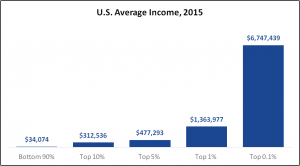
(click the pic for a larger presentation of it)
Assume, for instance, the above figures portray a 198% difference between the average incomes of the highest and lowest earning individuals and that the ~$34K/year figure represents a poverty-level income for a one person household. The same measure income inequality, 198%, would exist were the average incomes of the lowest and highest earners $100,000/year and $19,802,310.
Would there then be cause to gripe about income inequality in terms of poverty? It would not. It would not because poverty is a matter whereby how much more or less others make isn't what defines whether one is impoverished. Whether one is impoverished is a function of one's available money (current income and accumulated income, aka wealth) and the
prices of goods and services one must buy (food, housing, clothing, transportation, information, fees and excise taxes, etc.) and that are not considered economic luxury goods and services. [1]
Because income inequality is merely a difference measure, if one is of a mind to use it in an argument pertaining to poverty and what someone else has overlooked, one must combine one's discussion of income inequality with a discussion about prices. That is so whether one chooses to approach income inequality from the standpoint of income growth or by citing temporally static observations of income.
Note:
- Economically, luxury goods/services are forms of a "product" that are, in one's local economy, optional. For instance, in D.C., transportation is not an economic luxury good, however, transportation via one's privately owned car is an economic luxury good. In other local economies, that may or may not be so.
in their lazy mental shortcuts, think the only thing one in poverty must do is learn new skills and get a better paying job.
Well, to rise above the poverty what the hell else must one in poverty do but get a better paying job?
- It's not as though there's an abundance of "rich, dead uncles" having unclaimed fortuners.
- A poor person may win the lottery, but the odds of that are very slim.
- Theft is also an option, albeit an unlawful and unrecommended one.
The government offers assistance programs of which impoverished people can avail themselves to obtain resources by which to live and marketable skills they may sell to buyers of labor. I suppose the government could also offer resources that allow impoverished people to
emigrate, but not since the 1840s have people proposed that approach, and even then it wasn't proposed as an explicit solution for poverty.
in their lazy mental shortcuts, think the only thing one in poverty must do is learn new skills and get a better paying job. The ignorance of this is profound. A) poor people do not have the time and money to learn new skills in the current economic climate. B) If everyone in poverty did this, who would be left over working all of those millions of vital low wage service jobs?
Where there's a will, there's a way.
- How can poor people have no time to learn new skills?
- Even if they work and raise kids, the fact that they are impoverished and don't want to be impoverished means they must find time to learn new skills.
- If you clicked on the link just above and read the content at some of those articles, you'll have read about destitute individuals who parlayed their existing skills into profitable ventures. Quite simply, if one is of a mind to not be impoverished, one's first priority must be to do things that alter one's status as impoverished. Of all the things one might do with one's time, a use of it that one can be certain won't alter one's impoverished status is devoting so much of one's time performing a "dead end" job that doesn't pay enough to meet one's goals that one, in turn, has no time to invest any of it doing things that will alter that status.
- How much money must one have to learn new skills?
- College -- Far too few folks who are impoverished avail themselves of the fact that the priciest and most elite colleges and universities make it possible for qualified "ultra poor" individuals to obtain an education from them. That they do is one of the most significant and most easily accessed "field levelers" around. That such institutions meet 100% of demonstrated financial need prepares and enables "the least among us" to join the ranks of "the haves," and it precisely why a friend of mine who mentors young poor kids directs them to apply to the most elite private colleges and universities in the country. The money is there to be given out and those poor kids are most in need of it, so it's just flat-out stupid not to be a high performer in high school, apply to those institutions and, upon being accepted for admission, obtain it. For example:
- Adult training programs
Simply put, if one is poor, the things one cannot afford is indolence, ignorance, insipidity and fatuity.
Is a robot going to take over the front register at Burger King? That will probably happen anyway
Do you truly not see the argumentative contradiction in asking that question, the answer to which is indeed that the function will be automated [1], by asserting that a robot will probably perform that job?
Note:
- Automation of that sort is already happening in stores where it's economically feasible to do so.
The process of raising the minimum wage should have begun decades ago and raising it drastically now would agreeably be the wrong approach. It needs to start off small.
That process did begin decades ago and
has been going on for years,
since at least 1938 in the U.S. You and others may differ normatively about the rate and incidence of minimum wage increases, but the process of raising it has been going on for decades.
I know some of you cons will say “well why didn’t Obama fix income inequality?!”
For the same reasons and in the context I indicated in my above discussion about income inequality, even if they do, it's an ingermane question to ask.
Why have I written the above remarks? Only to implore you, OP-er, to, if you cannot (or don't want to) present a sound argument, at least present a cogent/strong one. (See:
Difference between argumentative/analytical soundness and cogency -- the difference between the two is in the nature of their conclusions, not that of their premises.) Frankly, I think many Republicans don't understand poverty period, be it in America or anywhere else; however, I cannot tick "agree" on your OP because the argument it presents in support of your central assertion/conclusion is too weak to agree with. I don't here expect folks to present perfect arguments, but my approbation nonetheless requires a stronger argument than you've presented. After all, one cannot be taken seriously in a discussion about public policy
and have weak arguments for one's positions.