Fascinating, your projection there. I've never pointed at a single year, while you've been focused on 2024.
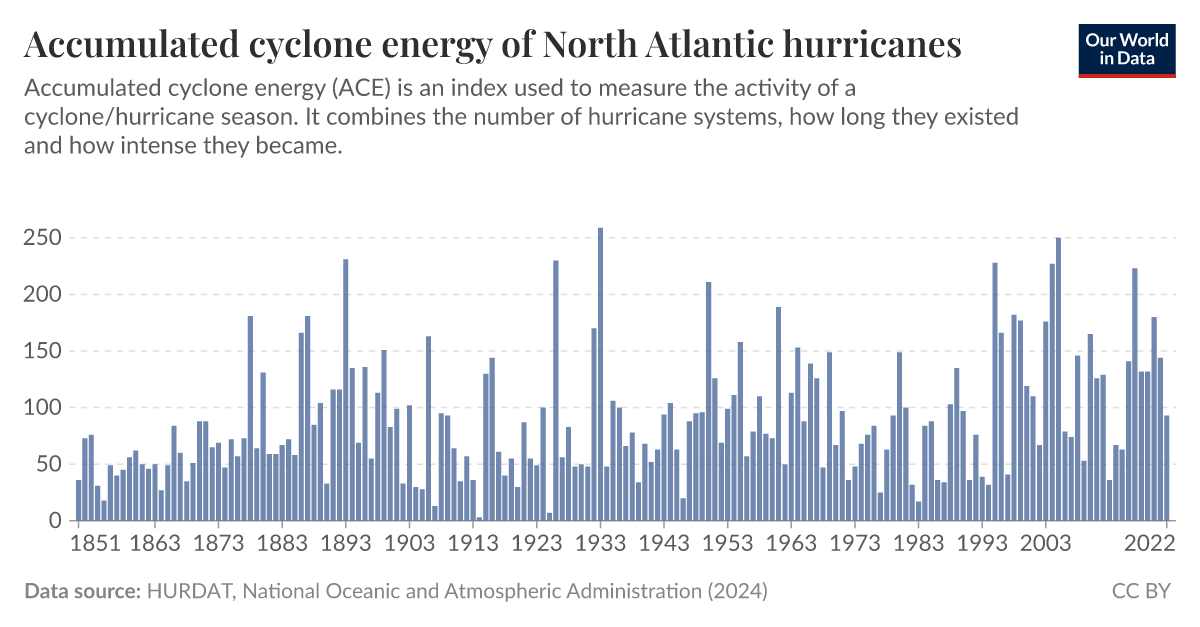
Unlike you, instread of cherrypicking single years, I always look at trends. And if we look at the North Atlantic trend, the ACE trend is definitely going up.
Accumulated cyclone energy (ACE) is an index used to measure the activity of a cyclone/hurricane season. It combines the number of hurricane systems, how long they existed and how intense they became.

ourworldindata.org
It true the western Pacific has seen slow hurricane seasons for the past 5 years. That's largely due to the persistent La Nina conditions. The The eastern Pacific, where the storms originate, has actually cooled a bit. And it also seems the warming Atlantic creates wind conditions that dampen Pacific hurricanes.
In any case, as ACE doesn't account for hurricane width, so it's not the best metric to use.
One again you show your poor thinking skills since I was using the
ACE data that covers the entire planet, while you devolved into the regional argument I never made.
Hurricane width is irrelevant it is the
accumulated cyclone energy that matters as the
NOAA which is where all the ACE data comes from states clearly their formula:
Calculation
Accumulated cyclone energy is calculated by summing the squares of the estimated maximum sustained velocity of tropical cyclones when wind speeds are at least tropical storm strength (≥ 34 kn; 63 km/h; 39 mph)<a href="
Accumulated cyclone energy - Wikipedia" at recorded six-hour intervals. The sums are usually divided by 10,000 to make them more manageable. One unit of ACE equals 10−4
kn2, and for use as an index the unit is assumed. Thus:
ACE=10−4∑vmax2
(for vmax
≥ 34 kn),
where vmax
is estimated sustained wind speed in
knots at six-hour intervals.<a href="
Accumulated cyclone energy - Wikipedia"
Kinetic energy is proportional to the square of velocity. However, unlike the measure defined above, kinetic energy is also proportional to the mass m
(corresponding to the size of the storm) and represents an integral of force equal to mass times acceleration, F=m×a
, where acceleration is the antiderivative of velocity, or vmax
. The integral is a difference at the limits of the square antiderivative, rather than a sum of squares at regular intervals. Thus, the term applied to the index,
accumulated cyclone energy, is a misnomer since the index is neither a measure of kinetic energy nor "accumulated energy."