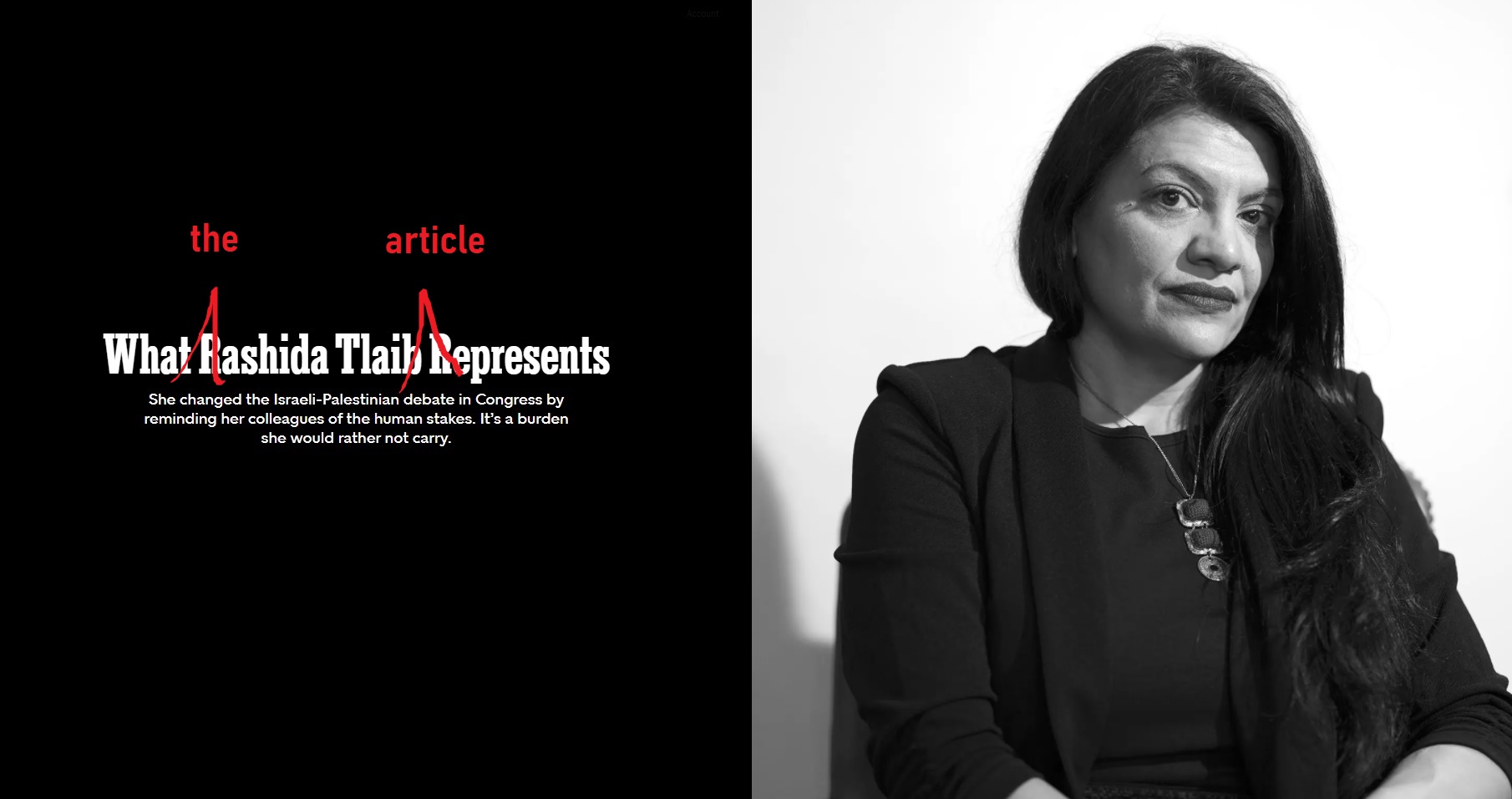
The weekend’s fawning feature is about Rashida Tlaib—or more specifically, about the righteousness of Rashida Tlaib’s anti-Israel dogmas. It follows just a few months after the paper printed another
flattering story about an anti-Israel (and
anti-Jewish) activist, Gaza poetry professor Refaat Alareer.
The premise of the earlier piece was, commendably, retracted with an
editors’ note acknowledging failures in reporting. (Alareer was feted as a bridge-builder, though he is a hatemonger.)
The new piece, which was published online on Thursday and is slated to appear in print in this weekend’s Sunday Magazine under the headline “What Rashida Tlaib Represents,” will get no such sweeping correction. That’s because author Rozina Ali was honest — not on the details of the conflict, but at least about the essence of Tlaib’s extreme positions.
Tlaib seeks an end to Israel. Ali more or less admits it. Tlaib is unhappy about Israel’s life-saving anti-rocket system, the Iron Dome. Ali doesn’t deny it. Indeed, to conceal these beliefs would be counterproductive, since the core premise of the piece is that they are noble positions.
In promoting that conclusion Ali plays tricks on her readers, with the tendentious characterizations starting at the very first sentence: “Last May,” she writes, “following protests in East Jerusalem over planned evictions of Palestinians, Hamas started firing rockets toward Tel Aviv, and Israeli airstrikes pounded residential buildings in the Gaza Strip.”
----------
Ali, at least, does mention the criticism that followed Tlaib’s slur about American supporters of Israel having “forgot[ten] what country they represent.” But she seems to miss that this example, too, belies her claim that accusations of antisemitism follow from mere “criticism of Israeli policies.” This, after all, was an allegation of dual loyalty levelled against
Americans, not a comment on Israeli behavior.
As a whole, Ali’s piece is meant as a lesson about, first, why Tlaib should be seen as a hero, and second, why Americans are allegedly receptive to her extreme anti-Israel messages.
For Ali, the answer to the first question is that Tlaib is a hero because her extreme anti-Israelism. That’s the author’s prerogative.
The second question is best answered not by the arguments in Ali’s article, but by the very
existence and nature of the piece, which is more of the same from a newspaper that too-often excuses, or even lauds, attacks on
Israel’s legitimacy and
Jews in general.
Here is yet another story taking aim at Israel. Here are yet more distortions meant to misinform readers about the conflict. When editors
make a point of defaming the Jewish state and whitewashing Palestinian contributions to the conflict, and do so
again and again, it would hardly be surprising if some readers take the bait.
The latest New York Times hagiography of an anti-Israel activist has dropped. Yet another story taking aim at Israel. Yet more distortions meant to

www.camera.org



 should even consider the above