"
Sure thing" what, nitwit? We both know you're too lost in your cultic delusions and myths to have actually watched that video without your head exploding so.....
LOLOLOL....wow.....Arctic ice grows in the winter....big news there....better tell the scientists who've studied the Arctic for decades, walleyed. The ice grows in the winter months and melts back in the summer. Every summer for the last four decades or so. it has been melting more and more. What about all that escapes you? Everything, I suppose, given how extremely clueless you are.
Here's the actual current state of the Arctic from the experts at the
National Snow and Ice Data Center, whose graph you used without any understanding of what it means.
Arctic Sea Ice News and Analysis
Wednesday 4th January 2012
Overview of conditions
Average ice extent for November 2011 was 10.01 million square kilometers (3.86 million square miles), 1.30 million square kilometers (502,000 square miles) below the 1979 to 2000 average. This was 170,000 square kilometers (66,000 square miles) above the average for November 2006, the lowest extent recorded for that month in the satellite data record.
At the end of November, ice extent remained below the 1979 to 2000 average in the Chukchi, Barents and Kara seas, and Hudson Bay was still nearly ice free. Ice extent was near average in the East Greenland and the Bering seas. These ice conditions may be connected to a strong positive phase of the Arctic Oscillation, which began during the last week of November. A positive Arctic Oscillation tends to help move ice out of Fram Strait and into the North Atlantic.
Conditions in context
The Arctic sea ice cover grew at an average pace through November, despite a brief slowdown early in the month. However, the ice extent remained far below average. Overall, the Arctic gained 2.36 million square kilometers (911,000 square miles) of ice during the month, which was slightly more than the average ice gain for November of 2.13 million square kilometers (822,000 square miles). On November 30, Arctic sea ice extent was 10.85 million square kilometers (4.19 million square miles), 625,000 square kilometers (241,000 square miles) more than the ice extent on November 30, 2006, the lowest extent on November 30 in the satellite record.
November 2011 compared to past years
Ice extent for November 2011 was the third lowest in the satellite record for the month, behind 2006 and 2010. The linear rate of decline for November over the satellite record is now 53,200 square kilometers (20,500 square miles) per year, or 4.7% per decade relative to the 1979 to 2000 average.
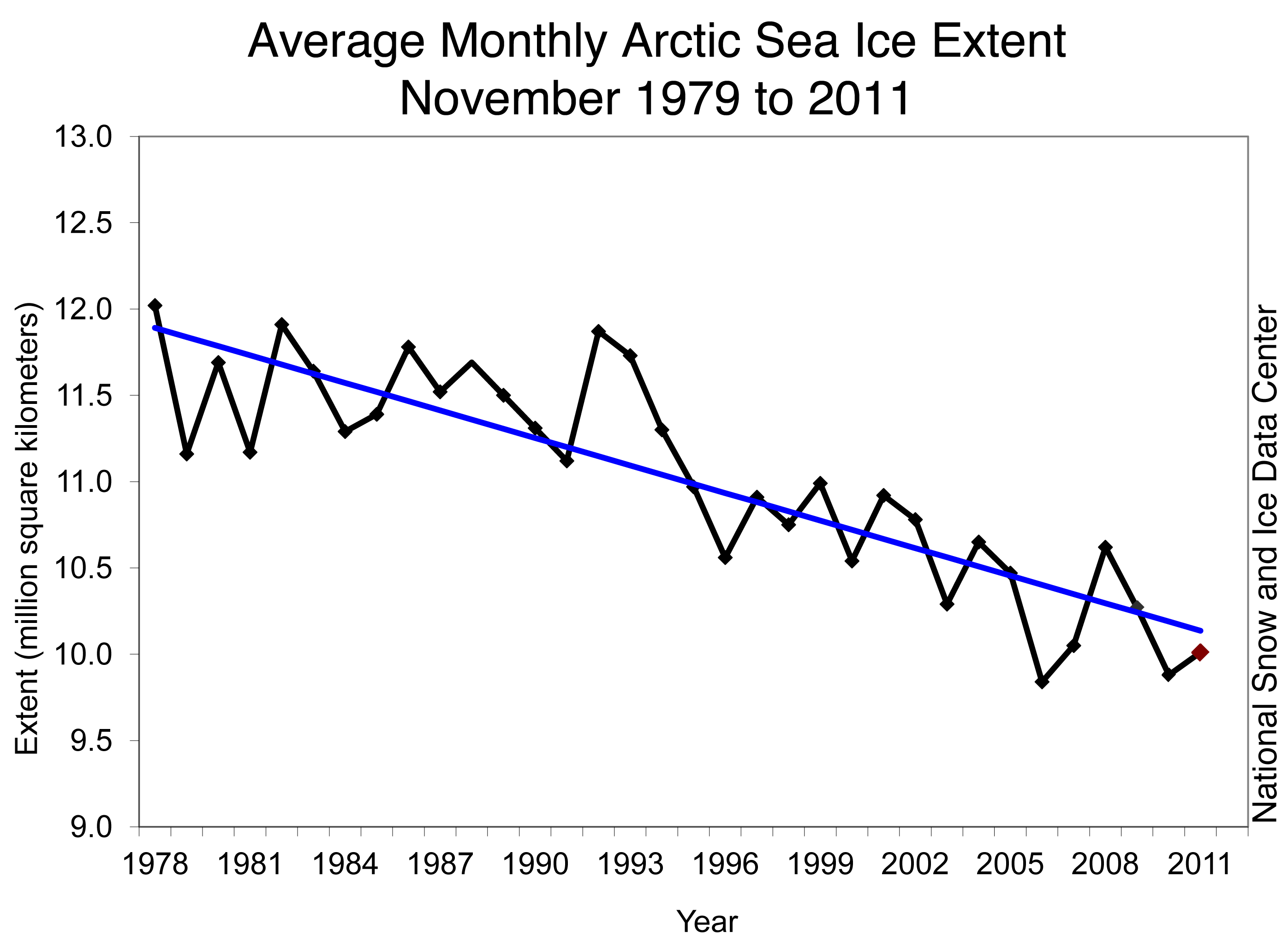
Figure 3. Monthly November ice extent for 1979 to 2011 shows a decline of 4.7% per decade. (Credit: National Snow and Ice Data Center)
If the ice is melting and it is, then I don't "
have to explain" squat, moron. Reality is what it is and it doesn't require us to understand it or explain it for it to happen anyway. Our understanding of the world is shaped by the reality of it, not the other way around, as you seem to idiotically imagine. Since the Arctic ice cap is floating sea ice and the ocean temperatures are also increasing, along with the atmospheric temperatures, it is hardly surprising that there is increasing ice melt. But the myths of your cult probably won't let you understand that.


