Here, lets take a look at what the temperatures and atmospheric CO2 concentrations have looked like since the cambrian period, some 550 million years ago.
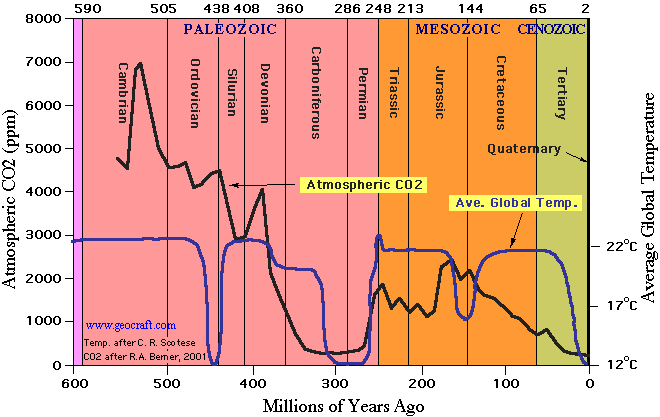
Sure seems like a good graph. Sturdy. Your source R. Totten is a bit an unusual character. He is an Intelligent Design proponent. Years back I was heavily into this sort of debate and read widely about it. I was 100% for ID. Looking back, any real ID admits evolution but insists god helped. I won't rob you of that pleasure for I once lived that way too, but I will say that is strictly not science. The scientific method cannot at all come to the conclusions of the sort your main man is touting. All the science can say is "sure is complex."
Totten claims up and down scientists have been wrong and are wrong about this. He is loosing credibility to me. Anyone can claim something is wrong and phrase it intelligently and make fine points--and still be wrong. I'm fine with his data, but where did he get that chart? It would be crucial to know that piece of info, can you fetch it for me?
He's the type of person that believes his conclusions before he tests them--like most people. That is strictly not science, it's fault-finding philosophy, its philological dishonesty and equivocation. I know this game well and avoid it when I can. Coming to justifying your beliefs after you've devoted yourself to them is dishonesty and bigotry. Those engaged in this style of belief and argument can never be convinced that they are wrong: they don't believe because of the justification, they came to believe it for some interpersonal reasons that fulfilled a need or desire. Can we agree this makes for worthless debate? That is if you believe your arguments for a personal reason then those beliefs cannot be shaken by another person no matter the argument.
How do you explain that the most prolific period on earth with regard to animal life happened when atmospheric levels of CO2 were above 4000ppm?
Maybe his data is fudged and so we need to know where he pulled this chart from. I hope it comes from a juicy research paper. But I don't see how this challenges my argument since it speaks to a biota that is very different from our own. At best we are living in a world that has ancient and tenuous ties to the biota of yester-year (millions).
If the claim of climate science that CO2 is a pollutant and will start to degrade life on earth if concentrations exceed 350ppm, explain how life on earth came into being at levels orders of magnitude higher. How can you believe that CO2 is harmful when the entire history of earth has shown that high levels of CO2 in the atmosphere are beneficial to life on earth?
I don't "believe" the CO2 above 450ppm is harmful. I read that it is harming coral. So I conclude that 450ppm can indeed cause a problem. Thus more CO2 is not unilaterally a perfect thing.
I know this conflicts with your rudimentary belief that plants require CO2 and the more of it the more lush the world is. Let me assure you I understand this point and agree, but only partially. more CO2=better world is true if there were no variables. Variables make expected linear relationships not quite linear, sometimes even inversed.
Coral is affected beyond ~450ppm which supports rich zones of habitat, including a quarter of all fish in the ocean. That's one reason to re-think the rudiment.
The fact that nature is no longer accounting for 100% of CO2 release may impact how nature handles it. So there is another variable. Perhaps causing spikes that the current climate is not use to since it's not the one producing this new source of CO2. Just because plants 550 million years ago got along with high levels of CO2 says very little for how our VERY DIFFERENT climate and biota will react. Perhaps it won't be bad and only a few coral die and nothing else happens.
We can only know these things once its too late to go back. But why risk loosing lush ecosystems just because a few people are convinced the more CO2 always means more life. Again, I agree up to a point but the relationship is not linear, it includes lotsa variables we understand and variables that science has yet to account for or understand.
The main reason we are increasing CO2 is fossil fuels. If we chose to develop smarter technology, we'd have no argument here, no risk, no reason to debate. I'm not saying stop the fossil fuel industry either. Such a change won't come overnight and would take at least 20 years maybe 50 to develop a mostly renewable grid. But someday it's got to happen anyway because the definition of fossil is that they are finite and will run out (not anytime soon, mind you).
Thus, I see this as you denying risk and I am saying there are risks involved. You think I mean a doomsday scenario but I want to be clear: that couldn't be further from the truth. All AGW advocates think there are risks involved with excess CO2 and other greenhouse gases and we should consider this--we don't know all the risks but they won't be welcomed You make us out to be idiots who think the sky is falling (to help bolster your argument appeal although this is known as a strawman fallacy) when really denying risk is on the horizon is one of the oldest tactics in the book and tends to bring more harm than would have otherwise happened if we just did what we know will eventually have to: build a renewable grid.


