Includes video.
Minneapolis Police Chief Medaria Arradondo claimed former officer Derek Chauvin violated several of the department's ethics policies. During day six of Chauvin's murder trial Monday, the chief claimed the former officer did not follow proper de-escalation and use of force codes.

www.oann.com
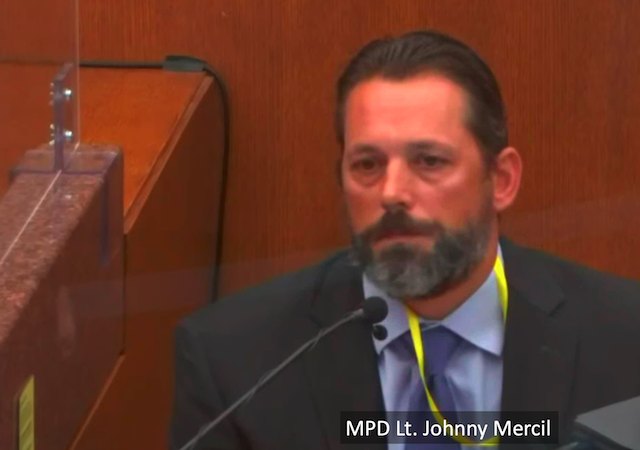
The actual trainer of Chauvin said the opposite...that he, himself, had used that same technique, to the point he also kept it on while waiting for paramedics..........and he is a prosecution witness......you can see how bad a day the prosecution had here......
Andrew Branca calls it the terrible, horrible, no good, very bad day for the prosecution as three of their own witnesses destroy their case against Chauvin...
Today was a terrible, horrible no good, very bad day for the prosecution, to a degree that I haven’t seen since the trial of George Zimmerman.
------
Basing your narrative of guilt on only half the context is a dangerous ploy because we, thank God, enjoy an adversarial legal system, and that means the defense gets to pop right up and expose the jury to the other half of the context, the half consistent with a narrative of innocence—and, in this case, they get to do so with your own witness.
And that’s precisely what happened with Mercil, and in a big, big way.
Nelson began by asking questions related to Mercil’s time as a street cop, with a particular emphasis on the tendency of suspects being subject to arrest to come up with all kinds of nonsense about why they shouldn’t be arrested that day.
Dangerous job, being a police officer? Yes. Are people generally unhappy about being arrested? Very rarely are they happy, Mercil answered. Do suspects frequently engage in a wide variety of behaviors to avoid arrest, including fighting, arguing, making excuses? Yes, they do, answered Mercil.
Indeed, when asked if he himself had ever disbelieved a suspect’s claim of a medical emergency as an apparent effort to avoid arrest, Mercil answered that he personally had done so.
All of this, of course, undercuts the part of the prosecution narrative that is relying on Floyd’s purported pleas and excuses about claustrophobia and anxiety and crying out for mama. Perhaps all of that is real—but a reasonable officer must also consider that maybe much of it is simply an effort to avoid arrest.
Nelson also once again put the use of pressure and body weight techniques in a favorable light. The state wants to present Chauvin’s knee in a negative light, as deadly mechanical asphyxiation, or as a “blood choke” as attested to by MMA Williams.
In fact, however, the use of pressure and body weight to restrain a suspect was adopted by the MPD because it was a lesser intensity of force than the prior practice of using strikes—either barehanded, or with batons, or even with weighted gloves—to compel compliance. Mercil concurred.
The take home message for the jury is that Chauvin’s knee, far from being a public execution in a public street, was a lesser force than would otherwise have been required.
Whereas Schleiter wants to pretend that all of Chauvin’s use of force and other decisions should have been based solely on the needs and desires of Floyd, Nelson once again had the state’s witness concede that under the MPD critical decision-making model the officer must consider a wide breadth of factors beyond just the suspect, including the officer himself, his partners, any bystanders—especially angry or threatening bystanders.
Schleiter had described use of force in a very static and binary way—once a suspect stops resisting, the officer should immediately stop his use of force, period. But Nelson got Mercil to agree that if that suspect had been forcibly resisting the officer only moments before, that would be a factor weighing in favor of continuing to apply force even after apparent resistance had ceased.
-----
When asked explicitly if any of the video of the event showed Chauvin placing Floyd in a “choke hold” (in this context meaning a respiratory choke but the term has been used with careless disregard for accuracy) Mercil was obliged to answer that it did not.
When asked if a carotid choke, or what MPD would refer to as an “unconscious neck restraint” required both of the carotid arteries to be compressed, Mercil answered that it did. So much for MMA expert Williams’ testimony to the contrary.
Further, when asked how quickly unconsciousness occurred when a carotid choke was placed, Mercil answered “less than 10 seconds.” Clearly, then Floyd was not being subject to a carotid choke for the large majority of the 9 minutes or so Chauvin had his knee in place, and likely never during that period.
When asked if Mercil trained officers that a suspect who had become unconscious could regain consciousness, get back into the fight, and perhaps even be more aggressive than previously, Mercil responded that he did.
This, of course, is a rationale for Chauvin maintain his knee across Floyd’s back even after Floyd lost consciousness.
As noted above, Nelson also explored with Mercil whether there were circumstances in which it would be appropriate for an officer to maintain a neck restraint for a substantial period of time, and Mercil conceded that there were.
Sometimes to maintain the neck restraint for however long it took EMS to arrive, asked Nelson? Mercil answered that he, personally, had maintained restraint on suspects for the duration required for EMS to arrive.
Prosecution visibly shaken after cross-examination of MPD force & medical experts

legalinsurrection.com
The other two witnesses of the day were also a mess for the prosecution as well.......
Andrew Branca, the go to guy for trial coverage........




})
})


