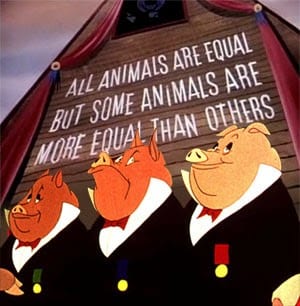
There is something real absurd about wealthy Entertainers and Corporations who are founding the Racist Marxist BLM.
Why are they doing this?
MLB
Coke
Delta.......
The secret to what initially looks like a clash of two philosophies, and they will, indeed, trick the socialists into believing that global socialism is here, while tricking you folks into believing just the reverse, is the marriage of the two.
It has nothing to do with race.
These folks don't care what color your skin is. . . they will of course try to create a universal dystopia, using race and the chaos to bring it about. . .
But it is about creating the Technocracy. A partnership between foundations and government, were wealthy un-elected oligarchs and celebrities, who once did direct your life, are now more openly in control, well, not them, but they will be the ones overseeing the computers and machines that run your life. Think. . . Neo-feudalism.
The Brave New World of Surveillance Capitalism
Surveillance capitalism as a revenue model through the observation and recording of as much personal data as possible to create highly effective targeted advertisements is growing unchecked. Can regulation level the playing field?

www.cpomagazine.com
"Certain radical critiques of capitalism posit that it must necessarily monetize everything in time. The basic argument is that capitalism inherently requires infinite economic growth to function properly, but we are in a world of finite resources. As traditional resources used to feed the furnace are exhausted, more aspects of life that were previously outside of the money economy must be drawn into it – including abstract things like behavior, relationships and even thoughts.
The merits of such theories are debatable. What is beyond debate is that human thoughts and relationships are already in the advanced stages of monetization. Prof. Shoshana Zuboff, a leading expert in the field of business administration in information technology settings since the 1980s, coined the idea of “surveillance capitalism” (in the April 2015 edition of the Journal of Information Technology) to describe this phenomenon – the observation and recording of as much personal data as possible to create highly effective targeted advertisements.
Surveillance capitalism and privacy
Google is one of the best and oldest examples of surveillance capitalism in action. Their ostensibly “free” services, like Search and Gmail, have always been monetized by the data they collect from users. Same story with Facebook. These systems are opaque at best for the end user. You can never be entirely sure exactly what or how much data they’re collecting, how detailed a personal profile they’re building on you, what it is being used for or whose hands it is passing through. Thus the “surveillance” aspect – it’s as if you have hidden cameras recording you all the time as you move about virtual space.. . . . . "
Capitalism seen doing 'more harm than good' in global survey
A majority of people around the world believe capitalism in its current form is doing more harm than good, a survey found ahead of this week's Davos meeting of business and political leaders.

www.reuters.com
". . . The survey confirmed a by-now familiar set of concerns ranging from worries about the pace of technological progress and job insecurity, to distrust of the media and a sense that national governments were not up to the challenges of the day.
Within the data there were divergences, with Asians more optimistic about their economic prospects than others across the world. There was also a growing split in attitudes according to status, with the affluent and college-educated much more likely to have faith in how things were being run.
Of possible interest to corporate leaders gathering in Davos this week was the finding that trust in business outweighed that in governments and that 92% of employees said CEOs should speak out on the social and ethical issues of the day.
“Business has leapt into the void left by populist and partisan government,” said Edelman CEO Richard Edelman. “It can no longer be business as usual, with an exclusive focus on shareholder returns.”