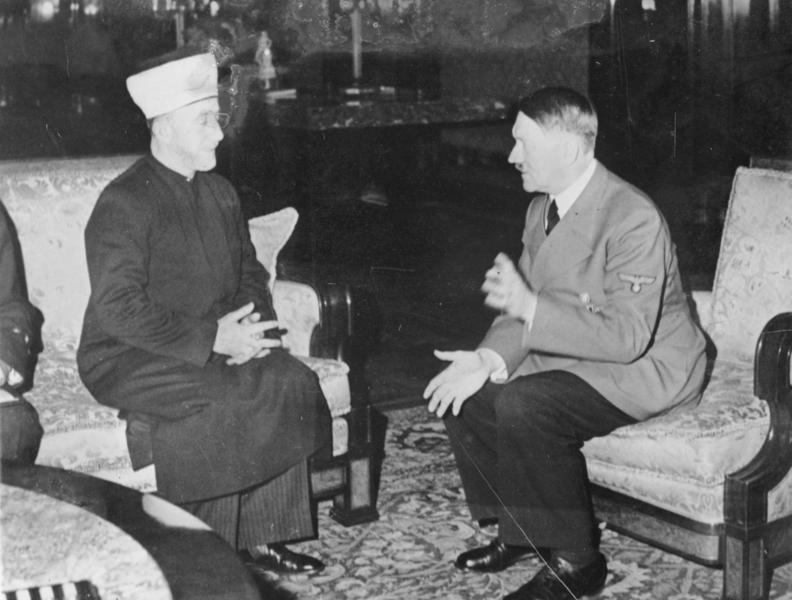
You called him an "ex Nazi" and claimed he trained Arabs
Figuratively ....
Officially Germany Nazi party ceased to exist at end of World War Two, but the ideology and agenda survived....
...
Husseini did just that, his reputation burnished by his Nazi collaboration. According to historian Bernard Lewis, pro-German sentiment was so strong in the Arab world “that even after the final defeat of the Third Reich it did not fade away and—what is perhaps more significant—it was not concealed. On the contrary, a pro-Nazi past was a source of pride, not shame.”
That pride was still alive in 2015, when the grand mufti of Jerusalem laid a wreath at Husseini’s grave. In 2019, Mahmoud al-Habbash, a former Hamas official who was appointed by Palestinian Authority chief Mahmoud Abbas as an advisor on religious affairs, marked the anniversary of Husseini’s death by praising him as a “great Palestinian national leader” and a “role model.” Now, nearly half a century after his death, the P.A. preserves Husseini’s memory for the next generation at the “Amin Al-Husseini Elementary School” in El Bireh.
In their seminal book
Nazis, Islamists and the Making of the Modern Middle East, Barry Rubin and Wolfgang G. Schwanitz noted, “While the Nazi ideology collapsed in 1945 and virtually vanished from German and European life, the radical Arab nationalist and Islamist ideologies flourished thereafter.”
This was the legacy of the Nazi-Arab alliance. Thus, wrote Rubin and Schwanitz, “the profoundly doctrinal hatred for Jews and the belief in the necessity of destroying them remained the core reason for the Arab-Israeli conflict’s enduring and irresolvable nature.”
As Rubin and Schwanitz documented, Husseini ensured that Axis-style ideology would continue within the Palestinian movement by making Yasser Arafat his successor in 1968: “The movement would be directed by these two sequential leaders and their similar philosophy and methods for an astounding 83 years, from al-Husseini’s becoming grand mufti in 1921 to Arafat’s death in 2004.”
Under Arafat, the Nazis served as an inspiration for Palestinian terrorists. As Rubin wrote in a study of the PLO, more than 25 activists “chose a
nom de guerre such as Hitler or Abu Hitler.” These included Fawzi Salim Ali Mahdi, who served in Force-17, a terrorist group “under Arafat’s direct command.” Ian Michael Davison, another notable Force-17 member, was a British neo-Nazi. In 1985, he helped murder three Israelis while attacking a yacht in Cyprus. The PLO group al-Fatah trained German neo-Nazi groups in Lebanon.
...
Since Amin al-Husseini forged his alliance with Hitler, Nazism has profoundly influenced the Palestinian national movement.

www.jns.org


en.wikipedia.org