United States presidential election, 2000
From Wikipedia, the free encyclopedia
United States presidential election, 2000
 1996
1996 ←
November 7, 2000 →
2004
537/538 electoral votes of the Electoral College
270 electoral votes needed to win
Turnout 51.2%
[1] 2.2%

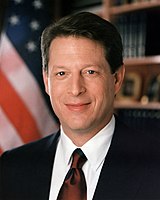 Nominee George W. Bush Al Gore
Party Republican Democratic
Home state Texas Tennessee
Running mate Dick Cheney Joe Lieberman
Electoral vote 271
Nominee George W. Bush Al Gore
Party Republican Democratic
Home state Texas Tennessee
Running mate Dick Cheney Joe Lieberman
Electoral vote 271 266
[2]
States carried 30 20 +
DC
Popular vote 50,456,002
50,999,897
Percentage 47.9%
48.4%

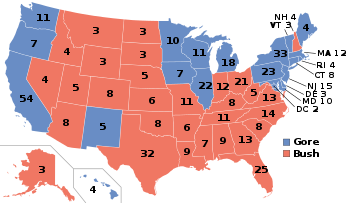
Presidential election results map. Red denotes states won by Bush/Cheney,
Blue denotes those won by Gore/Lieberman.
President before election
Bill Clinton
Democratic
Elected President
George W. Bush
Republican
The
United States presidential election of 2000 was the 54th quadrennial
presidential election. It was held on Tuesday, November 7, 2000. The contest was between
Republican candidate
George W. Bush, the incumbent
governor of Texas and son of former president
George H. W. Bush;
Democratic candidate
Al Gore, the incumbent
vice president; and various third-party candidates including
Ralph Nader. The 2000 presidential election was the fourth election in U.S. history and the first in 112 years in which the eventual winner failed to win the
popular vote(after the elections of
1824,
1876, and
1888).
Incumbent Democratic
President Bill Clinton was not eligible to serve a third term due to term limits in the
Twenty-second Amendment to the United States Constitution, and Vice President Gore was able to secure the Democratic nomination with relative ease. Bush was seen as the early favorite for the Republican nomination, and despite a contentious primary battle with Senator
John McCain and other candidates, secured the nomination by
Super Tuesday. Bush chose former
Secretary of Defense Dick Cheney as his running mate, and Gore chose Senator
Joe Lieberman as his. Both major party candidates focused primarily on domestic issues, such as the budget, tax relief, and reforms for federal
social insurance programs, though foreign policy was not ignored. Clinton and Gore did not often campaign together, a deliberate decision resulting from the
Lewinsky sex scandal two years prior.
The final outcome was one of the closest presidential elections in the nation's history. The result of the election hinged on
Florida, where the margin of victory triggered a mandatory recount. Litigation in select counties started additional recounts, and this litigation ultimately reached the
United States Supreme Court. The Court's contentious 5-4 decision in
Bush v. Gore, announced on December 12, 2000, ended the recounts, effectively awarding Florida's votes to Bush and granting him the victory. Studies have
reached conflicting opinions about who would have won the recount had it been allowed to proceed.
The
Green Party gained widespread public attention during the 2000 presidential election when the ticket composed of
Ralph Nader and
Winona LaDuke won 2.7% of the popular vote. Nader was vilified by some Democrats, who accused him of
spoiling the election for
Al Gore. Nader's impact on the 2000 election has remained controversial.