Latest in Robotics news thread

Researchers develop new-generation 'thinking' biomimetic robots as ocean engineering solutions
NUS Engineering researchers are closer to creating underwater robotic creatures with a brain of their own – besides behaving like the real thing. In the near future, it would not be too tall an order for the team to produce a swarm of autonomous tiny robotic sea turtles and fishes for example, to perform hazardous missions such as detecting nuclear wastes underwater or other tasks too dangerous for humans.
In the underwater robotic world, turtle robots are among the most maneuverable. The NUS team's turtle robot, besides being maneuverable, can also go about determinedly performing what it is set out to do, while being able to react to exigencies and obstacles.
 
Amphibious HexH2o drone shoots both aerial and underwater video
By Ben Coxworth
December 23, 2014
5 Pictures

Readers who checked out our recent article on the Seahorse human-powered airboat may have noticed something at least as impressive in the accompanying video – a camera-equipped quadcopter that can land on the water to shoot underwater footage. It's called the QuadH2o, and is made by a Thailand-based company of the same name. Now, that drone is about to be joined by a companion that sports another two propellers, along with some other extra features. It's time to say hello to the HexH2o.
 
Northrop Grumman MQ-8C Fire Scout makes first destroyer flight
By David Szondy
December 28, 2014
2 Pictures


A helicopter landing on the flightdeck of a destroyer is hardly news – unless it's the US Navy's latest Unmanned Aerial Vehicle. Northrop Grumman's MQ-8C Fire Scout became the first unmanned helicopter to operate from a US destroyer on December 16. Under guidance of the ship's ground control station, the MQ-8C made 22 takeoffs and 22 precision landings on the guided missile destroyer USS Jason Dunham (DDG 109) off the coast of Virginia.

No pilot need die!
 
Last edited:
Sea turtle robot charges its own batteries
By Ben Coxworth
December 30, 2014
2 Pictures

They may be slow on land, but when they're in the water, sea turtles are fast and maneuverable – qualities that are also desirable in underwater robots. Additionally, the robotic equivalent of a turtle's streamlined shell could be stuffed full of electronic components and batteries. It shouldn't come as a surprise, therefore, that both ETH Zurich and the ARROWS project have recently created their own turtle-bots. Now, the National University of Singapore has announced its own entry in the field, that can self-charge its batteries while at sea.
 
Robodynamics' Luna personal robot hits Kickstarter
By David Szondy
December 31, 2014
12 Pictures

Back in 2011, Gizmag looked at Robodynamics' Luna personal robot. At that time, the details were a bit scarce, though the company did say that the machine was shipping that year. As 2014 draws to a close, Luna has still to reach market, but the maker has launched a Kickstarter to raise money to start manufacturing while giving us a closer look at the robot's specs.
 
Ghost Drone follows its user, and is controlled via their phone
By Ben Coxworth
December 31, 2014
6 Pictures

It was just this June that we heard about the HEXO+ and AirDog drones, which were two of the first consumer multicopters to offer a Follow function – that's the ability to track the location of their user, and fly along above them. Since then, models including the Iris+ and Zano have come out with the same feature. Now, Chinese/American company Ehang is successfully raising production funds for its Follow-equipped GoPro-toting Ghost Drone. Developed in partnership with Duke University, not only is the quadcopter able to track and film its user, but it's also reportedly easier to fly than its competitors.
 
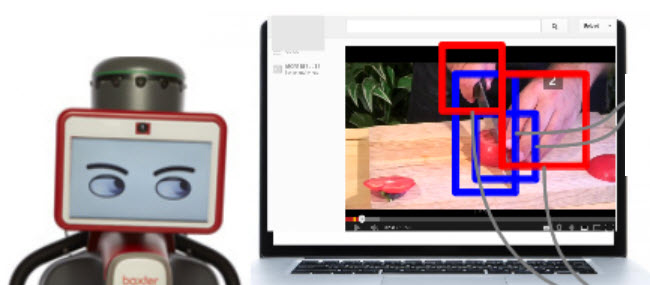
Robot learns to use tools by ‘watching’ YouTube videos
January 2, 2015
[+]
Imagine a self-learning robot that can enrich its knowledge about fine-grained manipulation actions (such as preparing food)simply by “watching” demo videos. That’s the idea behind a new robot-training system based on recent developments of “deep neural networks” in computer vision, developed by researchers at the University of Maryland and NICTA in Australia.
 
Omnidirectional underwater robot inspired by the cuttlefish
By Ben Coxworth
January 7, 2015
5 Pictures

Cuttlefish are fascinating animals, in that they use a pair of undulating fins to move forward and backward, turn on the spot, or hover in place. If you wanted to make an underwater robot that was highly maneuverable yet quiet and immune to tangled propellers, then the cuttlefish would be a good creature to copy. Well, a group of mechanical engineering students from Switzerland's ETH Zurich have done just that – plus they gave it an extra set of fins, allowing it to also move straight up and down.
 
Cooki robotic chef whips up meals at the push of a button
By Darren Quick
January 7, 2015
4 Pictures


Some claim that cooking is becoming a lost art, with many in Gen Y relying on frozen pre-packaged meals or eating out rather than learning the required skills from their parents. The Cooki from Sereneti Kitchen might not do anything to reverse this trend, but it could at least enable the cooking-impaired to enjoy a meal made from fresh ingredients. On display at CES in prototype form, this ambitious culinary contraption uses a robotic arm to whip up meals from pre-portioned ingredients.
 
World's first artificial intelligence personal robot developed by US startup Robotbase
"Not only can the robot understand what I say, it can actually see things around it in the same way that we humans do," said Robotbase CEO Duy Huynh at a demonstration of the technology. "It recognises faces, it recognises objects around the house in order to navigate by itself.

"We are the very first company to apply deep learning to robotics. It has computer vision, facial recognition, emotion recognition and pattern recognition with a single algorithm.

"Not just a robot, it's artificial intelligence. Not just recognising your face, it knows your mood. Not just understanding what you say, it knows what you really mean. It learns and gets smarter every day."
 
Robot sub beats nets for discovering what lurks at the bottom of the sea
By Ben Coxworth
January 13, 2015
2 Pictures

Curious about what's living on the deep sea floor? Well, the Autosub6000 AUV (autonomous underwater vehicle) is helping us find out. Led by Dr. Kirsty Morris, a team at the UK's National Oceanography Centre (NOC) has equipped one of the unmanned submarines with a high-resolution photographic system. As a result, it's claimed to be far more effective at identifying deep-sea life than the usual approach of scientific trawling.
 
Algorithm Improves Object Recognition For Robots
Algorithm Improves Object Recognition For Robots IFLScience

January 12, 2015 | by Lisa Winter

robot%20object%20recognition.jpg

The field of robotics has just taken a step forward with the development of an algorithm that will give artificial intelligence an increased ability for object recognition. This will help robots navigate their surroundings and become better equipped to help out around the house. Lawson Wong of MIT is lead author of the paper, which will appear in an upcoming issue of the International Journal of Robotics Research.

When robots are becoming familiar with objects, they view it in many different perspectives so that they recognize a coffee mug as a coffee mug, whether the handle is pointed to the left or right. The robot then needs to scan its database and search for the identity of the object. Unfortunately, after the artificial intelligence system learns to recognize a large number of items, it takes a long time to search through the database and make a correct identification.

The research completed by Wong’s team has utilized an algorithm which aggregates the different viewpoints, resulting in object identification that occurs up to ten times faster and makes fewer mistakes than previous versions which only take a single perspective into account. This allows the robot to operate more seamlessly, making real-time decisions and actions.
 
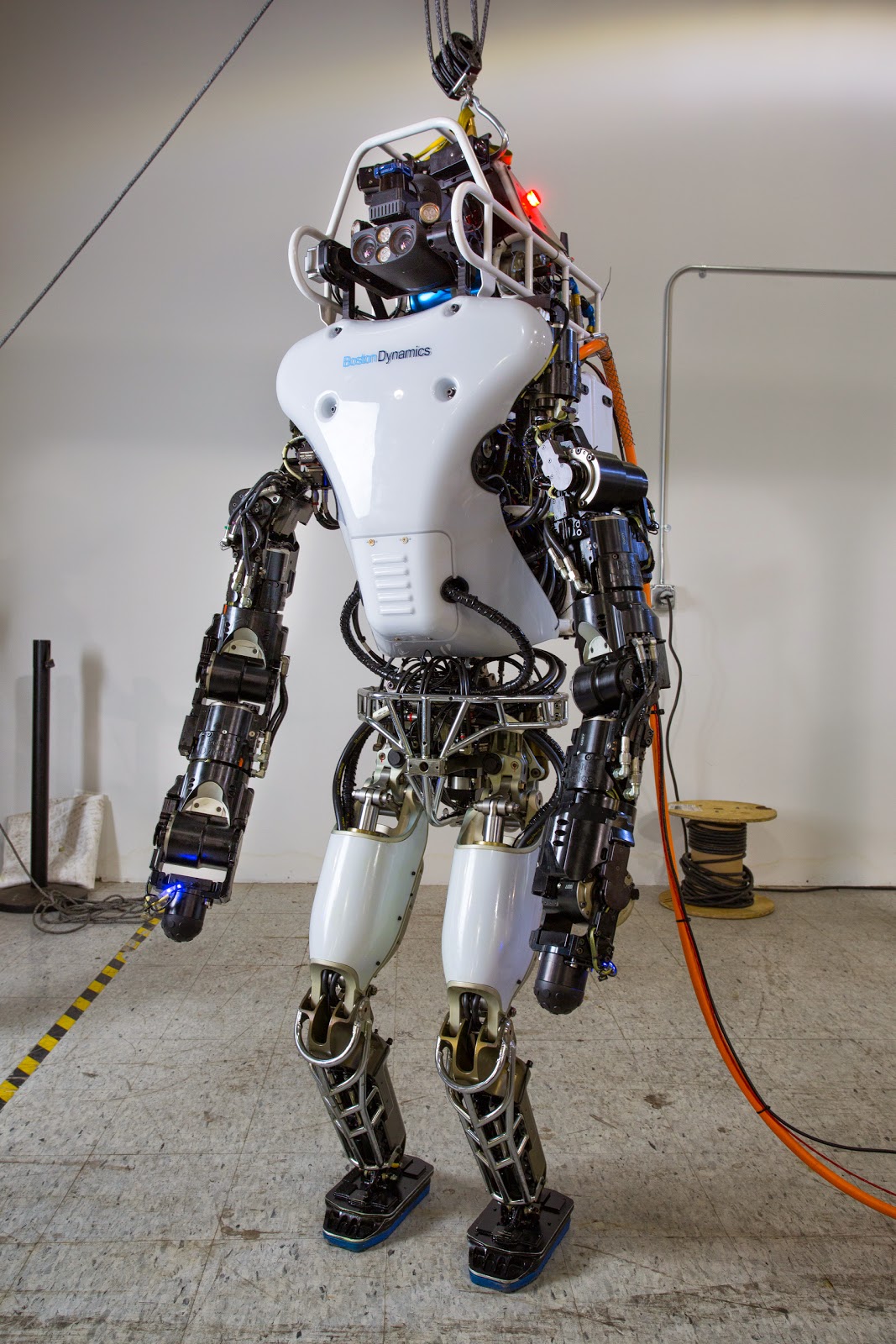
DARPA Humanoid Atlas robotsand other DARPA bots now will have no strings for competition

WPAT001.jpg

A total of $3.5 million in prizes will now be awarded to the top three finishers in the DARPA Robotics Challenge (DRC), the final event of which will be held June 5-6, 2015.

The most significant changes to the Altas robot are to the robot’s power supply and pump. Atlas will now carry an onboard 3.7-kilowatt-hour lithium-ion battery pack, with the potential for one hour of “mixed mission” operation that includes walking, standing, use of tools, and other movements. This will drive a new variable-pressure pump that allows for more efficient operation.

“The introduction of a battery and variable-pressure pump into Atlas poses a strategic challenge for teams,” said Pratt. “The operator will be able to run the robot on a mid-pressure setting for most operations to save power, and then apply bursts of maximum pressure when additional force is needed. The teams are going to have to game out the right balance of force and battery life to complete the course.”
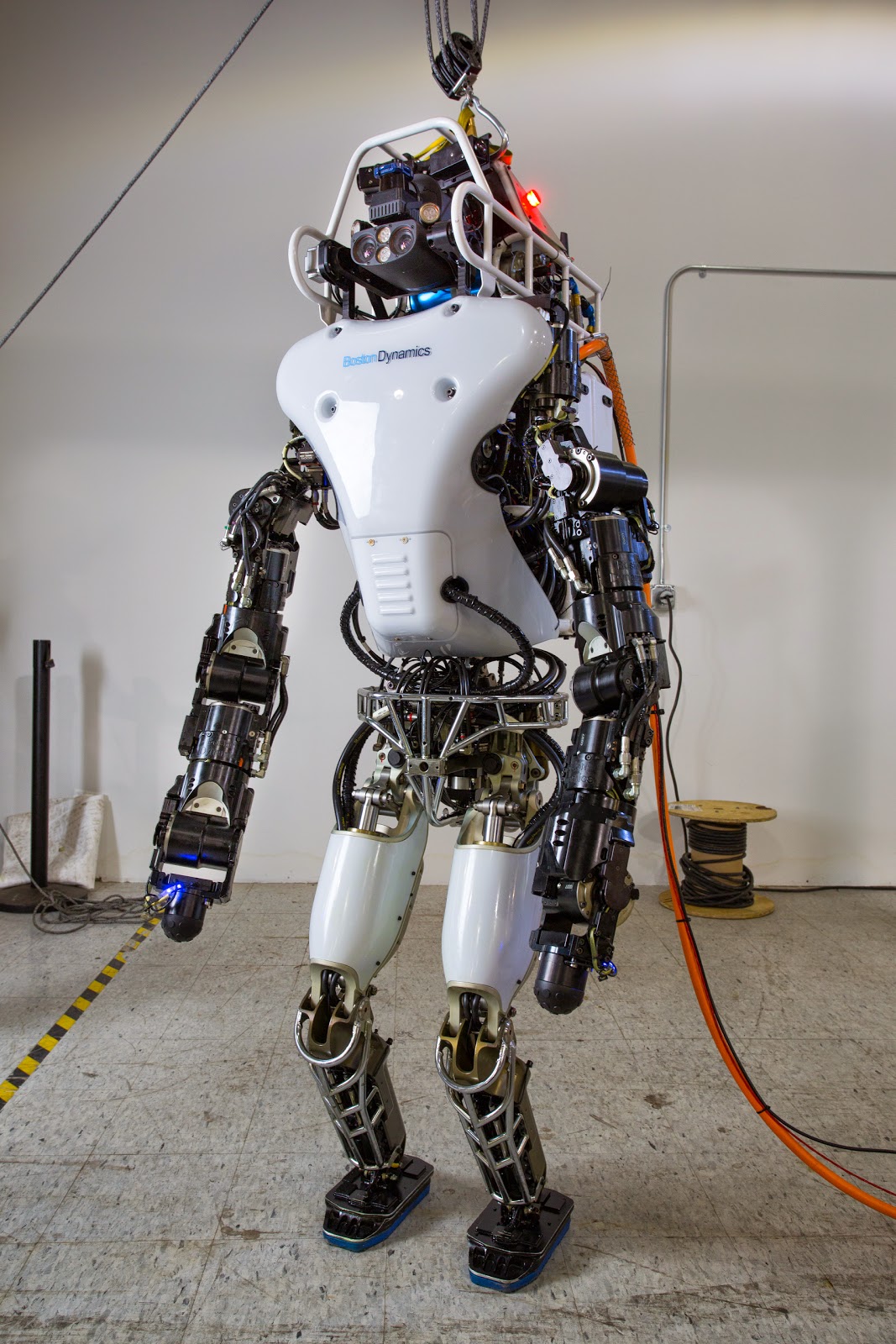

The Atlas robot was redesigned with the goal of improving power efficiency to better support battery operation. Approximately 75 percent of the robot was rebuilt; only the lower legs and feet were carried over from the original design. (DARPA image)


Other major upgrades to Atlas focused on increasing efficiency, dexterity, and resilience, and include:

Repositioned shoulders and arms allow for increased workspace in front of the robot and let the robot view its hands in motion, thus providing additional sensor feedback to the operator.
New electrically actuated lower arms will increase strength and dexterity and improve force sensing.
The addition of an extra degree of freedom in the wrist means the robot will be able to turn a door handle simply by rotating its wrist as opposed to moving its entire arm.
Three onboard perception computers are used for perception and task planning, and a wireless router in the head enables untethered communication.
Re-sized actuators in the hip, knee, and back give the robot greater strength.
A wireless emergency stop allows for safe operation.
As a result of the new pump, Atlas is much, much quieter than before!
The seven DRC teams using Atlas are scheduled to receive their upgraded robots by the end of January. The robots will be delivered with a “battery emulator,” a training tool temporarily mounted in the robot that simulates how the real battery will perform. This will allow them to switch modes between constant voltage for routine practice and metered voltage to simulate actual battery life.

Given their identical hardware, the Atlas teams will have to differentiate themselves through software, control interfaces, and competition strategy. Teams will have a few options on the selection of tasks they choose to attempt and the order they do them—and must manage time and battery life during their runs—but DARPA expects that the top-placing teams will complete all of the tasks.

Teams are likely to keep their robots connected to fall arrestors during much of the remaining months of training as a safeguard against premature damage to the robot. DARPA demonstrated the new Atlas with a fall arrestor in place.

“Risk mitigation is part of the game,” Pratt said. “It’s up to the teams to decide what chances they’re willing to take during training and risk falls and damage, but come the DRC Finals, the cords are cut.”


The competing teams have been operating under extreme pressure since the 2013 DRC Trials, working to upgrade their robots and software for the more demanding DRC Finals. In June 2014, DARPA announced a series of additional hurdles that teams will face in the Finals:

Robots will have to operate completely without wires—they may not be connected to power cords, fall arrestors, or wired communications tethers. Teams will have to communicate with their robots over a secure wireless network.

Teams are not allowed any physical intervention with their robot after it begins a run. If a robot falls or gets stuck, it will have to recover and continue with the tasks without any hands-on assistance. If a robot cannot sustain and recover from a fall, its run will end.

DARPA will intentionally degrade communications between the robots and human operators working at a distance. The idea is to replicate the conditions these robots would face going into a disaster zone. Spotty communication will force the robots to make some progress on their own during communications blackouts.
 
http://nextbigfuture...million-in.html

AGI Innovations Inc, (www.AGi-3.com ) an R and D company focused on advancing Artificial General Intelligence (AGI) has secured $4 million in funding to support research on long-term AGI development. AGI is the AI discipline concerned with developing systems with human-like cognitive abilities such as general learning, reasoning, and problem solving. AGI Innovations Inc, also known as AGi3, was formed early in 2014 to continue research originally spearheaded by Adaptive A.I. Inc (a2i2), an AGI R and D company formed in 2001. On completing its first generation AGI engine in 2008, a2i2 launched
 
15th post
The Boston Robotics Industry Is Crushing This Month

If January is any indication, 2015 is going to be a milestone year for a number of Boston-area robotics companies. At CES earlier in the month, multiple Boston firms showcased upgraded machines, which are capable of doing everything from cleaning your floor to challenging you in a round of beirut. And these companies have gotten substantial support, too, between funding from noteworthy VCs, buzz from a late night celebrity and news of a partnership with a major multinational corporation.
 
Mind of a Worm Uploaded to a LEGO Robot to Make the Weirdest Cyborg Ever

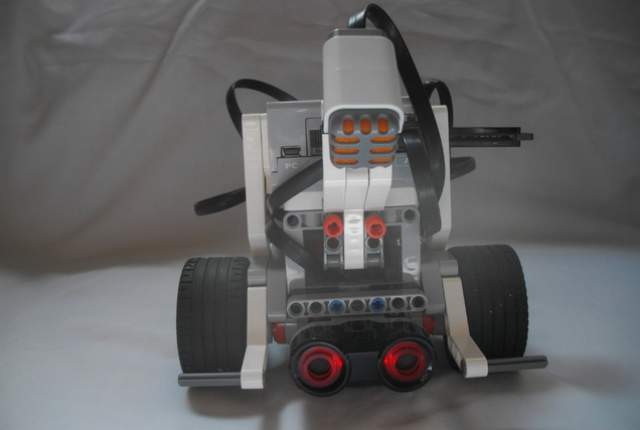
lego-worm.jpg


In a breakthrough for artificial intelligence research, a digital clone of the mind of a roundworm (C. Elegans) has been uploaded into a robotic body made from LEGO, as part of the Open Worm Project.

Once the software facsimile of the worm brain was integrated into the LEGO robot it, with no additional programming, exhibited behaviour consistent with the C. Elegans species, avoiding obstacles and attracted by food. The robot carries sensors that imitate the senses of a roundworm, bridged by software modelled on a worm’s nervous system.
 
VineRobot will keep tabs on the grapes
By Ben Coxworth
January 28, 2015
3 Pictures

While many of us may fantasize about running a vineyard someplace like the south of France, doing so wouldn't actually be all ... well, wine and roses. For one thing, you'd need to regularly walk up and down all those rows of vines, continuously stopping to check on the plants themselves and their grapes. It's the sort of thing that it would be nice if a robot could do. A robot like the VineRobot
 
Back
Top Bottom