*sigh* This again.
There is no doubt that Jewish Germans were persecuted in Germany in the 1930’s, including incarceration, brutality and killings, a fact that is beyond rational dispute. There is no doubt that Hitler and his regime wanted all Jewish Germans to leave Germany one way or another, this is evident from contemporary speeches, documents and other recorded events. There is no doubt that after the invasions of Poland and the USSR, the Germans found themselves in control of large native Jewish populations and it is a fact that by 1945 large numbers of these people, along with political prisoners, homosexuals, gypsies and others had been killed or had died whilst under German control.
After the war, the surviving perpetrators were tried and convicted of crimes against Humanity and the survivors from all the above groups either returned home or migrated to other countries to make new lives for themselves and until the 1960’s nobody really cared about what had happened.
Then, as Norman Fincklestein states, a Holocaust™ Industry was created to bolster American support for their “bulwark” against the “Muslim-Communist” hordes (that was before they were re-titled “Islamo-facsists” after the fall of the USSR), Israel.
He states, amongst other things..."Holocaust awareness," the respected Israeli writer Boas Evron observes, is actually "an official propagandistic indoctrination, a churning out of slogans and a false view of the world, the real aim of which is not at all an understanding of the past, but a manipulation of the present." In and of itself, the Nazi holocaust does not serve any particular political agenda. It can just as easily motivate dissent from as support for Israeli policy. Refracted through an ideological prism, however, "the memory of the Nazi extermination" came to serve — in Evron's words — "as a powerful tool in the hands of the Israeli leadership and Jews abroad. The Nazi holocaust became The Holocaust.
Two central dogmas underpin the Holocaust framework:
(1) The Holocaust marks a categorically unique historical event;
(2) The Holocaust marks the climax of an irrational, eternal Gentile hatred of Jews.
Neither of these dogmas figured at all in public discourse before the June 1967 war; and, although they became the centerpieces of Holocaust literature, neither figures at all in genuine scholarship on the Nazi holocaust. On the other hand, both dogmas draw on important strands in Judaism and Zionism.
In the aftermath of World War II, the Nazi holocaust was not cast as a uniquely Jewish — let alone a historically unique — event. Organized American Jewry in particular was at pains to place it in a universalist context. After the June war, however, the Nazi Final Solution was radically reframed. "The first and most important claim that emerged from the 1967 war and became emblematic of American Judaism," Jacob Neusner recalls, was that "the Holocaust . . . was unique, without parallel in human history." In an illuminating essay, historian David Stannard ridicules the "small industry of Holocaust hagiographers arguing for the uniqueness of the Jewish experience with all the energy and ingenuity of theological zealots." The uniqueness dogma, after all, makes no sense.”
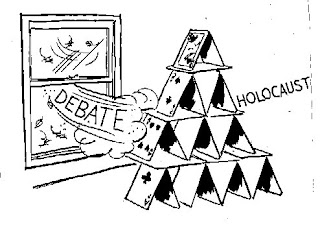
I personally have no doubt that huge numbers of innocents, regardless of their religious affiliation or ethnicity were murdered by the Nazi regime, before and during WW2 and this subject 60 years on, needs researching objectively in depth. This cannot happen if there are laws made that stifle such research. If people want to deny this ever happened, fine, but they should be able to present their evidence and those who disagree with them should be able to refute their arguments. That way we will eventually get at what actually happened.
Those who use Holocaust denial as an excuse to vent their hatred of Jewish people or to promote neo-Nazism, by whitewashing the past are a separate case entirely, but does criminalising them really help? Much better to ridicule them, in my view. Holocaust Denial is as bad as the Holocaust industry that promotes it. Laws that deny the deniers, only serve to strengthen their arguments; fortunately there are still 184 countries in the world that don’t have Holocaust denial laws.